


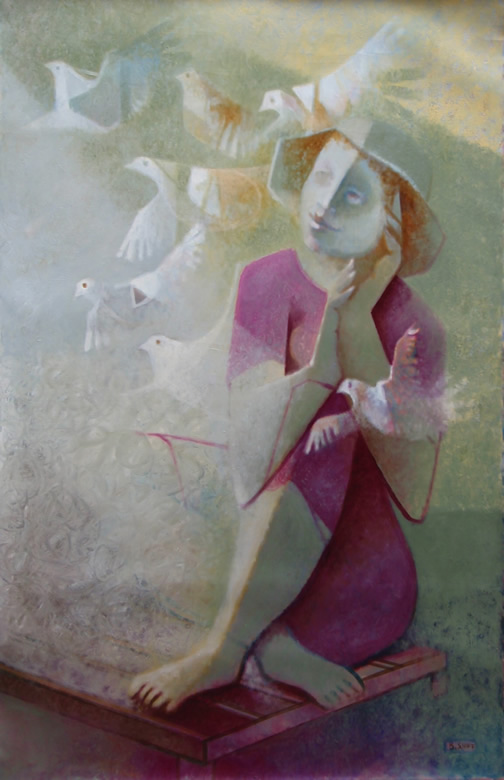
 EAST LANSING -
Hope, faith, love and contemplation are the
experiences one feels in viewing the paintings
Israeli artist Ben Shiff created in his visual
poetry now on display at Saper Galleries in
downtown East Lansing.
EAST LANSING -
Hope, faith, love and contemplation are the
experiences one feels in viewing the paintings
Israeli artist Ben Shiff created in his visual
poetry now on display at Saper Galleries in
downtown East Lansing.

Michigan
Impressions: Oil Paintings by Michael
Callihan is running at Saper Galleries
and Custom Framing, 433 Albert Ave., from
now until Dec. 31.
The exhibit, which will feature 30 new
paintings, is open to the public from 10
a.m. to 6 p.m. on Monday, Tuesday,
Wednesday, Friday and Saturday and 10 a.m.
to 9 p.m. on Thursdays. Admission is free.

|
|
Home About Artists Contact Testimonials Chat Live Now



Click icons above to see recent posts!
|
Meet
Roy Saper of SAPER GALLERIES and Custom Framing 
Hi
Roy, we’d love for you to start by introducing
yourself. I conducted a survey of well known public figures in the area asking them of who their favorite artists were and then proceeded to purchase original artworks by those artists. Those artworks by Dali, Chagall, Picasso and others became the base of the original collection that I displayed. The home-based gallery was operated on an appointment basis where people would visit and select what they wanted for their homes and offices. I added framing services after I tested local framers and was unsatisfied with their quality — so every day people would visit for art and framing services. By the mid-1980s I realized I needed much more help and a larger space. In 1985 I purchased a vacant corner lot in downtown East Lansing (which cost me three times what I paid for my home), interviewed architects, and by that fall (exactly 40 years ago) started construction of the present 6,000 square foot SAPER GALLERIES and Custom Framing building at 433 Albert Avenue, opening art festival weekend in May 1986. I recall people coming in, seemingly amazed that I would invest so much in creating a big city-like gallery in East Lansing where they knew it was destined to fail. When I started, we served mostly those who lived in the Mid-Michigan area and business large and small. Art in many local businesses and homes throughout Mid-Michigan came from SAPER GALLERIES. Since the internet, the floodgates opened and we have since been providing art to collectors throughout the world. We have on display between 1,500 and 2,000 original works of art of all media: paintings, limited edition prints, drawings, sculpture, hand-blown glass, wooden boxes for collections and keepsakes, mobiles, ceramics, and bas-reliefs, among others. I select all the art that we own and display, in most cases right from the artist’s studio here in America and from around the globe including countries where we do not share the same speaking language, but do share the visual language of the art they create. Today we have art from about 20 countries, some who never had shown before in the U.S.. We also show artwork by about a dozen Michigan artists. My focus has always been on quality, excellence in service, and a true dedication to the interests of every person we serve. If it is art-related we do it — from commissioning artists to create artworks for specific spaces including public art sculptures and for massive buildings, to providing exactly what people may want for their home. We always provide more than one may expect and a level of service that exceeds expectations, striving for perfection in all we do as that is what our clients expect and deserve. When I started in the art business, I never imagined that we would be serving future generations of those we helped in the 1970s, but that is often the case! I have acquired artwork to create dozens of significant exhibitions over the years that were a great success by virtue of the volume of people who have visited us to see exhibitions. The Dr. Seuss exhibition of his art and life brought a phenomenal crowd to the gallery daily where we stopped counting after 20,000 people came through. The Peter Max exhibition also attracted thousands of visitors who also had the opportunity to meet the artist. The Rembrandt-Picasso exhibition was the most scholarly as I displayed Rembrandt etchings adjacent to Picassos that were clearly inspired by the Rembrandts. John James Audubon, Russell Chatham, Norman Rockwell are among other artists for whom I created significant and unique exhibitions. We still provide free art searches so that whatever someone might want, we will provide. Our framing department may be the longest serving professional picture framer in the area, having completed tens of thousands of projects for individuals and businesses who rely on the best quality and service with assurance that we’ll never fail them. SAPER GALLERIES and Custom Framing is open 10 am to 6 pm Monday through Saturday for guests to explore and discover art they’ve never seen before. Many artworks are under $100 so the gallery truly services the entire community. The building is lit entirely by super large skylights (one 48 feet long), the walls are covered with an acoustical fabric and the space is fully carpeted so it looks and feels like a museum, but comfortable as home. More than 1,000 testimonials on the Saper Galleries website document client satisfaction with the SAPER GALLERIES level of customer service. We are grateful to the thousands of clients for whom we’ve had the privilege of serving and we welcome those who haven’t visited to bring a friend and discover a world of art in downtown East Lansing that they will likely see as a hidden treasure to share with others. SAPER GALLERIES is open to everyone and is free always. Can
you talk to us a bit about the challenges and
lessons you’ve learned along the way. Looking back
would you say it’s been easy or smooth in
retrospect? We’ve
been impressed with SAPER GALLERIES and Custom
Framing, but for folks who might not be as
familiar, what can you share with them about what
you do and what sets you apart from others? Most businesses simply say “no” when asked for a service or item they don’t carry. “No’ is not in our vocabulary. If someone wants something, we’ll have it made. We’ll “deliver” what anyone wants — and ensure that we exceed their expectations with every project, as evidenced in the testimonials and reviews people have written. We are known for that quality, dedication, and commitment to excellence, in part because so few businesses operate with such dedication. We operate with fairness to and high regard for the dedicated, professional SAPER GALLERIES team, art professionals who can be relied on for each project we provide to our clients. Our framing manager has been here more than 30 years so guests have consistency and reliability among those who assist and serve them. We do not have part time, beginner, temporary, intern, or student employees who are here today and gone tomorrow. The SAPER GALLERIES team is of professional, dedicated experts. Every service we provide is guaranteed to be as expected and documented in writing. Are
there any books, apps, podcasts or blogs that help
you do your best? We have won numerous awards for our professional services, art exhibitions, early use of technology, gallery design and efficiencies, serving as a model for new galleries which have attempted to emulate some aspects of the SAPER GALLERIES operation. Roy Saper shares with the public through numerous presentations to various groups, presentations in the gallery, narrated walking tours of gallery exhibitions, and in the past, teaching evening college classes at MSU and participating in the WKAR radio Ask About Art radio interview series. I stay engaged in keeping up with art market activity and news daily. Pricing:
Contact Info:
PARTNERS IN DESIGN: SAPER GALLERIES WITH ROY SAPER By McDaniels Kitchens and Bath, Lansing, Michigan March 2, 2023 Our 2023 Partners in Design series
continued in February with a fascinating event
with Roy Saper of Saper Galleries and Custom
Framing.
We were very fortunate to welcome Roy to our Lansing, MI showroom for this event, where he shared his extensive knowledge and insights into the art world with our participants. Everyone walked away inspired to seek out art and with a better understanding of the value of the art we purchase and already have in our midst. All About Saper Galleries The Lansing community is very lucky to be the home of Saper Galleries, which is a world-renowned, award-winning gallery that serves art collectors from around the world. For 44 years, Saper Galleries has provided a reliable, honest, and quality service to thousands of art collectors. They own and inventory more than 1500 original works of art by 150 artists from 15 countries, which are available to view and purchase. Their beautiful building houses a museum-like gallery, and they have been in this building for the past 36 years making it a landmark in its East Lansing location. They have updated or added to this building over the years, including a 2,000-square-foot west gallery added in 1998 that was highlighted in the June 2000 issue of Art World News. Saper Galleries prides itself on providing top-quality art for everyone’s tastes and at every budget level. The art styles they showcase range from traditional to impressionist, contemporary, and more. Saper Galleries and Custom Framing also offers a superior, professional framing service by experts with degrees in art and training in design and color. They have been helping Michigan clients with their framing requirements since the 1970s, and they strive to make the framing process easier for clients by sharing their knowledge and expertise. Their team has the highest regard for preserving the artwork, photographs, and other memorabilia to be framed. Saper Galleries is the only Greater Lansing member of the Professional Picture Framers Association. The Saper Galleries team is called on to present at national and international conferences, so we were very excited to have them present in our Lansing, MI showroom! Roy Saper is passionate and enthusiastic about art, and his presentation at our event on February 21st was amazing. Roy taught us how to recognize art originals, fakes, and copies. He also helped us understand the value of the art we intend to purchase and that we already own. Roy also taught us how to ask the right questions when purchasing art, having it preserved, and framed. We could have Roy come back every month to share his encyclopedic knowledge of art with our participants! A tour of Lansing-area Black art collections TAYLOR BLAIR FOR LANSING CITY PULSE Thursday, February 16, 2023 [Excerpted...] In East
Lansing, the Shona people’s art is represented
in a dedicated gallery exhibit at Saper
Galleries and Custom Framing, opened by Roy
Saper 45 years ago. Saper champions the
gallery’s ability to bring awareness through art
from all over the world and from different
ethnicities. A team of one, Saper makes the
decisions on the exclusive inventory and, after
hundreds of submission reviews over the course
of any given year, accepts under 1%. He also
attends international art expos to discover
unique pieces.
The gallery holds serpentine stone sculptures created in Zimbabwe by the Shona people. An example includes “Dancing Family of 3,” by Francis Chikowore, a 13-inch-tall, hand-carved cobalt stone sculpture of three intertwined people. Saper said the Shona people value ukama, a term that represents the concept or state of togetherness and kinship. “There’s nothing more precious than family, and the tribe expresses that,” he said. Saper also showed off a sculpture series of Black figures dressed in natural materials such as fur and beads made from coconuts. It was created by Roberto Hollanda, a Brazilian artist that aims to unite the country’s three identities (African, European and Indigenous). Lastly, he introduced Mathias Muleme, a Ugandan artist whose pieces he first purchased back in 1992. Currently, Muleme’s work at Saper Galleries includes the recently sold, “Ring Around 06,” an embossed etching of six children and an adult in motion underneath the sun, like the playground nursery rhyme “Ring Around the Rosie.” [The full text of this article is here.] East Lansing considering collaboration with Artspace on affordable housing for creative types By: Mikayla Temple, WSYM Lansing Fox 47 News September 30, 2021 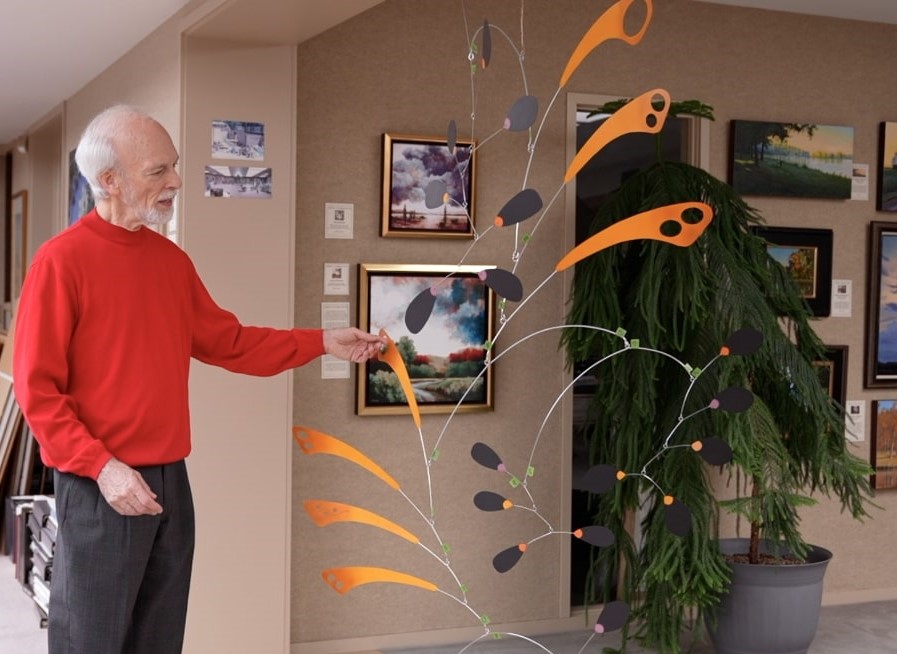 Click photo to view interview with Roy Saper and see Saper Galleries highlights! Saper Galleries displays for-sale inventory online with live chat feature By: Lauren Shields https://www.fox47news.com/news/east-lansing/saper-galleries-displays-for-sale-inventory-online-with-live-chat-feature November 30, 2020  Click photo to view Fox 47 interview Downtown East Lansing art gallery aims to be as responsive as possible to what their consumers want, including bringing its extensive art collection to their homes and answering their questions via live chat. Saper
Galleries, an art gallery in Downtown East
Lansing, has listed all its 1,500 works of
art—by 150 artists from 15 countries—on its
website, organized by artist name, for a
user-friendly consumer experience. Owner Roy
Saper says that it has taken years to list
everything. "We
started some time ago, but now actively, on
really a daily basis, we are adding more and
more to our website. We're also engaging
with social media to share with people new
additions to the gallery as they arrive,
which happens every single week," Saper
says. Saper
and his team have been on the forefront for
many years, he says, using technology to
share his inventory with consumers, not only
in his community, but throughout the world. "We
package and ship the works out that day, so
they can be received literally tomorrow, anywhere
in the world, and we do that continually
every single week from visitors throughout
the country and beyond," Saper smiles. Now,
especially considering the rules and
regulations regarding COVID-19 safety,
art-lovers can view pieces from the comfort
of their own homes. On sapergalleries.com,
one can search by artist, find descriptions
and sizes of each piece of art and now also
ask questions 24 hours a day, seven days a
week. "So,
if you're at home and it's past midnight and
you have a question about a work of art,
just hit the live chat link and you'll be
chatting with someone, and it very well
likely will be me, still up at that hour,
adding works of art to our website," Saper
says. "We'll answer questions immediately
that way or by email." The
inventory at Saper Galleries has been
hand-selected by Roy Saper himself, and
there are a large number of works for sale
that are well under $100, he says. One can
also find local artists on the Michigan
Collection page of the website, which
features at least a dozen artists within an
hour or so drive from the gallery. "Our
focus is on quality—works of art that people
really would enjoy displaying in their own
home. We don't buy someone just because of
their name," Saper says. "We only acquire
works of art by people who create works of
art that I'd enjoy having
in my own home." The
driving force for this art collector is to
make his consumers' experience as efficient
and enjoyable as possible, whether the art
is for the consumers themselves or a gift
for a friend or loved one this holiday
season. "We're
trying to be as responsive as we can to what
a consumer would want, and if a consumer is
at the computer at the early hours of the
morning, then we want to be there for them
so that when others are waking up, we're
packaging a work of art and we're running it
to a local carrier to get it to your
home, and, if desired,
we'll put it in our car and drive it to your
front porch," Saper says. Although
the art is online, Saper says one can still
safely visit the physical gallery Monday
through Saturday, Spend Locally: Saper Galleries and Custom Framing BY
SARAH SPOHN
https://eastlansinginfo.news/spend-locally-saper-galleries-and-custom-framing/November 30, 2020 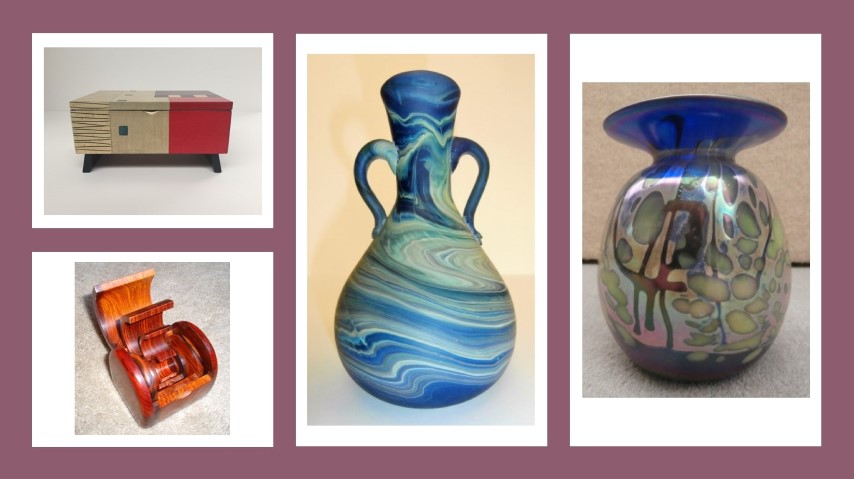 Trinket boxes and vases from Saper Galleries and Custom Framing that would make wonderful holiday gifts. If you’ve got a hard-to-shop for person on your Christmas list this year, check out Saper Galleries and Custom Framing. The world-renowned, award-winning brick-and-mortar art gallery features an ever-changing inventory of art displays and custom matting and framing services. Gallery Owner Roy Saper prides himself on his business being a one-stop-shop for unexpected, unique gifts. “A beauty of artwork as a gift is that it is not consumed or put away and forgotten, but rather is displayed, viewed, and enjoyed every day, forever,” he said. Saper created a cheat-sheet of his top five gift ideas in the store, including hand-blown glass vases from Hebron in the Palestinian West Bank. “From this region of difficulty comes the beauty that we are displaying at Saper Galleries and that hundreds have purchased as gifts and for themselves to view always,” Saper said. Other popular hand-blown glass vases and pitchers come from Californian artist Rick Hunter. Michigan-themed art is always a favorite, with prints and paintings of Michigan artist Kathleen Chaney Fritz – whose work is filled with lakes, dunes, and Mackinac Island. Wooden boxes made of cocobolo wood from Costa Rica, including nested boxes make the list, as well as hand-painted, wooden boxes by Brazilian artist Monica Martinez. Gift certificates for professional custom matting and framing services make a unique gift for those with photos, letters, art, awards, and memorabilia in storage. Since Saper’s been around since 1978 and seen many other galleries come and go in that time, the business has years of testimonials, customer referrals, and handwritten thank you cards from happy customers, who Saper now calls family. “Every student who wrote me a thank-you note for a presentation I gave to their class may be happy to know that not only did I read each of their letters, but I have them all saved as they are precious gifts that I appreciate and value,” said Saper. “Just as I do every single transaction that we’ve had here – the many tens of thousands of works of art and framing services we’ve provided to people throughout the globe.” Saper Galleries and Custom Framing is open Monday-Saturday from 10 a.m. to 6 p.m. with free parking at the rear entrance (433 Albert Avenue). Customers can preview a majority of the inventory on their website and purchase orders over the phone or via email. Same-day service is provided for shipping orders, and curbside pickup is also available.Reality
captured
When I
walked into Saper Galleries on Monday, Roy
Saper, the gallery’s owner, was wrestling with
an elegant Eames Lounge Chair, positioning it
under a skylight to watch the solar eclipse.
He welcomed me, and for about 20 minutes, we
sat there and watched the moon pass across the
sun. Then he suggested we look at something
almost as beautiful and almost as rare as the
natural phenomenon we’d just observed: Saper
Galleries’ newest collection of
hyper-realistic oil paintings. “It’s
that exacting level of precision that makes
hyperrealism so amazing,” said Saper as we
looked at one of Higueras’ oil paintings
entitled “A Bunch of Grapes Plus One,”
depicting a group of grapes so realistically
that it could be a photo. “It
highlights every little detail, even the
imperfections,” said Saper, and those
imperfections are exactly what makes these
paintings so realistic. “One
might say, ‘just do a photograph,’” said
Saper, “but it’s not a matter of if you can
paint something that looks like real life, but
can you make it feel like real life? It’s a
level of realism that goes beyond a
photograph.” As we
made our way deeper into the gallery, Saper
stopped at a painting by Bruscianelli
depicting a glass vase full of fruit. “It
feels like you could reach into the pitcher
and grab a piece of fruit,” marveled Saper.
“But then you realize this is a
two-dimensional painting.” But
don’t just take Saper’s endorsement — even the
“Carlos
Bruscianelli has been attempting to emigrate
to the “After
many months of negotiation, Bruscianelli has
just obtained a work visa to come and paint
for Saper Galleries,” Saper said. “In fact,
our federal government has said he’s so good
that we want him in our country,” he said,
producing a copy of Bruscianelli’s emigration
papers saying just that. We
walked on and examined the paintings of
Gleadow that depicted faux-photographic oil
renditions of book spines arranged neatly in a
row. “These
are so good that a lady was in the gallery and
she said she wanted this painting,” said
Saper, pointing to a piece depicting ragged,
used book spines. “And she said that this one
had a flaw in it.” Of
course, there was no flaw, just an illusion
created by paint and brush. But
still-life paintings have been around forever,
it’s a near ancient tradition, with origins in
ancient “Artists
are kind of doing a circle; they’re coming
back,” said Saper. “In the last 70 years,
we’ve been moving away from still-life,
hyperrealism and classical painting — there’s
more abstraction today.” And as
Saper pointed out, much of art history had
been dedicated to realism, with abstraction
only becoming popular in the late 1800s.
Today, realism often takes a back seat to
different forms of Expressionism. Paintings
like those Saper is highlighting, paintings
that hearken back to the High Renaissance when
realism reigned supreme, seem to be out of
fashion today. “But now
we’re seeing artists that were trained in this
classical style say it’s okay to paint like
this again,” said Saper. “Now we revere these
hyperrealistic paintings as something new, but
people were painting like this in the 1400s
and 1500s. There are ebbs and flows in a lot
of aspects of culture, this being one of
them.” As I
finished up my tour of Saper Galleries, Saper
made a joke about how eclipses are rare, but
finding artists with this sort of
extraordinary talent is even harder to come
by. “Hyperrealism”
Through November 40 Years of the Saper
Galleries: Art and Technology
By JAMIE
PAISLEY • 
Roy Saper has
been bringing art to "In
1985 is when I bought this land." recalls Saper.
"Interestingly, it was owned by Butterfield
Theaters, who owned in downtown Though
the newly relocated Saper Galleries did have a
weakness. An outdoor sculpture garden which left
some items vulnerable to purloining. 'Wait.
Hey, where's that 7-foot tall sculpture that
weights hundreds of pounds?' And that's when I
realized. - Roy Saper "It
was crazy. I'd come in in the morning, I'm looking
out the window into our courtyard, and thinking,
'Wait. Hey, where's that 7-foot tall sculpture
that weights hundreds of pounds?' And that's when
I realized." says Saper, about the robbery. "So,
to handle that, I spent more than a
quarter-of-a-million dollars to enclose that
courtyard and expand it. Make it a little bit
larger. And I'm glad I did, because it brings,
with the lighting that we have, it brings the
outdoors in. So, you almost feel like you're
outdoors. There're plants, it's beautiful location
and it's a beautiful venue for viewing art." After
his youth in Technology
is the only way that business today can survive.
No matter what business it is and we're proud to
always be on the cutting edge - Roy Saper "We
were the first gallery, I think anywhere, which
used the computer in a way that we still do and
more galleries now do." say Saper, proudly. "Now
we know every day what countries have visitors on
our website and what they're looking at.
Technology is the only way that business today can
survive. No matter what business it is and we're
proud to always be on the cutting edge of that and
that's observed by those who find Saper Galleries,
even though they might not be able to place Because
of its location, just north of MSU, there is a lot
of student foot traffic who may have never visited
a gallery before and have that deer-in-headlights
look just walking into the building. "I'll
tell you what it is: There's this sense of awe and
discovery when they come in." says Saper of the
wandering MSU students who first encounter the
Galleries as a museum of sorts, but with
pricetags. "They look around, there first comment
it 'I had no idea this place was so large in
size.' Its deceiving from the outside. You see a
little door. You see a brick wall, but when you
come in, it *is* large and when an 18-or-20 year
old comes in, often times they look around. They
rush out and then about 5 minutes later, they come
back with 2 or 3 friends. That's a sign of success
as far as I'm concerned." Last
week, Saper
Galleries and founder Roy
Saper celebrated turning 40 years old. You can
swing by and check out the hundreds of works of
art in their
East Lansing working to continue support of local art galleries By McKenna Ross Photos by Nic Antaya December 8, 2016 The State News, East Lansing, Michigan East
Lansing resident Roy Saper poses for a portrait
on Dec. 6,
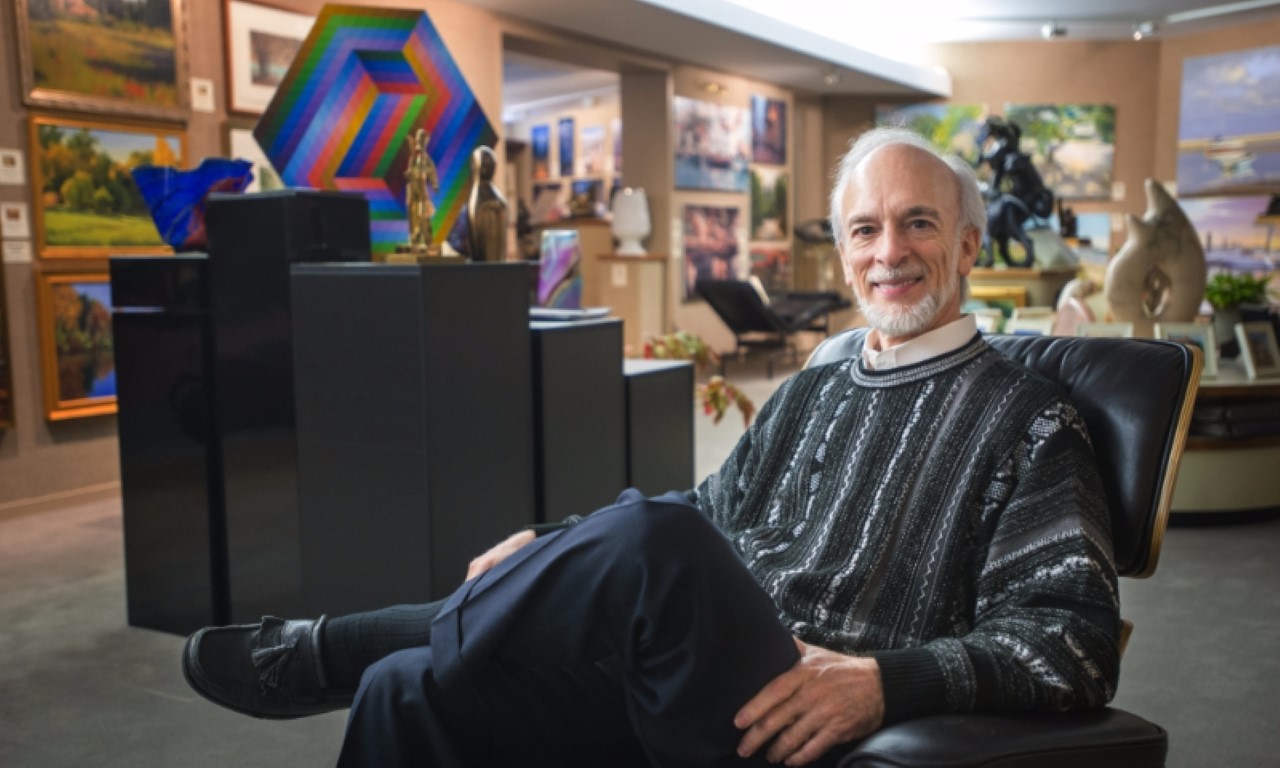 2016 inside of Saper Galleries
and Custom Framing at 433 Albert Ave. Saper
opened his gallery in 1978 and said, "Saper
Galleries provides a resource for everyone who
might have (or) who has an interest in art," and
that his gallery sells art to clients all over
the world. 2016 inside of Saper Galleries
and Custom Framing at 433 Albert Ave. Saper
opened his gallery in 1978 and said, "Saper
Galleries provides a resource for everyone who
might have (or) who has an interest in art," and
that his gallery sells art to clients all over
the world.Tucked away in downtown East Lansing, surrounded by housing and a comic book store on Albert Avenue, stands Saper Galleries — one of several art galleries downtown aiming to bring art and culture to the city. Roy Saper, the proprietor of the gallery, started his business in 1978 after graduating from MSU. The 6,000 square-foot gallery exhibits work from 150 artists from more than 15 countries with 1,500 pieces of inventory, meaning there’s something for everyone. “We pride ourselves in that we have artwork for literally everyone,” Saper said. “There’s not a person who would come in here and not find something they like. And (we’re) affordable — we have a ton of artwork that’s under $100.” Pieces in the gallery range from oil on canvas and pencil sketches to hand-blown glass and wood construction. Saper contributes his success to all the options of art in the gallery. “It’s a broad range of imagery,” he said. “We’ve found that the clientele that we have is very supportive of this gallery which is why we’ve been here for nearly four decades.” With only three people on staff, Saper said he works night and day before exhibitions to ensure they open smoothly. He said it’s worth it, though, to see the community appreciate the artwork. 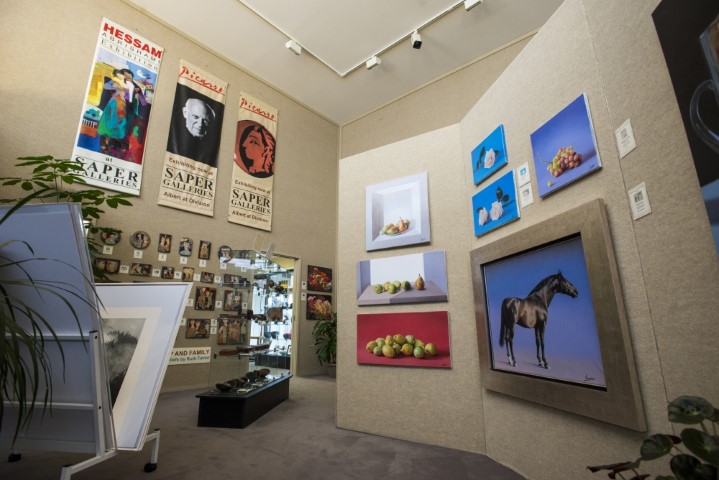 Various pieces of art are pictured on Dec. 7, 2016 at Saper Galleries and Custom Framing at 433 Albert Ave. The gallery has numerous windows that allow for the gallery to be illuminated by natural light. “We like being, and we are, a community gallery,” he said. “A gallery for the people, for the community. That’s been evidence from the shows we’ve had and the response we’ve had to those exhibitions. Around 7,500 clients and they’re very supportive of the gallery, which is nice. We’re in it for the long haul.” East Lansing has made an effort to be a community welcoming to art. The city has ordinances requiring large projects to dedicate 25 percent of its funds to art, and frequently hosts art and music festivals throughout the year. City Manager George Lahanas said another way East Lansing supports the art scene is by collaborating with MSU on (Scene) Metrospace, a gallery downtown. “We split the operation and the costs,” Lahanas said. “They control the content, and we offer free space and some utilities.” Still, East Lansing’s art scene faces some challenges. Deb Cholewicki, the gallery manager at Grove Gallery and Studios, said it can be hard to make a mark in the city. “I think overall, a lot of the community doesn’t really get what arts and culture is and that’s starting to change, which is a good thing,” Cholewicki said. “The other challenge is that we have a huge student population. That’s very transient, people are coming and going. Students don’t typically have a lot of money to come and buy art.”  Saper agreed. He said when he built his gallery in 1986, he thought he would start a trend in downtown. “We have a dearth of galleries,” Saper said. “When I bought this vacant parcel of land with nothing on it except a path that went through from Division Street to Albert, my belief was that between here and the Marriott, I thought all these buildings would turn into art galleries. I thought we would start something and all these others would come in, but it’s not easy to run an art gallery.” When Grove Gallery opened eight years ago, it aimed to add to the art scene. Cholewicki said she thinks it has helped. “I think it’s constantly evolving and growing,” she said. “I think that every year sees more momentum building for the excitement around the arts.” |
|
The Estates Magazine, East Lansing, Michigan August, 2016 (Click image below to see larger size text.) 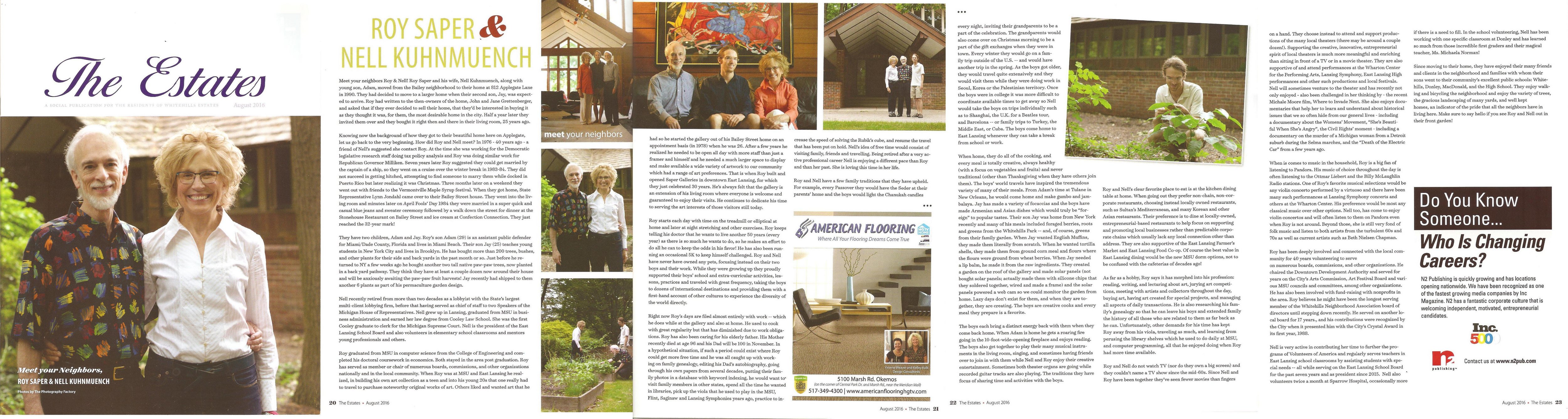 (Click image below to see larger size text.) 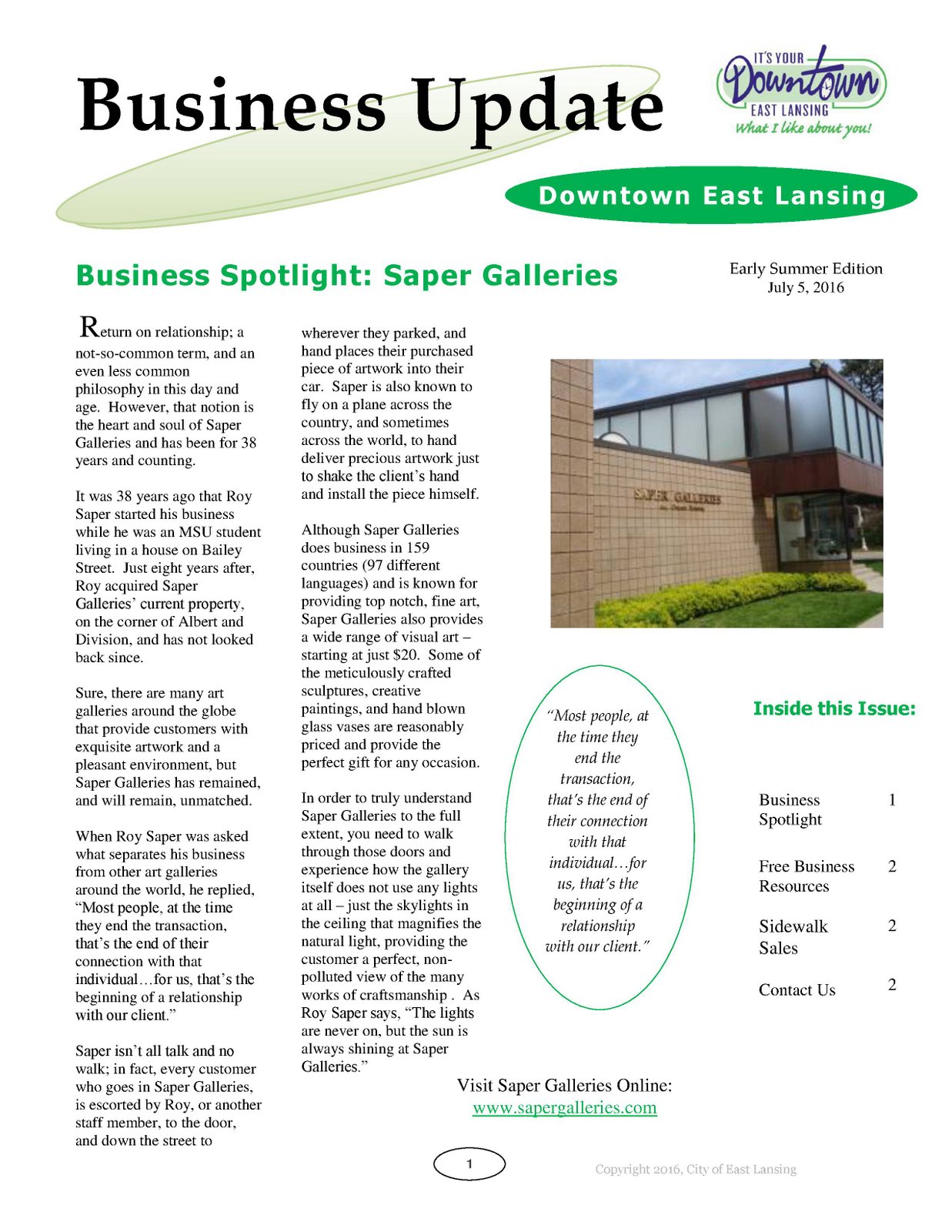 Saper
Galleries And East Arbor
Architecture Bring Art,
Architecture To Downtown EL
Authored on Monday, 13-Jun-2016 Author: Casandra Eriksen Excerpted from ELI.  Photo: Roy Saper,
framing manager Jennifer, and artist
Lou Heiser at the opening of Vistas
of Michigan: Oil Paintings of Lou
Heiser, October 4, 2015
Saper Galleries, long a fixture in downtown Easy Lansing, celebrated its 30th anniversary in downtown East Lansing on Friday, June 3. Asked how he got started, Roy Saper said, “I opened Saper Galleries in response to the community’s enthusiastic support of the gallery which I was previously operating out of my home at 429 Bailey Street, adjacent to downtown East Lansing.” Saper emphasized his lifelong love of art “I had been buying art since a teen (from baby-sitting and lawn mowing earnings) and after I came to East Lansing to study at MSU I continued buying art at auctions, selecting what I loved and wanted to own. In the early-to-mid 1970s others enjoyed the art in my collection and asked for my assistance to acquire artworks for them. By 1978 I created 20th Century Fine Arts, making available to collectors artwork that they told me they would like to own.” He adds that his business only grew from there. “I continued to buy more artworks that I loved, displayed them in my home, and residents of the East Lansing community called to make appointments to visit and see the collection. Seven years later, in 1985, I realized that there was enough activity that I needed to expand from an appointment basis to a larger gallery with regular hours-and more staff than a sole picture framer who assisted me.” Saper then hunted for a suitable piece of property for his expanding business. “I was shown locations of buildings in Okemos and elsewhere in the area but was not pleased with any existing building. I looked at the house where B/A Florist is (Grand River and Hagadorn) and saw the slate-roofed house as a possibility for the gallery and the smaller house in back as a possible framing facility. But that just wasn’t right for me. I considered what was then a vacant tuxedo rental facility which is now a FedEx location on Michigan Avenue near Harrison Roadhouse - but I wasn’t totally happy with that either.” After some fruitless effort, Saper contacted the City of East Lansing and asked what was available. He was told that “…the only vacant parcel of property in downtown East Lansing was at the corner of Albert Avenue and Division Street, land that was overgrown with weeds reaching out onto the sidewalk, posts at the perimeter to keep cars off the vacant lot, and overgrown trees.” Saper then drove to the Detroit area to talk to the owner of Butterfield Theaters who owned the land at the time, and bought it from him for nearly three times for what he paid for his house. “And now, 30 years later, I have far outgrown the 6,000 square feet (plus lower level) of the existing building and could easily use four-times what we have to better display the 1,500 artworks now in our inventory. I created the Gallery 30 years ago because our clients then-and now-have been so supportive of what we’ve made available to them.” When asked what his goals are for the future of Saper Galleries, Saper said “I have goals of every day and the next. We will continue to serve the interests and needs of every person who wishes to acquire a work of art for their home or office or as a gift. For those who have artwork that needs to be cleaned, restored or repaired, we will continue to provide the proper treatment to ensure the long term preservation of the artwork.” He emphasized the diversity of the work at Saper Galleries, stating that their “goals are to add more professional staff so that every task asked of us, from appraisals and research, to providing expert witness testimony in court cases involving art fraud, are handled quickly, professionally, and accurately, so that all of our clients receive the services they request-and more.” ...Saper Galleries is located at 433 Albert Avenue in downtown East Lansing. For more information you can visit their website http://www.sapergalleries.com/ A Passion for Community Saper Galleries Celebrates 30 Years BY CALLIE
OPPER
THURSDAY, June 2, 2016 — Thirty years
ago, Roy Saper opened the doors of Saper
Galleries and Custom Framing in downtown
East Lansing.Lansing City Pulse 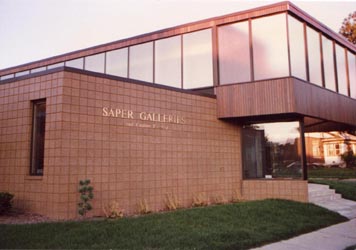 The gallery celebrates the anniversary with a free event Friday from 5 p.m. to 8 p.m. The gallery’s collection features over 1,500 works of art by over 150 artists from 15 countries. Roy Saper, founder and owner of the gallery, has been involved in the East Lansing community since he came to Michigan State University as a 17-year-old freshman in 1969. He graduated with a bachelor’s degree in computer science. Saper discovered his passion for art when he bought three Picasso reproductions at Harvard Coop in Cambridge when he was a preteen. “I have always loved, admired and have been passionate about the amazing talent of the great artists whose works I was exposed to in significant museums of quality art,” Saper said. Two of the museums he frequented were the Art Institute in Chicago and the Flint Institute of Art. “I started buying what I could, attended art auctions as a teen and bought artwork I could afford,” Saper said. “Tens of thousands of transactions later, I have placed original artworks in homes, offices hotels, and other facilities worldwide — and do so every day from downtown East Lansing.” After graduating from MSU in 1978, Roy Saper started an in-home gallery on Bailey Street in East Lansing. In 1985, he bought land in downtown East Lansing and designed Saper Galleries and Custom Framing. The gallery opened in 1986. “I am at the gallery Monday through Saturday and the first Sunday of every month,” Saper said. “When I’m not at the gallery, I am generally working at home by computer, handling our international and internet orders, communications with clients, artist evaluations, buying art, processing orders and managing our operations, as well as live chat inquiries.” A large part of Saper Galleries’ success is its commitment to community. Saper and his family invite schools and organizations into the gallery for special events and educational programs. “I and Saper Galleries are and have been very actively involved within the Greater Lansing community in many ways,” Saper said. “We support well over 100 organizations.” Saper was awarded the East Lansing Crystal Award in 1988 for service to the community.  “I made a commitment to serve, and that won't be diminished,” Saper said. “True commitment, dedication and passion does not fade. It is part of the heart, a part of the person.” The 30th anniversary celebration will acknowledge Saper Galleries’ success, as well as an celebrate others who have dedicated time, interest and funds toward promoting arts in the community. Guitarist Elden Kelly will be provide music for the event, which is open to the public. “Friends and those new to Saper Galleries can enjoy the art, music, beauty and friendships,” Saper said. “This is my living room, where all are welcome — particularly those who have never set foot in an art gallery before or considered acquiring a work of art.” While 30 years is a great accomplishment, Saper has no plans to stop anytime soon. “I am 64 and want to keep going another 50 years,” Saper said. Saper Galleries 30th Anniversary Celebration 5-8 p.m. Friday, June 3 FREE Saper Galleries and Custom Framing 433 Albert Ave., East Lansing (517) 351-0815,sapergalleries.com The Estates Magazine, East Lansing, Michigan February 2016 (Click image below to read in larger size)  Saper Galleries To Host Winter Creative Mixer Tonight Thursday, 28-Jan-2016 EastLansingInfo.org Author: Caitlin Leppert 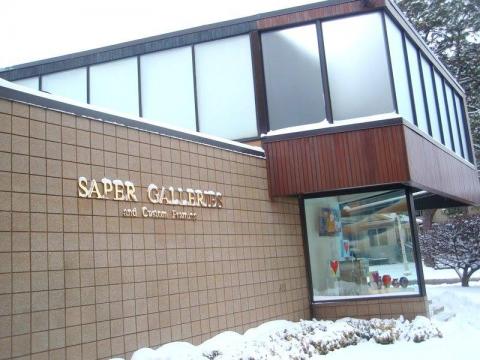 This
Thursday, Saper Galleries will
open their doors from 5-7 PM to
welcome East Lansing creatives for
the Arts Council of Greater
Lansing Winter Creative Mixer. The
event, sponsored by The Greater
Lansing Convention and Visitors
Bureau, is free of charge, and
attendees will be treated to
complimentary snacks and
beverages. This
Thursday, Saper Galleries will
open their doors from 5-7 PM to
welcome East Lansing creatives for
the Arts Council of Greater
Lansing Winter Creative Mixer. The
event, sponsored by The Greater
Lansing Convention and Visitors
Bureau, is free of charge, and
attendees will be treated to
complimentary snacks and
beverages.Gallery owner Roy Saper said the event will provide a platform for all types of creatives to network and collaborate. “[The event is] bringing together people that have this common thread that ties to an overall larger umbrella that already exists in other areas, like government and politics. People learning to share, exchange and explore in creativity.” East Lansing boasts a historically friendly relationship with the arts. The Arts Council of Greater Lansing hosts three creative mixers each year, and between the mixers, multiple art and music festivals take over East Lansing’s downtown streets. In the nearly 38 years since its conception, Saper Galleries has done its fair share of arts promotion within the City. The gallery welcomes between 100 and 200 organizations each year, including East Lansing High School students, MSU education students and ESL students. Saper said cities thrive when they fully embrace the arts. “Creativity finds new explorations for a city. Creativity is how progress is made. Communities that don't encourage creativity don't foster and grow.” East Lansing continues to see growth, due, in part, to events such as Thursday’s mixer. Yet, there is still progress to be made. Saper estimated the City has achieved only five percent of its potential. According to Saper, the other 95 percent could be achieved by establishing a downtown performing arts venue, constructing an open studio space for artists to create and audiences to watch, as well as create a gallery to display art from the former Kresge Art Museum. “There are a thousand and one possibilities… East Lansing just needs to take initiative,” he said. Thursday’s Winter Creative Mixer could be the collaborative platform to springboard such initiatives, but at the very least, the mixer will get East Lansing’s artists together for an evening of conversation, collaboration and inspiration. Saper Galleries is located at 433 Albert Avenue. Rare glass from the West Bank finds a home in East Lansing By KATIE COOK WKAR Radio Broadcast on Current State, January 7, 2016 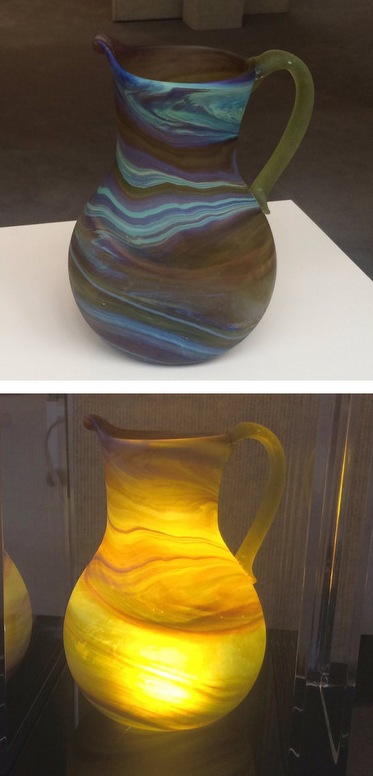 A Hebron glass pitcher as it appears normally and when illuminated. KATIE COOK / WKAR Hebron glass is a type of hand-blown glass made in the Palestinian West Bank, and Saper Galleries in East Lansing has the world’s largest collection of it outside the Middle East. We hear from Roy Saper about this beautiful glass. Listen...9:57 Gallery owner Roy Saper admires some pieces of Hebron glass from the collection. CREDIT KATIE COOK / WKAR The Story Behind The World’s Largest Collection of Hebron Glass Now Displayed at Saper Galleries Sunday, December 27, 2015 ©2016 The New Citizens Press By TNCP Staff 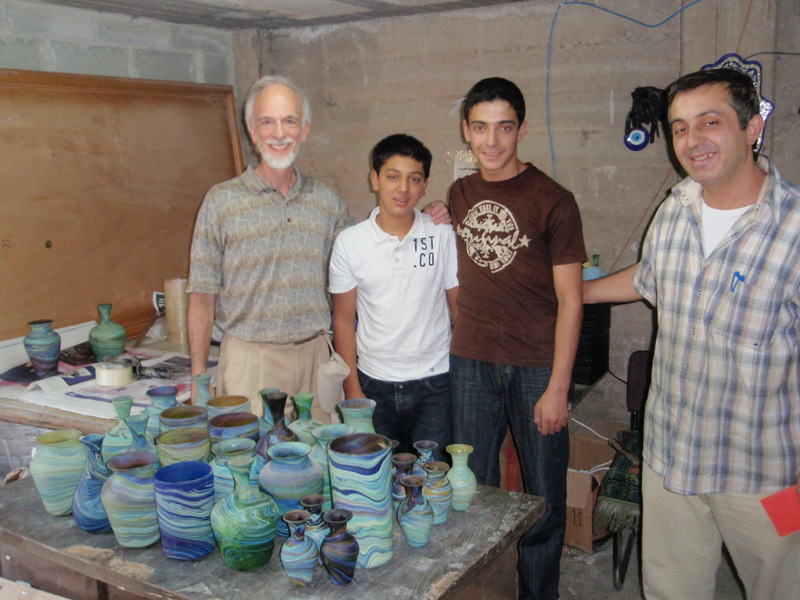 Roy Saper
stands with second and third generations
to the elder Hamzeh Natsheh, all
involved in the family glassblowing
business just as were the many
generations of the Natsheh family before
them over more than 700 years. They are
preparing to package the 30 Hebron glass
vases. Saper suggested that he would be
back later to pick them up. He was
told he would not succeed in getting
through the checkpoint back into Israel
with them. They were shipped. Roy Saper
stands with second and third generations
to the elder Hamzeh Natsheh, all
involved in the family glassblowing
business just as were the many
generations of the Natsheh family before
them over more than 700 years. They are
preparing to package the 30 Hebron glass
vases. Saper suggested that he would be
back later to pick them up. He was
told he would not succeed in getting
through the checkpoint back into Israel
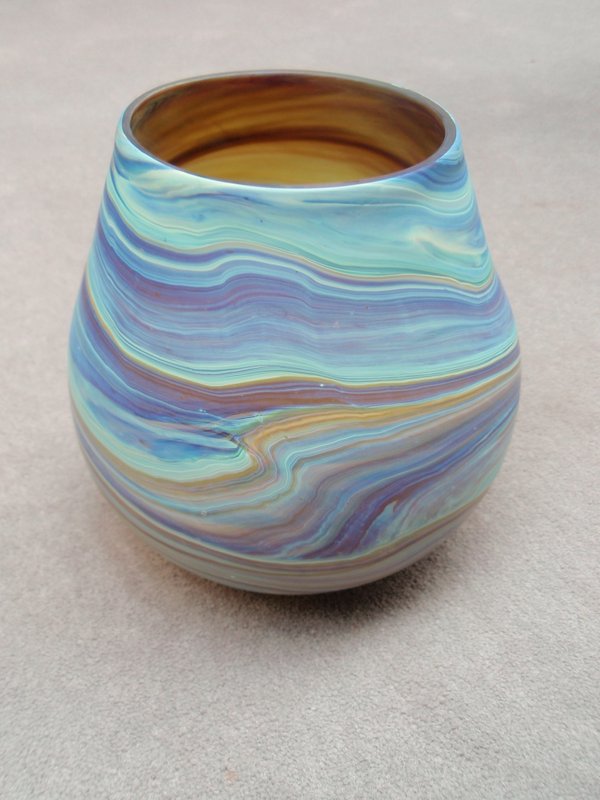
with them. They were shipped.For more than 2,000 years hand-blown glass has been made in Hebron, the largest city in the Palestinian West Bank. Although, the beautiful glass works are rarely seen outside of the Middle East, Hebron artisans created 100 of the unique, swirl-colored hand-blown glass vases, decanters and pitchers for the opening of The Hebron Glass Collection at Saper Galleries located at 433 Albert Avenue in downtown East Lansing. However, according to Roy Saper, the owner of the gallery, there is so much more to the story, and extraordinary events led him to find and seek out these beautiful works of art. He has always worked intuitively when choosing the pieces for his gallery. Motivated by the traditions of the ancient craft of glass blowing Saper was willing to take the arduous trip to find the historic glassblower's shop that held the art that represented struggle, life, death and history within the vessels. Saper's desire to bring the vividly colored art back to Michigan was a journey that he and his family will not soon forget. The Trip Due to political, security and other challenges in the Hebron area, it is difficult for the glass artists to export their creations and the lack of tourism reduces the opportunity for the world to see, enjoy and collect the hand-blown glass that artisans have learned to create from their parents as passed down from prior generations. In 2012, Saper and his wife, Nell Kuhnmuench and son, Jay, visited the one remaining family-owned business, which is still making glass in Hebron, a small hot and dusty town, in the West Bank of the Palestinian territory. Saper said, “On a very hot afternoon we went through shelves of glass and hand-selected 51 vases to be sent to us in the United States for the visitors to Saper Galleries.” Saper said, "I was immediately captivated by the swirling colors achieved by the glass-blowers, unlike any other blown glass I've seen before or made in any other country." "This glass truly is unusual and is also Fair Trade. The glass blowers are paid fair wages and use sustainable methods in their operation." Saper's son was selected to serve as an intern for an American Non-Governmental Organization (NGO) in Nablus, West Bank where he collaborated with local university students to teach young Palestinian refugees. Jay's focus was teaching the arts, particularly music and drama, to young children in an ancient city known for training suicide bombers during the Palestinian uprisings 12 years ago. Saper and his wife went to Nablus toward the end of the summer of 2012 to pick Jay up after his couple month experience of teaching and working with the Arab children. It was not an easy trip for the couple. After picking up Jay in the West Bank they were detained for three or four hours at an Israeli check point near an Israeli settlement. They were ordered out of their car. Saper said, “Nell and I were separated from Jay and each put in metal holding cells while we were each interrogated and searched before we were eventually permitted to pass into Israel after quite an extensive ordeal that caused me to wonder if we would ever be reunited with our son.” The harrowing experience included the presence of dogs, automatic weapons, and guards who kept them in place until another interrogator would arrive to ask them more questions after they grilled Jay. The concern of their interrogators was whether they would be a risk to the security of Israel after having spent time in the West Bank said Saper. “My camera showed that we were associating with Arab Muslims such as an artist who showed us her city including the rubble of bombed out homes that were destroyed by Israeli Defense Forces (IDF). The Arab artist from Nablus became a friend of my older son, Adam, who also interned at the NGO a couple years earlier. We were in an area where there were no tourists, certainly no Americans, and we posed a concern to the IDF at the checkpoint who were there to protect Israel from any potential risk,” said Saper. The Long History Hand-blown Hebron glass is a Palestinian tradition that is centuries old. The artisans today blow glass in Hebron just like their parents and grandparents and prior generations did before them. Hebron glass dates back 2,000 years and the city is said to be the oldest continually occupied city in the world. It is mentioned in the Bible 87 times and is said to have been founded more than 3,700 years ago. Hebron artisans use long metal hollow tubes to pick up a slurry of molten recycled glass in an 1,800 degree furnace and blow through the tube to expand the glass, turning the tube and using metal tools to form the glass into the desired shape. Additional molten glass is added to the blown shape and is swirled into the magical designs that define the style of Hebron glass. The functional glass vessels are often of ancient Phoenician designs and are largely amber, green or blue colors made from molten recycled glass and cobalt. An article written by Gail Simmons entitled “Hebron's Glass Factory” in ARAMCO World, the writer was told, “Twenty-five years ago, hundreds of tourists came to Hebron every day, and we had no export market. Now that Hebron is off the tourist map, we're trying to open new markets, exporting to European countries, the USA, Canada." The owner of the glass studio Saper visited Hamzeh Natsheh who told him that all the glassmakers other than his family are no longer making glass. From the above referenced article, Natsheh said: "When I was born, there were around 15 glass manufacturers in Hebron, based in the old city Now, my cousin and I are the last two glassblowers in our family. This is a very hard job." The glassmakers in Hebron were dealt a big blow when the unrest began. Most of the glassmakers in Hebron are out of business as there is no tourist traffic to Hebron. However, that did not deter Saper from taking the time to pause and reflect before his trip to Palestine. His goal was to bring a family heritage of glassblowing going back centuries to this country. The deeper-rooted issue of the unstable nature of the area and the fact that artisans were able to push beyond those limits and still create were in the forefront of his decision to pursue the creative glass pieces. The Future There is clearly a chance that glassblowing in Hebron will cease to exist. Natsheh 's family has been making glass in Hebron for 700 years and it will continue only if the younger generations maintain the traditions of their ancestors and keep the family glassmaking secrets in production. Natsheh told Saper he is concerned about China mass producing glass and the possibility of that cutting into the market for original hand-made Phoenician glass from Hebron. In an effort to increase demand for Hebron glass, Natsheh's family is at the early stages of engaging in some export while starting to expand the range of items made in their glass furnaces. But as the elder glass blowers age, their reliance on the younger generations in their family becomes critical in keeping the tradition of Hebron glass alive. "We are fortunate to have the original Hebron glass still being produced, but as the younger glass blowers face competing interests in a more global society, the future of Hebron glass as it has been known for 2,000 years is at risk,” Saper noted. Saper was pleased to see young people working in the shop, he said, “I was at Hamzeh's glass workshop, I was also served by what may have been his son and his two grandsons, all working. The grandsons looked to be school-age children -- and the future of Hebron glass.” The Reality The reality is that terror and danger in and around Hebron and throughout much of the Palestinian territories is destabilizing for businesses. The United Nations provides weekly reports showing evidence of the continual daily conflicts between Israelis and the Palestinian territories. Saper recounts, “When I was walking to my car parked in a large area of building rubble, two Arabs starting running fast toward me and when they approached me they looked scared and pleaded for me to do whatever I could to help them from the terror they are experiencing in Hebron. The Muslim Arabs were in fear because of the terror they were experiencing from Israeli settlers and the IDF.” He added, “In all the interactions and exchanges I had with Arab Muslims driving throughout much of Palestine, they each were peaceful, welcoming, warm, sharing drinks and fresh figs with us during Ramadan (when they were not able to eat or drink), wanting to have their photos taken with us. We were invited to homes, given food to take for the road, taken to places we wanted to visit, and treated like invited guests.” While there does not seem to be an end in sight to the conflict, Saper remains optimistic. He said, “Since visiting Hebron three years ago I have since re-ordered nearly 200 glass vases and pitchers to be made for me by Hamzeh's family of multiple generations. Hamzeh sends me photos of glass that they've made over the years and I select the styles, colors, and sizes of those I like -- and several months later the boxes start to arrive. Each glass vase was made explicitly for us based on what I love -- and know others will as well. There is no collection of Hebron glass anywhere in the world as large as what we have here. As long as Hamzeh's family continues to make them for us, we will continue to have them on display at Saper Galleries.” The hand-blown Hebron glass collection will be available at Saper Galleries through February [or until sold out]. Videos showing the glass-makers creating the glass in the ancient tradition are on the Saper Galleries website, http://sapergalleries.com/HebronGlass.html. The gallery, now in its 37th year, is open Monday through Saturday, 10 a.m. to 6 p.m. and the first Sundays monthly from 1 to 4 p.m. at 433 Albert Avenue in downtown East Lansing, MI. The gallery, fully accessible and welcoming to all, may be contacted at 517-351-0815 and roy@sapergalleries.com. Lansing City Pulse Dec. 1 2015 Ancient glass -- Saper Galleries showcases glass art from Hebron BY KEVIN MCINERNEY TUESDAY, Dec. 1 — For
over 2,000 years, hand-blown glass has
been made in Hebron, the largest city in
the Palestinian West Bank. Rarely seen
outside of the Middle East, 100 of these
unique, swirl-colored hand-blown glass
vases, decanters and pitchers made by
Hebron artisans will be on display at East
Lansing’s Saper Galleries.
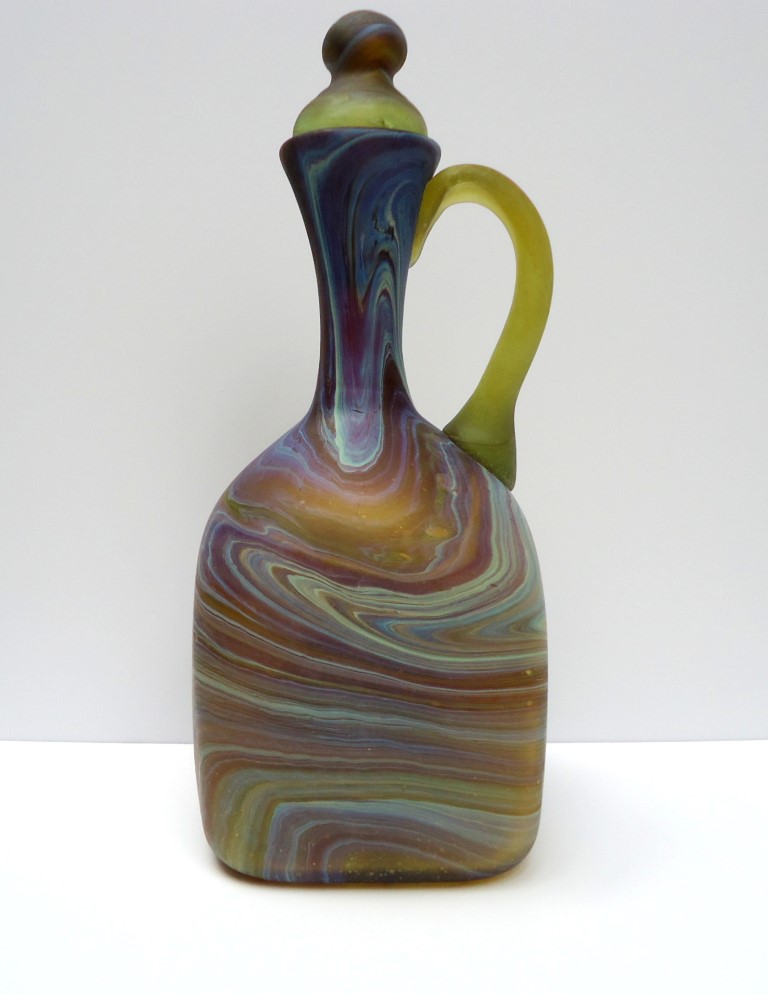 Hebron artisans use long metal hollow tubes to pick up a slurry of molten recycled glass in an 1,800 degree furnace and blow through the tube to expand the glass, turning the tube and using metal tools to form the glass into the desired shape. Additional molten glass is added to the blown shape and is swirled into the unique designs that define the style of Hebron glass. The functional glass vessels are often of ancient Phoenician designs and are largely amber, green or blue colors made from molten recycled glass. Many artisans learn the glass blowing craft from their parents as it is passed down from prior generations. In 2012, Saper Galleries owner Roy Saper and his family visited one of the few remaining family-owned businesses in Hebron that is still making glass based on Phoenician traditions. Residents of the region claim that nearly a dozen other glass blowing studios have closed in recent years. "I was immediately capt 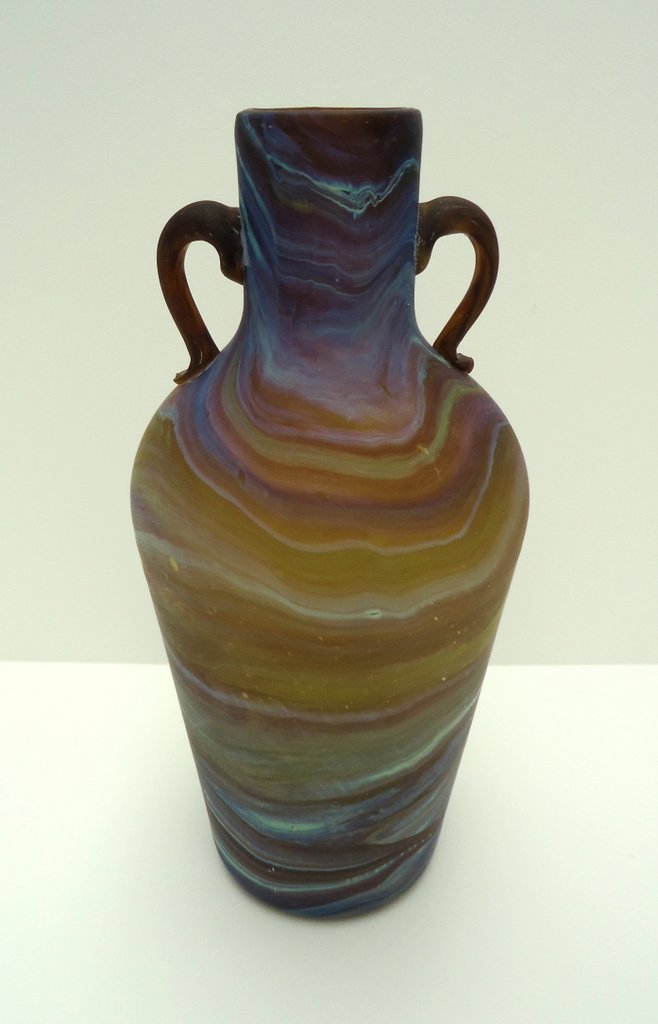 ivated
by the swirling colors achieved by the
glass-blowers, unlike any other blown
glass I've seen before or made in any
other country," Saper said. "This glass
truly is unusual and is also Fair Trade.
The glass blowers are paid fair wages and
use sustainable methods in their
operation." ivated
by the swirling colors achieved by the
glass-blowers, unlike any other blown
glass I've seen before or made in any
other country," Saper said. "This glass
truly is unusual and is also Fair Trade.
The glass blowers are paid fair wages and
use sustainable methods in their
operation."Due to political, security and other challenges in the Hebron area, it is difficult for glass artists to export their works. The lack of tourism reduces the opportunity for the world to see or purchase these hand-blown glassworks. Since 2012, Hebron artisans have collaborated with Saper Galleries to create a variety of exclusive glass items for the gallery. The 100 vases, pitchers and decanters created this summer for the gallery is the largest collection of Hebron glass designs ever exhibited together outside of the Middle East. The Hebron Glass Collection at Saper Galleries opens Sunday with a reception from 1 to 4 p.m. at Saper Galleries. The opening is free, open to the public and is fully accessible. The exhibition will continue through January 2016, and the gallery is open 10 a.m. to 6 p.m. Monday through Saturday and 1 to 4 p.m. on the first Sunday of each month. Artist Meet And Greet At Saper Galleries: Lou Heiser's Vistas Of Michigan
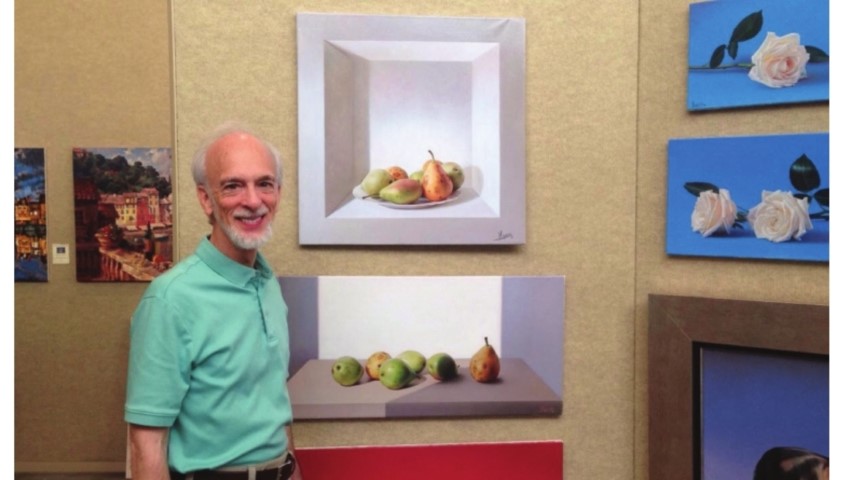
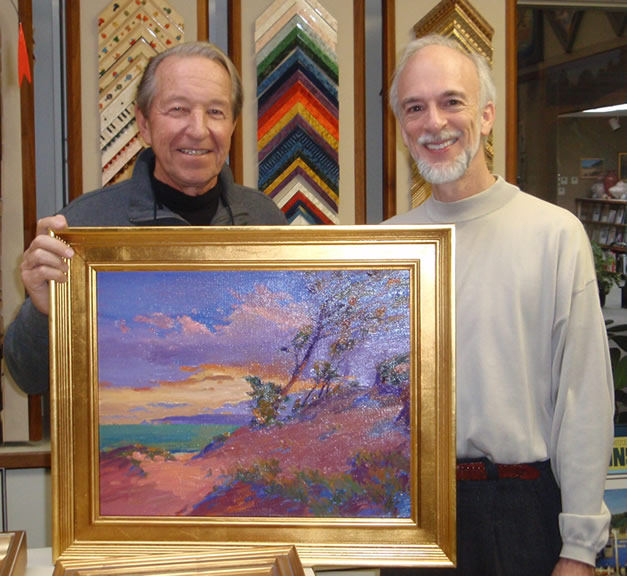
Artist
Lou Heiser and Saper Galleries owner Roy
Saper
This
weekend, discover artist-eye views of
Mother Nature that exist far closer to
home than you might imagine. Artist Lou
Heiser will take viewers on a journey
through the beautiful landscapes of
Michigan with his collection of oil
paintings entitled “Vistas of
Michigan.” The exhibition will
be opening this Sunday, October 4, 2015
from 1 to 4pm at Saper Galleries in
downtown East Lansing. It is free and open
to the public.
Saper
Galleries is a long-standing East Lansing
gallery that has acquired its much
deserved attention over the past 37 years
by serving both the local community and
art collectors from all over the globe.
Owner, Roy Saper started the business in
1978, in his first home at 429 Bailey
Street in East Lansing. Even then he was
committed to a philosophy of sharing
quality art with fellow residents. “I
create these exhibitions, always free to
everyone, as a commitment to community and
love of sharing,” says Saper. Over 1,500
original works of art by 150 artists are
available at Saper Galleries, and the
inventory is always changing. “I like
original artwork that connects with
people,” Saper states. He adds that the
gallery strives to stock one of a kind art
and diverse collections that appeal to all
different tastes and that only a few
talented individuals are selected every
year from an incredible number of artists
vying to be represented in the collection.
Lou Heiser is one of those few. Saper
recognized the quality of Heiser’s work
immediately, and has displayed his oil
paintings since the artist approached him
in 2009. “What I like, in particular,
about Lou Heiser’s paintings,” reflects
Saper, “is their relevance, and that he
has a technical proficiency and maturity
that allows him to achieve the results he
is seeking.” Heiser is a
successful architect and landscape painter
from Chicago, Illinois. He has designed
houses all over the country, including
homes in Leelanau County, Michigan, and
his oil paintings are featured in various
galleries across the state. Vistas Of
Michigan explores
the nooks and crannies of Michigan in a
collection of oil paintings that reflect
the allure of nature and the artist’s
imagination. “The paintings portray scenes
that he visits near where he lives up
north,” notes Saper, “and he captures the
exaggerated colors as a reflection of what
his mind's eye sees. He does not paint for
an audience, he paints for himself, and
the joy and exuberance in his paintings is
evident.”
The artist
will be in East Lansing to meet with
gallery visitors during the First Sunday Gallery
Walk, Sunday, October 4, 2015
from 1 to 4pm at Saper Galleries, 433
Albert, in downtown East Lansing. The
exhibition will continue through December,
Monday through Saturday 10 am to 6 pm and
the first Sunday monthly from 1 to 4pm.
Further information can be found at www.sapergalleries.com. Wednesday,
December
10,2014
How
Deep the
Rabbit Hole GoesNew Saper Exhibit Threatens to Peel the Skin Off the Real World While browsing the
eclectic works along the walls of East
Lansing’s Saper Galleries, it’s easy
to feel like you’ve tumbled down one
hell of a cultural rabbit hole. The
pieces come from eras throughout time
and from all over the world, with
styles and media as varied as the
subject matter. If there could be a
factor that lends consistency to this
artistic smorgasbord, it’s the
enthusiasm for the works by the
gallery’s owner, Roy Saper. With
energetic aplomb, Saper can illustrate
the ways of how well deserved an
exhibit’s home on his walls can be.
On the gallery’s walls, you’ll witness the all out naval combat of John Bentham-Dinsdale’s warships as well as serene windows into early 20th century life by Fabienne Delacroix. But if Saper’s new collection of still-life paintings of fruit and jars by Colombian born artist Juan Carlos Ospina Ortiz seems a little dry at first, don’t be so quick to dismiss it. Just think of Saper as Morpheus from the late ‘90s cyberpunk actioner “The Matrix” in the pivotal scene where he proffers the film’s hero with a perception-altering choice: Believe what you want to believe and walk away or listen to Saper and see how deep the rabbit hole goes. “This guy is a master of his style and that is evident by his technical skill,” Saper said while admiring one of Ortiz’s pieces. “That’s the kind of artist that deserves attention and that’s why we brought his collection here.” The works in Ortiz’s collection convey a complexity that the casual observer might not notice at first glance. The still life works feature the subject matter one would expect from the form: Bowls of fruit and pitchers set atop platforms that are draped in cloth. But it’s when the duration of your viewing passes a “moment’s glance” that the works really come to life. Everything down to the leaves on the grapes is rendered in stunning detail. Those very leaves are one of many details that Saper feels serve as testament to the mastery conveyed in the works. “A great artist sees details that others don’t see,” Saper said. “You might see a leaf, but (someone like Ortiz) sees 30 shades of green. When you look at them in the painting, you feel like you could touch them.” But the rabbit hole goes deeper still. Ortiz repeats several objects in the works that have reflective surfaces like steel pitchers or glass jugs. These objects might initially seem banal or incidental at first, but if you look closely at the reflection of the surfaces, it’s almost like an entire other work. The tiny details of the environment in which the work was created bend and diffuse around the object in a manner that you almost expect to see your own face as you look at the painting. You can even see the lamp that brightly illumined the workspace and dictated the lightning dynamic of the objects that were rendered. Saper receives thousands of submissions per year, but he admits Ortiz’s garnered his curiosity. It wasn’t until Ortiz’s works were in front of him, however, that Saper’s attention was piqued. “Ortiz is the Tiger Woods, the concert master of the orchestra,” gushed Saper. “He’s a talent that just so excels, I just want to share it.” The technical prowess on display in Ortiz’s work is undeniable. It would seem that no detail is too small for him tackle, be it the labyrinthine reliefs on a stand that holds fruit or the tiny reflections of light in the seeds of the fruit itself. If talent seeped in the classic style is not enough to give you moment to garner your interest, Saper has one more facet to share that may win your attention. “It’s these kinds of works that encourage us to look at things in a new light,” Saper said. “It’s gives us cause to pause and reflect. To take in and appreciate all that’s out there that costs nothing to enjoy.” PERSONAL TOUCH IS KEY TO INTERNATIONAL SUCCESS FOR LOCAL GALLERY The Greater Lansing Business Monthly WRITTEN BY MICKEY HIRTEN POSTED AUGUST 2014 Original article here. It’s 12:45
in the morning and
Roy Saper is
sitting by his
computer, signed
on to his
gallery’s website.
Why? Because it’s
2:45 p.m. in
Australia and
that’s where his
customers are. Or
they’re in Japan
or Spain or
anywhere else in
the world where
Saper’s eclectic
collection creates
interest . . . and
sales.
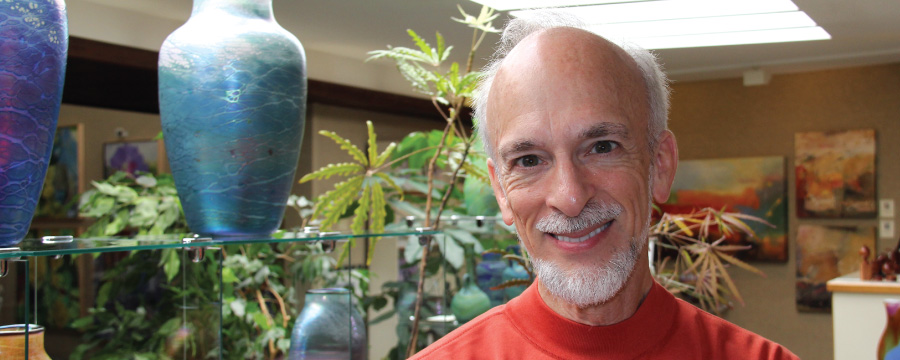 His inventory includes 1,500 original items drawn from a roster of 150 artists. There are works by masters such as Rembrandt etchings and Picasso lithographs. He has modern works by popular artists like Peter Max, Norman Rockwell, Fabienne Delacroix and Theodor Geisel, better known as Dr. Seuss. There are glass vases, sculpted ceramics and cocobolo wood bowls from Costa Rica. “I buy them all for only one reason,” Saper said. “Because I like them. What I don’t do is buy what other people are selling.” Unlike other galleries, he says he doesn’t require artists to deal exclusively with him or set their prices. “I ask only what they would like for their art.” His lower-cost location in East Lansing offers pricing advantages that benefit artists and customers. “They’re not paying the premium that they would at a big city gallery.” But for the right works, they can still pay handsomely. There is art in his studio priced as high as $140,000. But that isn’t what sustains his base of 7,000 active customers. “A great gallery doesn’t have to be expensive,” Saper said. Some of his art sells for as little as $20. It is the mix of works, styles and price points that Saper says account for the 10,000 transactions he’s made since opening for business in 1978. He cited revenues over that time of “eight figures” or, more broadly, “a million dollars a year over 36 years.” It’s the personal touch, the attention to customer needs, that has made him successful. Saper manages his gallery as if it were his home; customers are welcomed as guests and they often leave as friends. Saper started his gallery business in his first home on Bailey Street before moving to Albert Avenue in 1986. He designed the gallery, which is recognized for its creative use of lights and space. It reflects his artistic side, music, most notably. While a student at MSU, Saper played viola in the school’s chamber orchestra and symphony and later sat with the Lansing, Saginaw and Flint Symphonies. His academic studies have a harder edge — computer science, engineering and economics. Together, these create a very savvy business persona. And no, Saper does not paint or sculpt. “There is no need for me to ever attempt it,” he said. “I’d rather enjoy what others are doing.” What Saper has been able to do is translate a passion for customer service to his website which, while not particularly sophisticated, is functional, friendly and informative. “There’s not a lot of flash” he said. “This is what people want: see it quick, see what it costs and communicate with the seller.” “The website cost us zero to build,” added Saper. “A large percentage of the people will have a good experience and will come back. And then the next week they come back and order something else. It’s the basics: show people what you have, respond quickly. We respond so quickly people can’t believe it.” Customers praise Saper the gallery website. There are dozens of testimonials from across the globe — a power sales tool, according to Saper. Nagisa from Wakayama, Japan writes “Hi Roy, actually, that was such quick delivery, so I was surprised. Delivery was perfect. The art works are splendid. Thank you.” Or from Lynn, in Calgary, Alberta Canada “Roy, I just wanted to quickly touch base and let you know that my son absolutely loved the Jeff Margolin sculpture that we got for him for graduation. This special occasion was made even more so by this unique art piece, and I have you to thank for making that all possible.” Closer to home, from Lansing, Bill wrote “Thanks for your enthusiasm and knowledge of the contemporary art scene and for helping us put together a collection, which we are very happy with. I love visiting your gallery and feasting on the artists’ work you represent.” The flow of conversation is continuous. Saper Galleries’ website tracks communications with a live feed feature, which highlights minute-by-minute testaments. It adds immediacy, credibility and trust to his operation. “It’s opened up a world that we never really knew existed,” Saper said. “We communicate with people overseas like we are talking with people next door.” And sometimes it happens at 12.45 in the morning. Author: Mickey Hirten Mickey Hirten is an award winning writer and editor. He has been executive editor of the Lansing State Journal, the Burlington Free Press in Vermont, and was the financial editor and a columnist for the Baltimore Evening Sun. He is the current president of the Michigan Press Association. His wife, Maureen Hirten, is director of the Capital Area District Library. First Sunday Gallery Walk Lansing State Journal online August 3, 2014 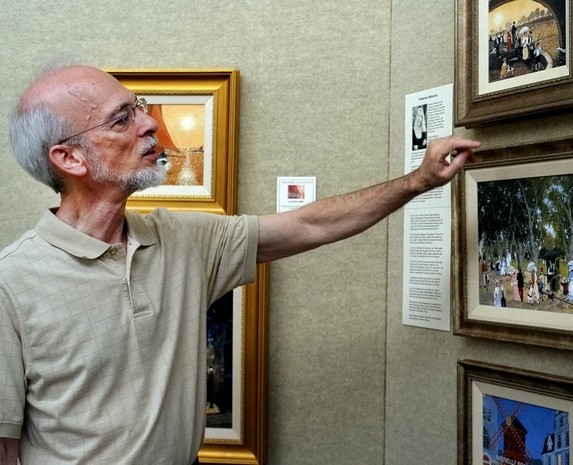 Robert Killips | Lansing State Journal Roy Saper of Saper Galleries in East Lansing talks about the work of French artist Fabienne Delacroix he has on exhibition. The gallery is open for the First Sunday Gallery Walk. 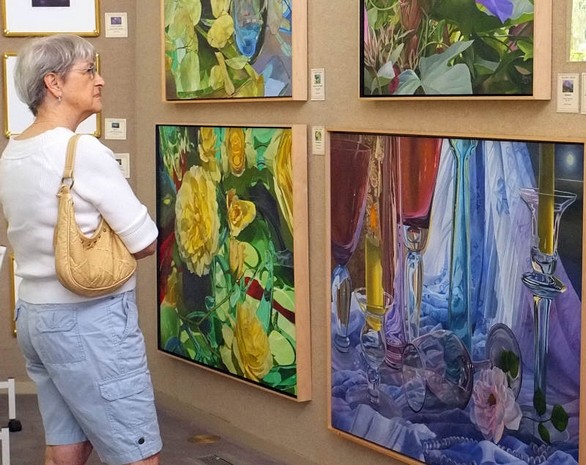 Robert Killips | Lansing State Journal Jackie Borszich looks at the smooth and luminescent oil paintings of Hilary Eddy at Saper Galleries in East Lansing as part of the First Sunday Gallery Walk. 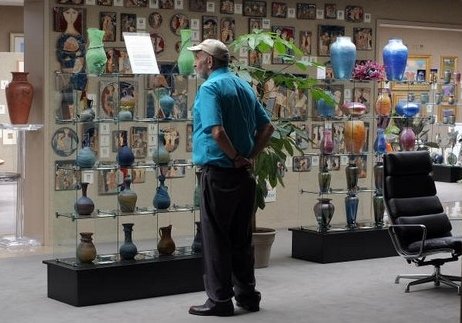 Robert Killips | Lansing State Journal A man looks at the pottery on display at Saper Galleries in East Lansing Sunday. Today's Feature: Paintings of Parisian Artist Fabienne Delacroix East Lansing, MI 8/1/2014 - 9/30/2014 433 Albert Avenue East Lansing, MI http://sapergalleries.com/Fabienne.html 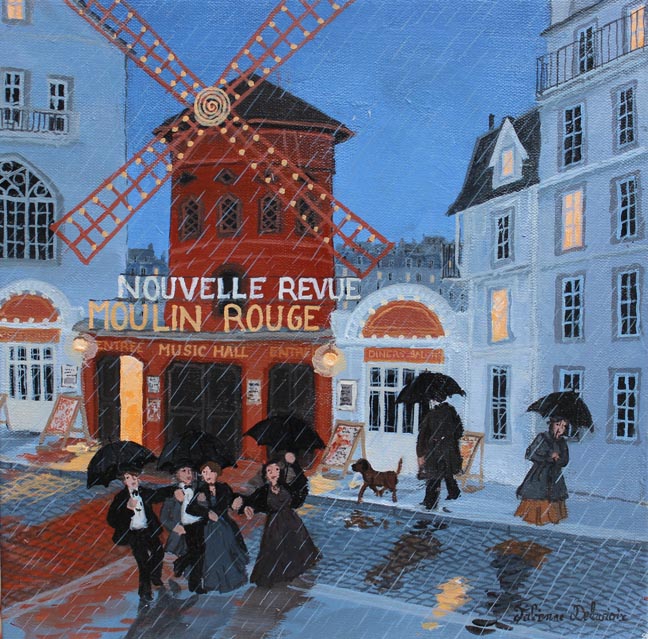 Fabienne
Delacroix is a
painter whose
works are
steeped in the
poetry of
another time.
Like her
father, the
renowned
artist Michel
Delacroix, her
quiet, lyrical
canvases are
windows on the
past - that
legendary era
of memory and
desire, when
life was sweet
and pleasures
innocent and
simple. She
paints this
simpler time
with a
nostalgia that
seems
surprising in
one so young,
until one
remembers that
the word
nostalgia has
its roots in
an ancient
Greek term
meaning "to
return home." Fabienne
Delacroix is a
painter whose
works are
steeped in the
poetry of
another time.
Like her
father, the
renowned
artist Michel
Delacroix, her
quiet, lyrical
canvases are
windows on the
past - that
legendary era
of memory and
desire, when
life was sweet
and pleasures
innocent and
simple. She
paints this
simpler time
with a
nostalgia that
seems
surprising in
one so young,
until one
remembers that
the word
nostalgia has
its roots in
an ancient
Greek term
meaning "to
return home."Home for Fabienne Delacroix is the inspirational landscape of her beloved country, France. Her province is the harmony that reigned during the Belle Époque (the "beautiful era" in France and Belgium between 1871 and 1914), that carefree period when people flocked to the French Riviera to take country walks and bathe in the waters off their shores. This point of departure, amid the glorious natural beauty of the South of France, only further illuminates Fabienne Delacroix's love of romance and extraordinary natural gifts as a painter. Fabienne's natural gifts developed with intimate schooling that few painters are fortunate to have received. Born in 1972, she is the third and youngest child of Michel Delacroix. To this day, she remembers the long afternoons of her childhood when she played away the hours in her father's studio as he quietly worked away at his easel. By the age of 10, following her family's return to France after a brief stay in the United States, she began to paint. Two years later, she showed her work for the first time at a gallery in Carmel, California, where it proved so popular that it sold out. Unlike Michel, who is best known for his cityscapes, Fabienne more often paints seascapes and pastoral landscapes. While she shares many of her father's interests, she is very much an artist in her own right. Her style and choice of subjects, often pastoral landscapes, are uniquely her own and her palette and management of color are marked by her own strong character. Fabienne displays a mastery of light and color that is similar to that of French Impressionism. She uses vibrant colors and each composition is full of detail. The mastery of her medium and her intuitive capacity to distill the essence of a land and seascape in her images have already established Fabienne Delacroix as a noteworthy artist. This summer Fabienne Delacroix's painting are being exhibited in Boston and New York and she also had recent solo exhibitions in Washington, DC, San Francisco and Japan. The artist contacted gallery owner Roy Saper about displaying her work in East Lansing earlier this year and the first seven paintings just arrived depicting families in a simpler time and place enjoying shared leisure activities in parks, villages and at sea. The paintings are small, intimate and inspired by the artist's early childhood memories in French literature and poetry. Delacroix recently returned to her native France after living in Madagascar where the earthen colors have influenced her palette. Saper Galleries is displaying the original paintings by Fabienne Delacroix through September at 433 Albert Avenue in downtown East Lansing Monday through Saturday 10am to 6pm and the First Sundays monthly from 1 to 4pm. Phone 517-351-0815 for more information or visit sapergalleries.com to link to photos of Fabienne and her artw ork. Award-winning Saper Galleries has been providing artwork and custom framing services to East Lansing and the world since 1978. The gallery displays 1,500 original works of art by 150 artists from 15 countries. Michigan's
beauty
on display at
East Lansing
gallery
EAST LANSING — Kathleen
Chaney Fritz paints Michigan scenes such
at boating on its lakes, lighthouses,
Mackinac Island, vineyards, harvests, sand
dunes and families sharing Michigan's
beauty.
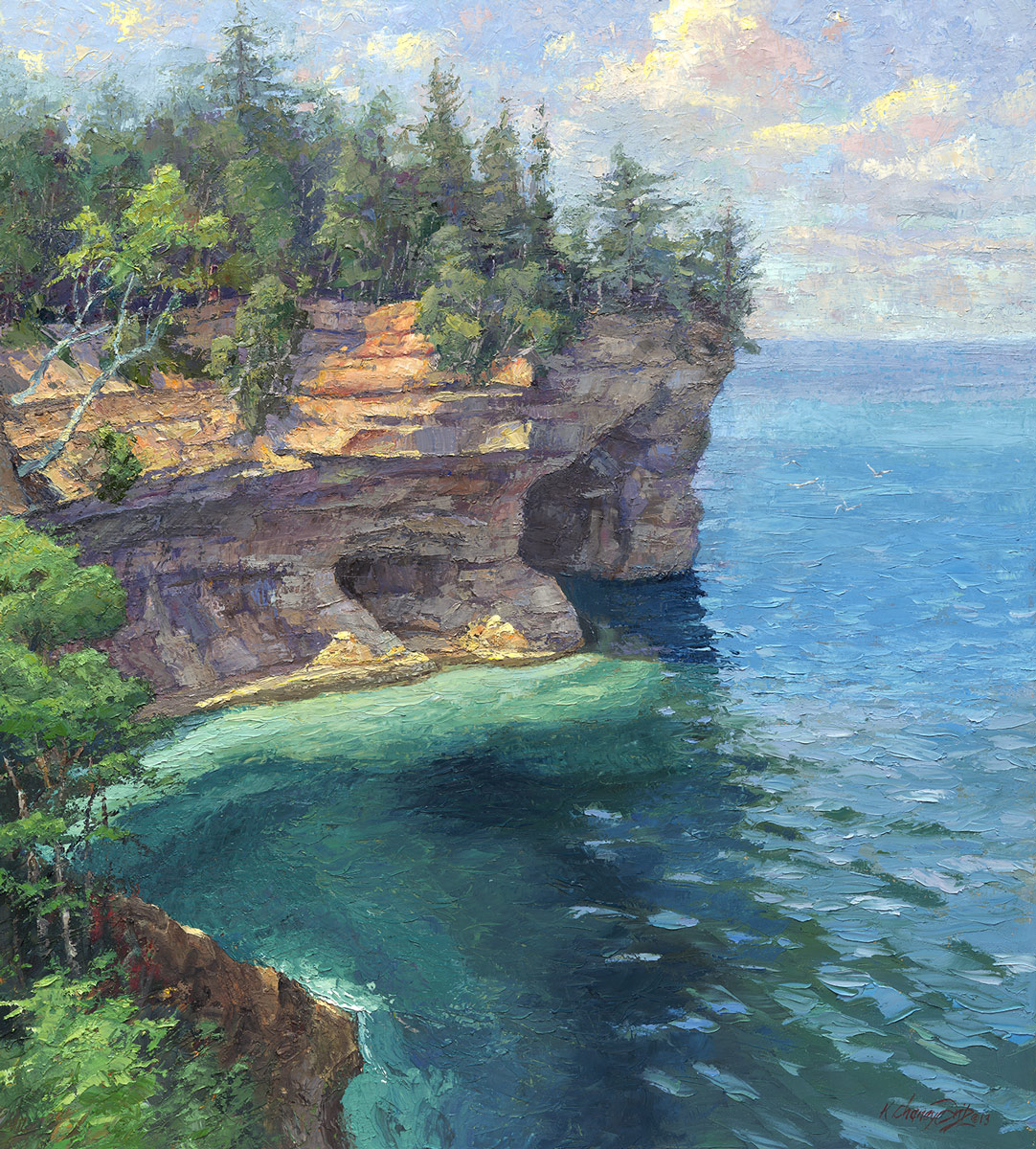 New
oil paintings by
the Michigan artist
are on display at downtown East
Lansing's Saper Galleries. New
oil paintings by
the Michigan artist
are on display at downtown East
Lansing's Saper Galleries."Her imagery is timeless; her paintings awaken the senses and allow us to revel in the beauty that is unique to our Great Lakes state," observes gallery owner Roy Saper. A graduate of Kendall College of Art and Design, Chaney Fritz worked for many years as a freelance illustrator, honing her skills in drawing and her ability to quickly deliver on a variety of projects. Since 1986 she has been a professional artist, painting Michigan scenes that viewers recognize and enjoy. More than 300 of her creations have been acquired by visitors to Saper Galleri 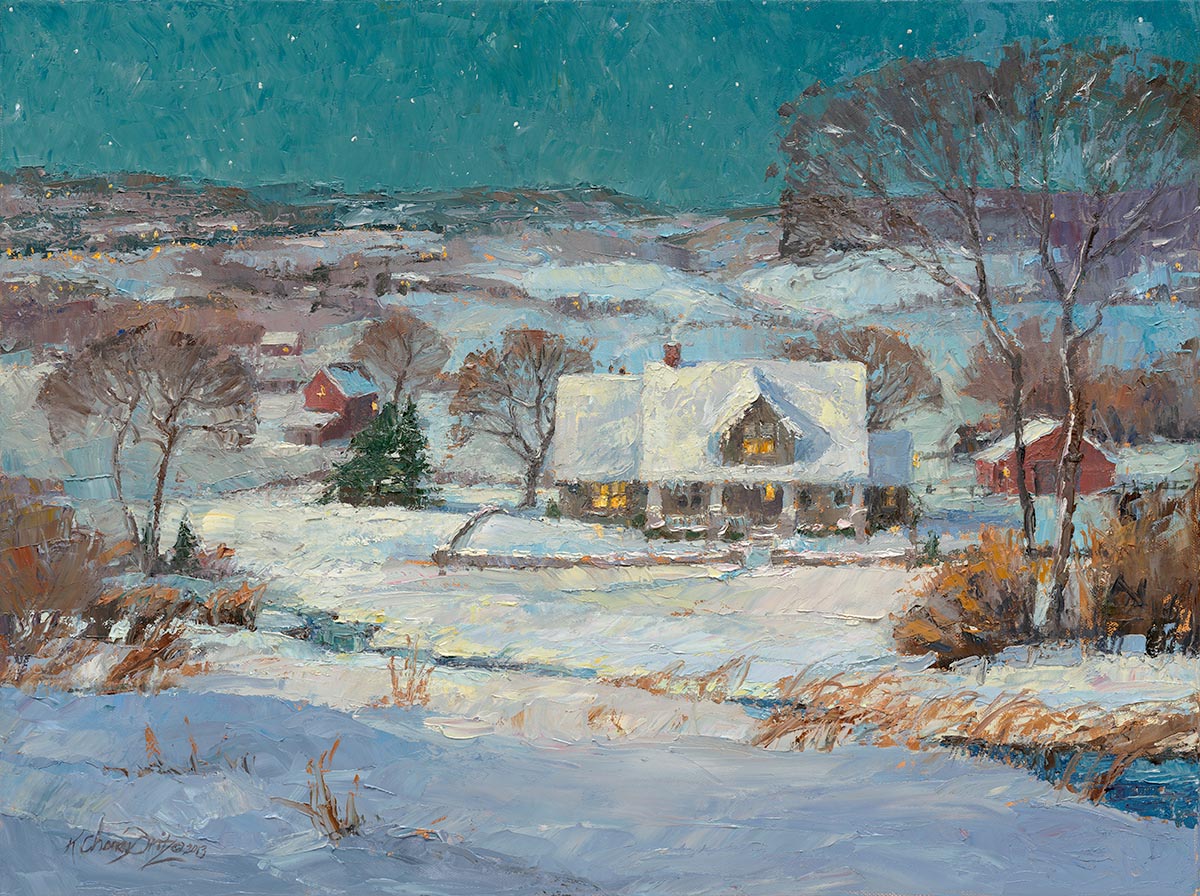 es
since the gallery started representing
her five years ago. es
since the gallery started representing
her five years ago.Her Michigan scenes display her talent to convey a special feeling, using paint, brush and palette knife . The water reflections, the shadows, the brilliant sun, the textures of flower petals, vistas all come to life in her paintings. Saper Galleries, 433 Albert Ave., downtown East Lansing, will continue to display the paintings and limited editions of Kathleen Chaney Fritz Monday to Saturday, 10 a.m. to 6 p.m. and March 2 – and all first Sundays monthly – from 1 to 4 p.m. Art Comes Alive Art Competition Cincinnati, Ohio June, 2013 Juror Roy Saper is the creator and owner of Saper Galleries and Custom Framing, a full service fine arts gallery based in East Lansing, Michigan, USA. Saper Galleries serves customers world-wide with an actively accessed website which receives inquiries from nearly 100 countries from where 48 languages are spoken. In 1986 Saper designed and built its present 6,000 square foot contemporary gallery which has won numerous awards for its design, efficiency and use of large skylights to bathe the gallery interior with natural daylight. Saper has also won awards for its marketing successes, use of computer technology, and creative management. In August, 2009 Saper was recognized with the Art Business News Gallery Excellence Award, the top honor in the United States presented to an art gallery for the success of it exhibitions. Saper Galleries was recognized by Décor Magazine as the number one American gallery in 2007 for its Picasso exhibition. The 2009 award was for its Dr. Seuss art exhibition. Saper has been recognized as the Outstanding Small Business Person of the Year by the Lansing Michigan Chamber of Commerce and was awarded the Business Arts Award by the Arts Council of Greater Lansing. Saper regularly juries art exhibitions throughout the United States and lectures on all aspects of collecting art and other topics such as the challenge of modern art, art and architecture, fakes and forgeries, art-in-public places, and other art topics. He is called on to serve as an expert witness in legal cases involving art fraud and insurance cases. Saper also serves as an art appraiser for community art evaluation events, advising people of the value of their artwork, and as a consultant to various arts organizations. sapergalleries.com | 1 Gallery Contract Award Wednesday, June 5, 2013 'We're going to keep on going' After cancer surgery, Roy Saper is proudly back to 'not normal' by Lawrence Cosentino City Pulse 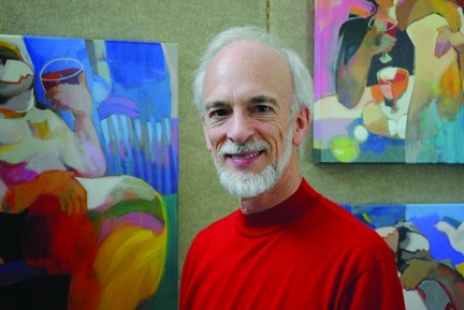 Roy Saper was
getting high
in his kitchen
last week from
making
chocolate chip
pecan waffles.
Pour,
sprinkle,
press, sizzle.
Roy Saper was
getting high
in his kitchen
last week from
making
chocolate chip
pecan waffles.
Pour,
sprinkle,
press, sizzle.I told him I needed to stop at one waffle. “No, we’re going to keep on going,” he said. “That’s the deal.” The owner of East Lansing’s Saper Galleries is persuasive enough when he’s hawking a Jiang Tie-Feng serigraph or a Tunis Ponsen watercolor. Now that he’s trumpeting the benefits of early cancer detection, he’s unstoppable. Before Saper’s cancer surgery March 14, almost everything flipped his hair-trigger enthusiasm switch. Now everything does, period. “I wore a catheter for two weeks, which is kind of cool,” he beamed. He explained that it helped him multitask. “You don´t have to go to the bathroom. It´s doing it for you.” Saper, 61, said he feels “a thousand percent better” after a radical prostatectomy and a difficult post-operation month. His doctor doesn’t guarantee he’s cancer-free, but Saper is sure that the operation saved his life. “If I can make it to five years, that´s good,” he said. “If I can make it to 10, that´s really good. I´m going for 50.” Saper’s diagnosis in early March, after a biopsy came up positive for aggressive prostate cancer, was just a hair short of there’s-no-point-in-operating. He considers any chance to tell his story, including this one, to be another reward for his "temporary inconvenience." “Waiting too long could be an end-of-life decision,” he said. “There is no question but that if I didn´t bother getting retested in early 2013 and waited a year or so, that would have been too late.” If he did nothing, Saper was told, he had two to five years to live. The cancer cells were doubling every four months. "You´d like your investments to do that," he said. Saper is an art dealer, but his training is in quantitative economics. He plots and graphs everything, from the maple syrup he makes in his kitchen to his utility bills for the last 20 years. He keeps a spreadsheet on the sap yield of each tree on his lot for each year, how much syrup was produced and how long it took to boil it down. From December 2010 to January 2013, another spreadsheet on Saper’s computer tracked an alarming 64 percent increase in prostate specific antigen. As men get older, PSA goes up, but not that fast, unless something is wrong. In January, his doctor felt a lump on his prostate and sent him to a specialist. “People who don´t go to a doctor for a physical, who don´t get a PSA test, it´s like never taking your car for an oil change after 50,000 miles,” Saper said. “It will die. It has to. It has moving parts that need to be fixed.” Saper told the doctor he was planning to go to Costa Rica to pursue one of his latest discoveries, handmade boxes made from cocobolo wood, for his gallery. "Go ahead, but don´t schedule any more trips," the specialist told him ominously. A biopsy at Sparrow Feb. 23 came back positive for cancer. On the Gleason scale, used to measure the aggressiveness of cancer, scores of 8 to 10 are often considered inoperable because the disease has probably spread to the bones. Saper’s Gleason score squeaked in just under 8. Ever the empiricist, Saper tossed a jar of crystalline syrup marked “March 9” onto the table. “It takes 42 gallons of sap to make one gallon,” he said. “I just boil it up here while I’m doing computer work. Free maple syrup. You can’t get any more local than that.” Five days after Saper boiled that jar of syrup, he was in pre-op at Sparrow Hospital. “They used the Da Vinci laparoscopic robotic method to do a radical prostatectomy,” he said, arching his art dealer’s brow at the mention of Da Vinci. “It was the coolest thing.” While waiting on the operating table, he peered across the room at the surgeon’s console. “His fingers are in little rings and there are foot treadles, like on an organ,” he said. “It´s totally science fiction.” The Da Vinci machine is used in several types of operations, including prostate removal, to minimize invasiveness and increase precision. “It’s fascinating,” Saper said. “These five robot arms go inside my body. One´s a camera, one´s a light. He´s got cutters, slicers, suture things. Look on YouTube for videos.” (Note to male readers: Do not do that.) Saper said they removed his prostate, seminal vesicles and “some other stuff,” including the part of the urethra that passes through the prostate. “They hack that off, then they take the bladder, and bring it back down and connect the urethra to it, stitch it back up,” he said. “Total reconstruction of your insides.” Anesthesia might have something to do with Saper´s blithe description. All he remembers about the five-hour procedure is quizzing the anesthesiologist on the function of each person in the room as she wafted the mask in his face. “After about three of those, I was in the recovery room,” Saper said. But the memory of what happened after surgery tripped Saper’s hard-to-find “pause” button. “This is terrible," he said softly. "This is terrible.” After surgery, they rolled him to his room, put his feet on the floor and told him to take two steps to bed. “No way,” he said, and fainted. He bit his lower lip as he fell, spurting blood. A few days later, when they tried to get him out of his bed into a chair, he fainted again. Never a man with flesh to spare, Saper hadn’t had anything to eat for days. Anemia and fluid loss were a major worry. His weight neared 120 before finally inching back up. “I wanted to die,” he said. “I thought, ‘I just can’t do this.’” In the weeks after his surgery, Saper’s savor for life was tested further. His well-traveled world shrank to one corner of his art-filled home, designed by modernist architect Alfred Browning Parker for a General Motors executive in the 1960s, now pressed into service as an infirmary. For a month, Saper barely got up from the low-slung leather sofa in his living room. Next to the couch, a black slat coffee table designed by modernist George Nelson was festooned with a Foley catheter bag and drainage tubes. Staying hydrated was a constant problem. “I watched the fluids drip, trying to imagine whether I would ever go back to work and the computer and ever eat a real meal or dine in a restaurant again,” he said. Saper still looks alarmingly thin, but he got his restaurant wish. Over the Memorial Day holiday, he went on a 1,700-mile road trip with his wife, Nell Kuhnmuench, to visit their two sons: Jay, 22, graduated that weekend from Middlebury College; Adam, 27, goes to law school at New York University. One of the first things Saper did upon recovery was to resume a genealogy project he started back in the 1970s. “When I feared I was checking out, that was the first thing I thought of,” he said. “That’s the greatest gift I could leave my kids. I’m anxious to get this going.” This month he dug into a backlog of art-related inquiries. He gets frequent requests to help with court cases involving art fraud and evaluates art for estates and probate cases. “I had a two-month break, but now I´m back at it,” he said. “I’m not a retirement kind of guy.” Saper is also looking after his own parents. His dad, 96, lives half a mile away and is “slowing down.” His mother, 95, has Alzheimer’s and doesn´t always recognize him. He visits them both nearly every day. But the main focus of his life, other than family, has always been the gallery. Saper Galleries started shortly after its namesake came to Michigan State University in 1969 to study music therapy. For a while, Saper took a detour from art under the influence of a charismatic professor, Carl Page (father of Google co-founder Larry Page), ending up with a bachelor’s degree in engineering from the Department of Computer Science. After graduating, Saper did economic forecasting for then-Gov. James Blanchard, but his side job — an art dealership he ran from his house on Bailey Street, was more rewarding. “I needed to do the art thing full time,” he said. “I remember going to the Harvard Co-op at 12, 13 and buying prints. Some people collect music or books or go to films, are fanatics about baseball. That was the thing I connected with.” Saper’s itch for quantification still came in handy. When he talks about art, the fusion of passion and commerce is so complete it’s a wonder he ever considered any other vocation. “When one sees a work of art that is a joy, if you like it, you have to get it,” he declared. “I guess that´s maybe what love is, if there is a definition: when you see something, someone, and you want to have that connection, long term.” That can be slippery concept in love, but in the art market, long-term connections are neatly quantified. For years, Saper’s routine was to get to the gallery a little after 8 a.m., work a full day, go home for a family meal, and return to the gallery until midnight. But Saper is too gregarious with clients and walk-ins to be as productive as he would like at the gallery. In recent years, he started doing more work at home, a habit that set him up well for the latest phase of his working life. Last week, he started coming back to the gallery for short trips. “I´d rather be going to work every day than to be visited by relatives every year, 6 feet under,” he said. Work is just one of a long list of things Saper wants to do with his next 50 years. There are books to read, ancestors to trace, sons to advise. Chances are he´ll do more than one of those things at once. He’s reaching new heights in Saper-tasking, even without a catheter. Standing at the kitchen counter, brushing his teeth, he exercises his legs with a rubber therapy band while reading a trade magazine, listening to music and scanning the computers out of the corner of his eye for new emails. He isn’t getting chemotherapy or radiation treatment, but every Thursday, he goes to the doctor’s office for physical therapy and white-knuckle electrotherapy to further wake up his bladder muscles. He admits that electric butt probes are no fun, but it’s part of a trade-off for which he is profoundly grateful. “It´s no big deal,” he said. “I can walk, I can see, I can think. The mind is the same. It´s just a lot of parts were cut out. I am back to my old normal, which is proudly not normal.” The Art of Local Sustainability Published on May 14, 2013 Roy
Saper, owner of Saper Galleries in East
Lansing, MI talks about the importance of
doing business locally, and how that ties
into the bigger picture of sustainability.
Creative, innovative, and entrepreneurial,
Roy shares his thoughts on how art might
hold some of the answers to the questions
we're dealing with as a culture.
(Starts at 0:57) Saper Galleries to Exhibit Costa Rican Boxes Lansing State Journal May 2, 2013 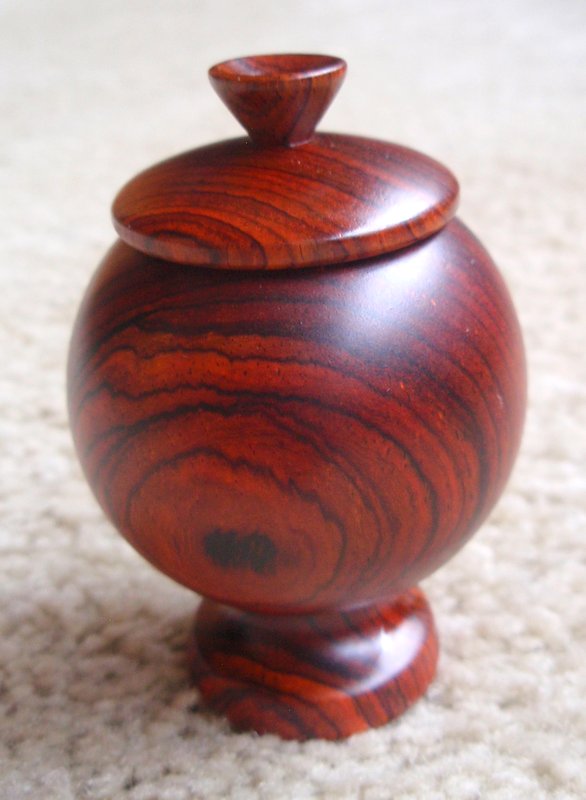 EAST
LANSING —
Highly-polished,
unique boxes
crafted from
wood from
cocobolo trees
in Costa Rica,
will be
featured at
the first
exhibition to
celebrate
Saper
Galleries'
35th
anniversary
this Sunday,
May 5 from 1-4
p.m. The
exhibition is
free and open
to the public. EAST
LANSING —
Highly-polished,
unique boxes
crafted from
wood from
cocobolo trees
in Costa Rica,
will be
featured at
the first
exhibition to
celebrate
Saper
Galleries'
35th
anniversary
this Sunday,
May 5 from 1-4
p.m. The
exhibition is
free and open
to the public.In 2011, gallery owner Roy Saper discovered the rosewood-like richly grained and colored boxes and brought back to his downtown East Lansing gallery dozens of the boxes. Having sold most of those he purchased soon after returning to Michigan, Saper returned to Costa Rica in March, 2013 to track down the artisans and select more than 200 boxes to bring back for the gallery's first 35th anniversary exhibition opening this Sunday at Saper Galleries, 433 Albert Ave., downtown East Lansing. Saper Galleries opened Art Festival weekend in 1978 and has grown from a local business to one with a sizable international clientele from more than 100 countries, winning many awards for its exhibitions over the past 35 years. In rural Costa Rica, Saper located the artist workshops which were found by continually asking locals while driving the countryside. "The workshops do not have addresses and emails and phones just don't exist for most," observed Saper. 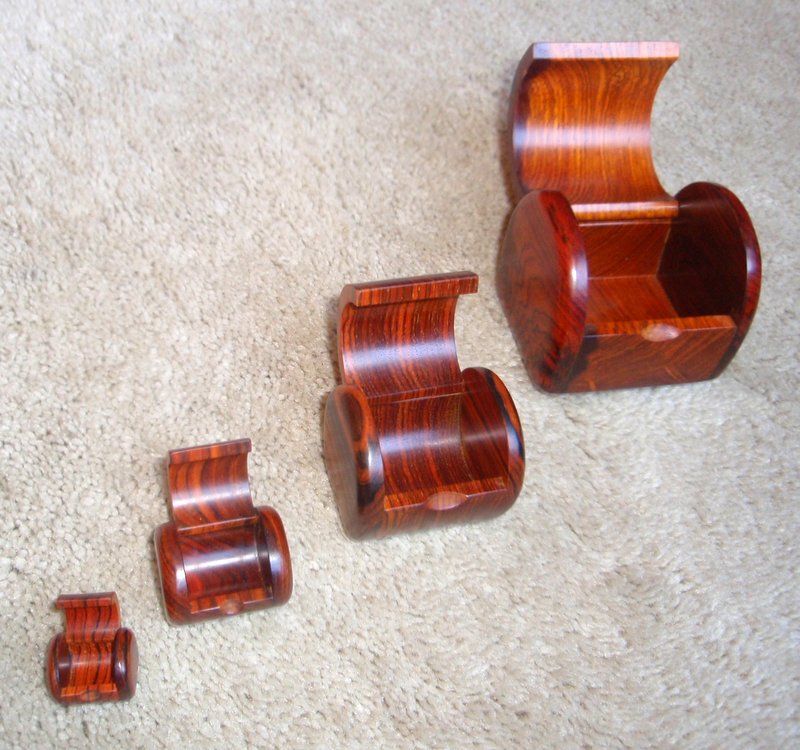 "That is why I revisited Costa Rica: to find the artists and bring their creative craft back to the United States." Saper Galleries is the only North American gallery carrying the cocobolo boxes as the artists do not export them out of their country. "It is fascinating to watch logs of cocobolo being transformed into polished boxes that collectors will use to contain their jewelry and special mementos," noted Saper. "The process involves sawing logs of the rare but sustainable cocobolo tree to smaller pieces that are trimmed, shaped, assembled, sanded and polished by hand in sawdust-laden workshops open to the air in the rural countryside." Galleries is open Monday through Saturday, 10 a.m. to 6 p.m. and the first Sundays monthly from 1 to 4 p.m. For more information and tour detail, contact the gallery at (517) 351-0815 or through the sapergalleries.com Web site. City Pulse Wednesday,
March 27, 2013
Finding fair trade in E.L. by Terry Link Fair trade or free trade? How many understand the differences between them? As many of you know, I prefer fair trade, buying local when possible and linking the local with the global. Perhaps you’ll see the advantages as I do. I recently visited Saper Galleries, 433 Albert Ave. in East Lansing, and marveled at the breathtaking art Roy Saper showcases from around the world. Two exhibits caught my eye immediately. One was elegant glass pieces from Hebron, the other handcrafted wood creations from Costa Rica. I asked Saper about his method for finding such artwork from remote places and getting them back to mid-Michigan. The stories are, in typical Saper fashion, rich in detail and a feast for the ears. It turns out his venture to Hebron was ostensibly to visit his son Jay, who was doing a semester abroad in that region. He had heard about the glasswork done by some artists in Hebron and had seen a few pieces at Kirabo, a fair trade store a few blocks west of the gallery (see below). So, despite warnings not to travel to Hebron, he and Jay made the journey to find an artist still creating these unique glass works. Perhaps more interesting is Saper’s approach to buying art when he visits artists around the world. He asks them what they want for it and simply pays it. No quibbling, no seeking discounts for buying multiple pieces. If Saper likes the art and feels others will, he wants the artist’s trust so he can come back in the future and acquire more. The pieces he brings back may not be “certified” fair trade, but what could be fairer than paying the full price the maker asks? The woodworker in Costa Rica — whose beautifully crafted boxes and other pieces mesmerized Saper in a market there — was harder to track down. He had to rent a car and drive into the rural areas to find him. Limited language skills prevented an extensive conversation but, again, Saper paid the artist what he wanted for his work. How many of us get paid what we think our time and talents are worth? Saper not only brings our community great beauty and tremendous craftsmanship from the hands of gifted artists, he supports their work and helps make them more prosperous. He links the local and global, as we should. Gail Catron sells handmade goods from around the world at her East Lansing shop, Kirabo, 225 E. Grand River Ave. Catron doesn’t do nearly the amount of globetrotting Saper does, but she is committed to selling only fair-trade products in which the artisans receive fair wages and treatment. Catron finds and uses suppliers who themselves are Fair Trade Federation members, which requires them to meet a fair trade “Code of Practice.” Gail also has relationships with others she has met, like Ugandan activist and author Jackson Kaguri, who is building schools in rural Uganda. Kaguri provides her with handmade items that she sells at Kirabo, with 100 percent of the sales returned to help fund the development of the schools. Where we shop matters! Adding these beautiful things to our lives from locally owned shops committed to fair trade can simultaneously build a better society here and abroad. [article clipped.] (Consultant
Terry Link was the founding director of
MSU’s Office of Campus Sustainability and
recently retired as director of the
Greater Lansing Food Bank. He can be
reached at link@lansingcitypulse.com.)
Exhibit featuring new work of magic realism painter Rob Gonsalves opening at the Saper Galleries in East Lansing By Zeke Jennings | zjenning@mlive.com on February 01, 2013 http://www.mlive.com/lansing-entertainment/index.ssf/2013/02/exhibit_featuring_new_work_of.html Rob
Gonsalves' "The Chalkboard
Universe," depicting Albert Einstein
lecturing to students in front of a
chalkboard where equations gradually
morph into the cosmos.
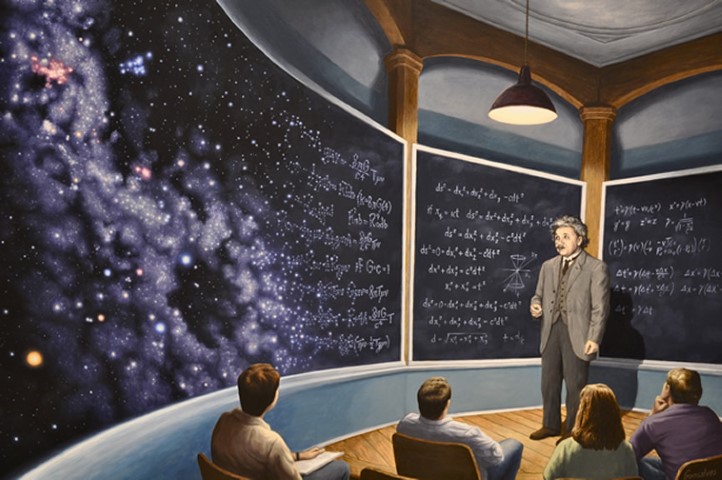 EAST LANSING, MI – A special exhibit featuring the work of Canadian magic realism painter Rob Gonsalves will open Sunday, Feb. 3, at the Saper Galleries, 433 Albert Ave. Gonsalves’ artwork has been displayed all over the world and has been the subject of several books published by Simon & Schuster. Gallery owner Roy Saper describes Gonsalves’ work as “appealing to all ages.” “This is a wonderful indication of the universal language of art and the reason for now displaying Gonsalves' most recent images which have not been seen before in this area," Saper said. The opening reception will be from 1 to 4 p.m. Sunday. The exhibit will remain on display through March. Gallery hours are 10 a.m. to 6 p.m. Monday, Tuesday, Wednesday, Friday and Saturday and 10 a.m. to 9 p.m. Thursday. The gallery is open from 1 to 4 p.m. the first Sunday of each month. Admission is free. For more information, visit sapergalleries.com or call 517-351-0815. Saper Galleries Unveils 'Magic Realism' Pieces By Brytanie Killebrew The State News February 4, 2013 http://statenews.com/article/2013/02/saper-galleries-unveil-magic-realism-peices Saper Galleries and Custom Framing brings realism, surrealism and illusionism to East Lansing. The gallery, 433 Albert Ave., opened “The Magic Realism of Rob Gonsalves” exhibit to the public yesterday from 1 to 4 p.m. Saper Galleries owner Roy Saper, an MSU alumnus, was excited for people to experience Gonsalves’ work. “This guy is so inventive,” Saper said. “I really like his work and he’s a great person.” Rob Gonsalves is a Canadian-born artist whose work captures both surrealism and illusionism. The exhibit contained 11 of Gonsalves’ framed and unframed works that are available for purchase. Each piece is something Saper believes is understandable for both children and adults. “This is art for the 100 percent, not the 1 percent,” Saper said. “Rob Gonsalves would appeal to everyone.” Saper admires how effortless and “outside of the box” Gonsalves works are. “He starts with a white box and turns it inside out,” Saper said. It has been nine years since Saper Galleries held an exhibit of Gonsalves’ work. In 2004 the gallery displayed 67 pieces by the artist, who also attended the event. According to Saper, Gonsalves’ work, along with every piece displayed in the gallery, was chosen because of his personal enjoyment. “I wanted to introduce the community to an artist who is current, young and significant worldwide for his work,” he said. Aside from displaying works, Saper said he also enjoys working with MSU students. “I love MSU students coming more than anyone else,” he said. “Too often on campus (they’re) stuck in the grind of going to class, going to the cafeteria and studying. This place offers students a break.” Saper believes the gallery is a great place for students to discover and learn about art. In the past, he has spoken to a group of education and poetry students about art and poetry, as well as human medicine students about the calming effects of art. “A lot of classes come here. This is a classroom … And what better place to learn and discover than here?” Saper said. MSU alumna Michelle Jekel attended the exhibit and appreciated Saper’s wide selection of works. “I always come back to roam MSU’s campus. I’m really glad I came in,” she said. Suzanne Lowe, who considers herself an appreciator of art believes Saper Galleries is great for the community. “We are very fortunate to have Saper Galleries here,” she said. “The Magic Realism of Rob Gonsalves” will be displayed throughout March. Saper
Galleries Brings
Global Art to
Capital Region
Walking
into Saper Galleries makes
an art-lover's heart beat
faster: paintings on large
canvases and small;
landscapes, portraits and
abstracts; sculpture in
silver, stone, bronze or
marble; intricate boxes of
polished wood; hand blown
glass in gleaming colors
or muted hues; mobiles
that sway gently overhead.The Greater Lansing Business Monthly February 2013 "The biggest problem p  eople
have when they come to my
gallery is that there is
just so much here that
people love," said gallery
owner Roy Saper. "It's
hard to
choose." eople
have when they come to my
gallery is that there is
just so much here that
people love," said gallery
owner Roy Saper. "It's
hard to
choose."Walking through the gallery is like visiting a fine museum where appreciative visitors can find something beautiful to suit every taste, every mood and every occasion. And if the art lover doesn't find exactly what he/she wants, a word to the owner will suffice. Besides everything on view, there is an impressive collection that isn't currently being displayed. And, failing that, Saper can probably find just what the buyer wants by searching it out though his connections with the art world and making it available to the purchaser. With 1,500 pieces of art in the collection and work by more than 150 artists from 15 countries, Saper Galleries is the end of the rainbow for those looking to enhance their environment with art. Saper, the man behind the galleries, has been fascinated by art from an early age. He studied viola as a boy and attended high school at Interlochen Arts Academy where he was surrounded every day by the arts in all their diversity. Even at the age of 14, he began collecting pieces of art that spoke to him. After high school, he attended Michigan State University, initially with the intention of majoring in music therapy. However, he found himself drawn to a completely new field — computers. This was in the late 1960s when the world of technology was in its infancy. Saper ended up as one of the first-ever MSU students to graduate with a degree in computer science. He went on to complete the course work for a Ph. D in economics, but his path led him in another direction. "In 1978, I started selling art out of my home. My first customers were not people in the area. Rather, because I had unique works of art, people from outside the community traveled to purchase pieces from me," said Saper. "I acquired the land, the last vacant parcel in downtown East Lansing, for the current gallery in 1985. In preparation for my first show in the new space, I contacted well-known community figures and asked them that if they could acquire any work of art, what would it be? Then I went out and bought art by the artists they had chosen. I had work by Calder, Chagall, Picasso and other well-known artists. That's how I began building the collection I have now." For 34 years, Saper has been making available to people the works of art that people want, works of high-quality that are very desirable. "Our phenomenal success came about not only because of what we have available but also because we treat every single person who comes through our doors with respect," said Saper. "We give them time, courtesy and dedication; we are interested in their opinions. It's more than the Golden Rule; we treat people the way they would like their parents and grandparents to be treated! You can see by the testimonials on our website that our customers appreciate the way we do business." Saper travels the world to buy pieces of art; he was recently in Israel where he purchased a quantity of ceramic relief work by Ruth Faktor. He has traveled to Costa Rica for hand crafted boxes, bowls and trays made of cocobolo wood. He goes often to New York City and others centers of the art world. But he also welcomes artists to his gallery who come in to show Saper their work. Close to 1,000 artists each year visit Saper hoping to interest him in their work. He says, '"If I like it, I buy it. And I don't buy just one piece. When I visited Israel, I ended up purchasing 150 pieces by Ruth Faktor. I don't look at resumes, reviews or lists of where an artist has exhibited. What's important to me is whether or not the art speaks to me. " Saper is always learning, he says. He continues to seek out work from relatively unknown artists, and his interests are vast. His expertise is similarly panoramic. He is often called upon to make presentations, write articles and even testify in cases of art fraud. Saper Galleries offers art at prices ranging from $20 to six figures. There is also a full-service framing center. He says, "Our business model is different from most businesses. Yes, we want to make money, but we want to do it in a way that honors our customers. We offer everything at a fair value and always keep respect for our customers and our artists foremost in our minds. That model has served us well." For Saper and his three employees, the art "business" isn't 8 to 5. The gallery has an interactive website, live chats, and they are always available by phone. They do a great deal of business with people outside of Michigan and outside of the United States via phone or Internet. And, even though the gallery is busy, every customer can expect personal service and a genuinely positive experience. The gallery itself is large with art at every turn. Natural light flows throughout the rooms, and art is grouped to its best effect. It's easy to understand why people find visiting the gallery a moving experience. And it's easy to see that Saper's artistic vision has created an environment that is filled with beauty, imagination and inspiration. Saper Galleries 433 Albert Ave. East Lansing, MI Phone: (517) 351-0851 www.sapergalleries.com Saper Galleries to exhibit enchanting world of Rob Gonsalves Lansing State Journal Jan. 29, 2013 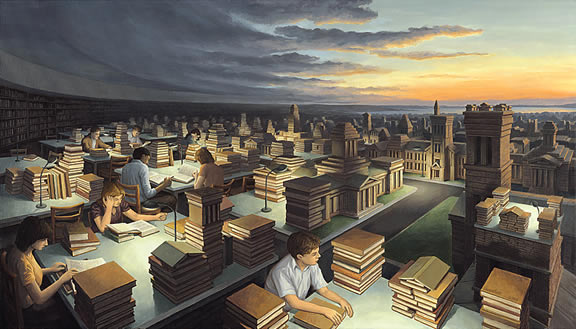 Books stacked
high become Towers of Knowledge on
tables where students are studying
under mysterious lighting. /
Courtesy photo
EAST LANSING — Imagination and creativity inspire Rob Gonsalves’ magic realism. What appears at first glance to be normal, realistic scenes, can become mesmerizing, captivating depictions of an enchanting world to an observer. A Gonsalves’ image is a visual double entendre, a second meaning appears to counter the expected, often eliciting a smile, according Roy Saper, owner of Saper Galleries in East Lansing. For example, In Gonsalves’ “Sailing Islands,” tall pine trees by a water's edge morph into sailing ships with tall masts. Books stacked high become his “Towers of Knowledge” on tables where students are studying under mysterious lighting. A view across a river of a Manhattan-like skyline with lights dotting skyscraper windows at dusk changes to a forest scene, the tall buildings becoming a thick forest of evergreens in a snowfall in Gonsalves’ “Light Flurries.” An exhibition of Gonsalves’ artwork will open at Saper Galleries Sunday, Feb. 3, 1-4 p.m., in downtown East Lansing. It is the second time the local gallery has exhibited his work. "Since we first displayed 67 Rob Gonsalves artworks in 2004, collectors have purchased from us close to a thousand of his prints on canvas and paper ... ," Saper said. "We have shipped them worldwide as guests from more than 100 countries have viewed the Gonsalves images on our web site ... .” Saper Galleries first exhibited Gonsalves artwork with a major exhibition of 67 limited editions on canvas and paper in late 2004. Simon & Schuster has published three books of Gonsalves' paintings, the award-winning "Imagine a Day," "Imagine a Night," and "Imagine a Place". “This is a wonderful indication of the universal language of art and the reason for now displaying Gonsalves' most recent images which have not been seen before in this area," Saper said. Saper Galleries, in its 35th year in downtown East Lansing, has won numerous national and international awards for its exhibitions. In this Rob Gonsalves
work, entitled, 'In The Chalkboard
Universe,' a professorial Einstein is
lecturing to students in front of a
chalkboard where equations gradually morph
into a depiction of the cosmos. / Courtesy
photo
If you go...The exhibition of artwork by Rob Gonsalves opens Sunday, Feb. 3, from 1 to 4 p.m. at Saper Galleries, 433 Albert Ave., downtown East Lansing, phone 517-351-0815. The exhibition continues through March. Hours of operation: Monday through Saturday 10 a.m. to 6 p.m., Thursdays 10 a.m. to 9 p.m., and the first Sundays monthly from 1 to 4 p.m. The State News Michigan State University By Katie Ziraldo | Published October 5, 2012  Elementary education student Alyssa
O’Connor looks at Hebron Glass Collection vases at
Saper Galleries, 433 Albert Ave., on Thursday,
Oct. 4, 2012. O’Connor was there with her poetry
class. Julia Nagy/The State News
Hidden away in Hebron, the
largest city in the West Bank, is a form of
artwork rarely seen outside the Middle East.
Using a long metal hollow tube, the artist picks
up molten recycled glass in an 1,800-degree
furnace and then blows through the tube to
expand the glass.
The efforts result in a type of artwork most Americans would be unfamiliar with. That’s why Roy Saper, the owner of Saper Galleries, 433 Albert, wanted it for his gallery. “I knew about the Hebron glass, and I knew it was really rare and nobody could ever go to Hebron because it’s a war zone,” Saper said. “It’s a very dangerous place to be, like much of the Middle East. But I knew I had to go there.” 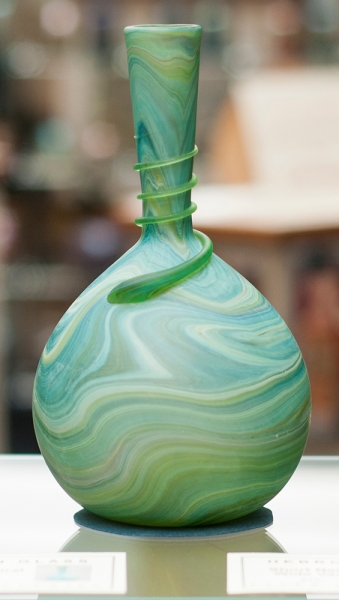 A
Hebron Glass Collection vase is on display
at Saper Galleries, 433 Albert Ave., on
Thursday, Oct. 4, 2012. A
Hebron Glass Collection vase is on display
at Saper Galleries, 433 Albert Ave., on
Thursday, Oct. 4, 2012.Saper’s mission was easier said than done. He said the experience of going to Palestine with his wife and son was unreal. “What I learned is it’s easy to get in, but hard to get out. To get out you have to go to Israel, and they don’t let just anybody out. If you have some kind of Palestinian connection, there will be difficulties.” Saper said the Hebron glass now is a rarity. “There were 14 studios in Hebron making glass, and now there is only one family, after glass has been produced in Hebron for a couple thousand years at least,” Saper said. “They’re down to the last family. My feeling was I have to go there and get that glass and bring it back … It’s really exciting to get to share something with our community like that, that they would never see otherwise.” The owner’s drive to display rare artworks is not a new passion. “For 34 years what I’ve done is make every effort to display for our community works of art that they otherwise would never see,” he said. It is this quality that makes Liz Fuller, a Saper Galleries employee, so pleased with her work. “Every day is a learning experience,” Fuller said. “It’s an amazing place to work, especially being an artist and getting to see everything we have here.” Art history and visual culture professor Susan Bandes said it is important for people, especially college students, to experience art from other parts of the world and know its history. “I think it gives us a broader perspective than we normally would have, and it also puts current events into a cultural context,” Bandes said. Saper said the collection is the perfect opportunity for Americans to experience other cultures. “It’s totally unique and different, and nobody will see it this large and significant anywhere else in this country,” Saper said. The Hebron Glass Collection will be on display at Saper Galleries for the month of October. Rare Hebron Glass
Collection to be Exhibited in East Lansing
|
| Art Business News,
a national business publication
serving the fine-art market,
recently honored Saper Galleries
in East Lansing, Mich., with the
2009 Gallery Excellence Award
for Best Gallery Event. The inaugural program—which pays tribute to the nation’s top art galleries across the United States—is judged by a panel of industry experts who distinguish the nation’s top-performing galleries in five art-related categories. “Saper Galleries literally ‘stole the show’ for Best Gallery Event, thanks to their strategic event planning, community outreach and, of course, phenomenal results,” Art Business News Managing Editor Jennifer Dulin Wiley says. The Saper exhibition “The Art of Dr. Seuss” was cited as the top exhibition of all art galleries in 2008 in terms of scholarship, breadth and detail of exhibition, planning and implementation, and community involvement and visitor responsiveness. Saper Galleries will be featured with the four other Gallery Excellence Awards winners in the magazine’s September issue, and each will receive a commemorative award to display the accomplishment in their gallery. “We are so honored to have received the call telling us of our having been selected as the top exhibition gallery for 2008 in this inaugural program,” noted gallery owner Roy C. Saper. “I have always strived to create for our community, gallery visitors and friends the very best exhibitions possible, showing artworks that have never been brought together before and presenting them in a manner that is exciting, informative, and relevant – and totally free to the visitor.” Saper buys the art to form the exhibitions he creates, using the art to present a story of the artist’s life, enlightening the public on the importance and relevance of the artists exhibited. An early exhibition displayed original Norman Rockwell paintings and drawings. Later he displayed the 50 “best” Audubons from the artist’s Birds of America portfolio. The popular Peter Max exhibition was the largest and the Pablo Picasso exhibition received the most international attention, winning Saper Galleries the top gallery of the year award for exhibitions in 2007 as determined by Décor Magazine. The 2008 Dr. Seuss exhibition opened the eyes of more than 20,000 visitors who learned that there is much, much more to Dr. Seuss (author-painter Ted Geisel) and his life than most people knew. Recently Saper appeared with Seuss’s widow, Audrey Geisel for the dedication of a Lorax sculpture in LaJolla, California. The mission of the Gallery Excellence Awards program is to strengthen and invigorate the art industry by recognizing successful retail gallery practices nationwide. The awards give magazine subscribers the opportunity to learn more about effective art-business practices from the nation’s top galleries. According to the U.S. Census Bureau there are 6,328 galleries in the United States. Art Business News is a respected B2B publication that has been serving the fine-art industry for more than 30 years. The monthly magazine is distributed to readers across the United States, Canada and overseas. Saper Galleries (www.sapergalleries.com) is an internationally respected full service art gallery which represents 150 of the world’s better artists. It was founded by Roy Saper in 1978 in East Lansing, Michigan and serves clients throughout the world providing art of every medium for homes, businesses, public art installations and special commissions. |
Treehugger.com
Photo of Saper Galleries solar panels and part of roof garden
http://www.treehugger.com/slideshows/treehugger-exclusives/treehugger-readers-edible-container-gardens/page/5/#slide-top
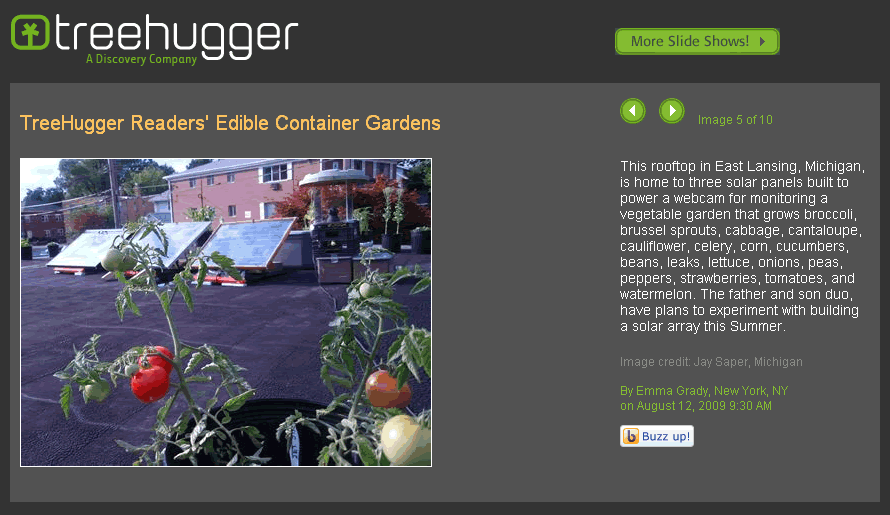
Saper Galleries' "Dr. Seuss" Wins National Honor
Towne Courier
Sunday, August 15, 2009
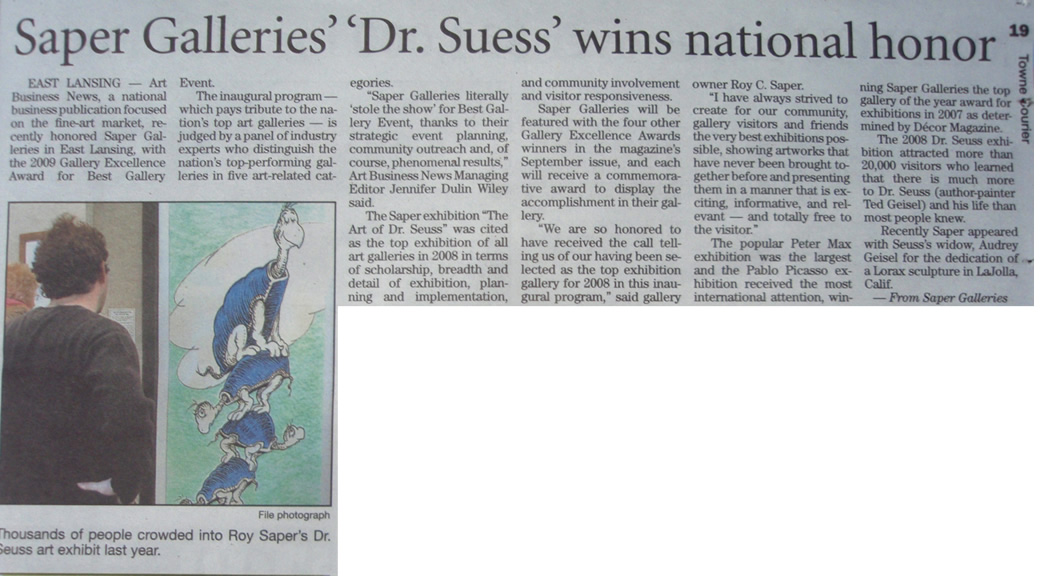
LansingCityPulse
Wednesday, March 25,2009
LOCAL BUSINESS PROFILE: SAPER GALLERIES
Not your parents´ art: Saper Galleries puts a personal touch on art dealing
When
you think of an art gallery, what comes to
mind? Maybe big, empty hallways with paintings
on the wall, spotlights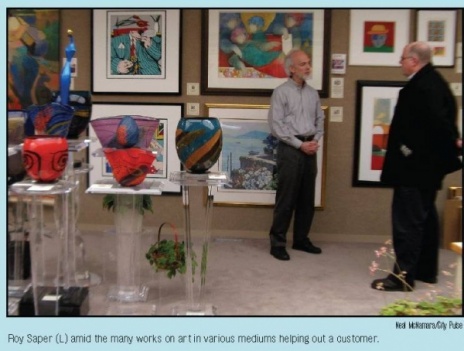 blazing across the
canvases. Or maybe it’s a stuffy art collector
with a British accent, displaying the
masterpieces of Van Gogh or Monet.
blazing across the
canvases. Or maybe it’s a stuffy art collector
with a British accent, displaying the
masterpieces of Van Gogh or Monet.
blazing across the
canvases. Or maybe it’s a stuffy art collector
with a British accent, displaying the
masterpieces of Van Gogh or Monet.
Or maybe you’re already bored with the idea.
Well,
walking into Saper Galleries, at 433 Albert
Ave. in East Lansing, you realize that all
your preconceived notions about art galleries
are untrue.
Roy Saper first opened the gallery in 1978 in
his home on Bailey Street in East Lansing and
saw customers by appointment only. The gallery
was the culmination of Saper’s dream to “buy
artwork and share it with people.”
In 1985, things started to get too big for his
home, so he looked for a new location.
“We looked all over the area: Lansing, East Lansing, Okemos,” he said. “Then we found this junky, vacant lot. So I designed our building, and we moved in May of 1986, a week after my son was born.”
Over
the years, Saper Galleries has been host to a
multitude of different art show. The 2006
Picasso show won Décor Magazine’s top award in
2007, and the ongoing exhibit on Dr. Seuss
paintings is receiving great attention. Saper
credits his years of success to his unique way
of conducting business.
“There are too many followers and not enough
leaders,” he says. “If you want to advance in
this world, you need to be a leader. It’s easy
to copy, but it takes a little more work to
come up with something original. Rather than
doing what others do, step back and ask, ‘how
can I make it better?’ I’ve created something
that seems right, and I’ve done my own thing.”
When you walk into Saper Galleries, you
certainly can feel the difference between it
and other art galleries. Either Roy or another
worker immediately greets you and thanks you
for stopping by. And there’s no pressure to
buy as you look at the 1,500 pieces of
artwork, ranging from paintings and sculptures
to glassware and vases.
“Our doors are open,” Saper explains. “We try to make it like a public place, but it´s totally privately owned. It’s more like a living room, not a museum or a library. I want people to be totally comfortable. You can even bring in your homework and kick off your shoes if you want.”
In
designing the gallery, Saper was very careful
to be as environmentally friendly as possible.
It’s a rarity to see lights on, due to the
vast number of skylights, bringing in more
natural light, which Saper says is the best
way to view art. And even when the lights do
come on, there are sensors that will dim when
no one is around.
The entrance has two doors, designed to
prevent a blast of cold air from nipping at
your heels. The walls are three times as thick
as the average wall, helping to insulate the
gallery.
“I tried to think of everything when designing
it,” Saper said. “Starting from scratch
thinking efficiently just makes more sense.
Americans are too wasteful. We need to save
resources and save money, especially now.”
Saper
is really just concerned with helping people,
not only in getting art but also helping
themselves.
“I’m honest,” he says, “I’ll tell you
straight, but in a positive way. If someone
brings in their artwork, I won’t just turn
them away; I’ll give guidance, tell them how
to get people to pay attention to their work.
We can all value from criticism from someone
who has knowledge. I focus on helping people
out, specifically in the visual art, and I
always will.”
Saper
Galleries has also helped out in selecting
pieces of artwork in many Lansing-area
businesses and public places. One of the more
well-known pieces is the statue in front of
Oldsmobile Park, the Lansing Lugnuts’ stadium:
a baseball player autographing a baseball for
a child, with two other kids seated on a bench
nearby. Saper also has another big project up
his sleeve.
“It’s intended for this area, and it will be
one of the most significant sculptures in the
area. I’ve flown to New York and Mexico City
to work it out.” He adds with a smile, “But
it’s not announced yet.”
Saper
plans on being a permanent fixture in the area
for another 30 years, if possible. It’s his
dedication to the arts and patronage to the
community that won him one of the City of East
Lansing’s Crystal Awards in 1988, the first
year they were awarded.
“There’s no expectation that you have to walk out of here and have bought something,” he says. “It’s about creating a connection to the artwork. Enjoy yourself, and if you’re not, then you haven’t been here long enough.”
Saper
Galleries
433 Albert Ave., East Lansing 10 a.m.- 6 p.m. Monday - Saturday and Thursdays until 9 p.m. (517) 351-0815 www.sapergalleries.com
'Oasis' found at Saper Galleries
By Nick
Krizinski
The State News
Published: March 3, 2009
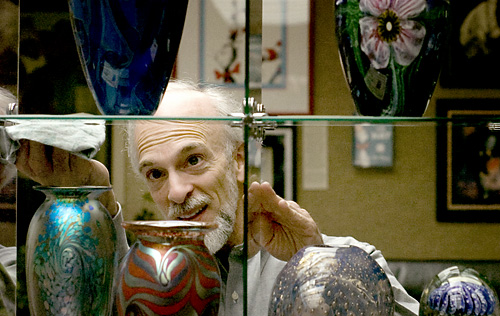 Josh Radtke The State News Saper Galleries owner Roy Saper meticulously cleans display shelves in his gallery, 433 Albert Ave. Saper takes great pride in the artwork he displays as he buys all the pieces himself. He said although selling the artwork is great, it’s always hard to see it go. |
Tucked behind Grand River Avenue
is Saper Galleries and Custom Framing, 433 Albert
Ave. For 23 years, the gallery has been bringing
aesthetic charm to the city.
The gallery is unlike any other. For those who wish to enjoy an afternoon glancing at the creations of divine artists, Saper Galleries welcomes patrons with open arms free of charge.
Owner Roy Saper’s passion for art began at an early age. He began collecting art as a teenager. First displaying works in his childhood home, his collection followed him to his college dorm room, and later into his current residence in East Lansing.
“Art is very much like music,” Saper said. “It’s something that you enjoy and want to share with people. I really enjoy the expressions and the mediums that artists portray.”
All the pieces in the gallery are owned by Saper. His collection grows as he travels and visits art exhibits.
“When I see an artist whose works I enjoy, I buy it because I like it,” he said. “And I figure if I like it, other people will like it as well.”
As time progressed, Saper’s passion for art only grew and so did his desire to share art with the community.
Saper said he had no long-term plans to construct a gallery. In 1985, construction began on the building where the gallery currently resides. By 1986, Saper moved in and displayed his collection.
“It was just a natural course,” he said. “And I’ve been having fun ever since.”
Saper prides his gallery on the differences it has compared to larger, more commercial art galleries. When purchasing art from an artist he’s interested in, he doesn’t examine the background of the artist in question, as some galleries do. For Saper, the process is more down to earth — he judges the artists solely on the quality of their art.
“We won’t celebrate art for reasons other than for aesthetic reasons,” he said.
Upon walking into the gallery, you can expect an enthusiastic welcome from Saper himself.
He shows patrons around the gallery, chatting about the art and the artists, serving as a personal guide to the exhibits.
Saper said this is how relationships are established with the patrons.
“Give people the time and the attention that they deserve,” he said. “We think about building a relationship with the people and treating each person like it’s our last.”
Almost one-third of galleries close after their third year, according to Saper. He says the differences that set his gallery apart from others could possibly be the reason behind his success in the art industry.
“Those who are running those galleries don’t have a strong commitment to what they’re running,” he said. “You can’t treat it like a job. You have to do it because you enjoy it.”
Saper applies his logic not only to running his gallery, but to all businesses in general.
“When starting something, don’t copy what someone else has done,” he said.
“Wipe the slate clean and try to create something the best it’s ever been created, and make it unique.”
Apart from his visitors, Saper has an immense dedication to supplying new art in his gallery. During a given year, Saper receives more than 1,000 requests from artists, all asking him to buy and display their works in his gallery. Because of the massive amount of requests, Saper said he rejects 99 percent of them.
“For somebody to get their art in here, that’s pretty noteworthy,” he said.
Whether they’re members of the MSU community or patrons from the 22 countries Saper works with, those who buy the art from the gallery can expect quality in their purchase. Saper makes sure the buyer knows everything about the piece they’re investing in.
Appreciation for art isn’t costly, Saper said. The gallery sells original sketches from artists for as low as $20. For the more affluent art enthusiasts, other pieces can be found for a higher price.
With 1,500 to 2,000 pieces of art for sale and on display at any given time, the gallery is now displaying the work of Theodor Geisel, or Dr. Seuss — quite appropriate considering his birthday was Monday.
“With all the things that are negative in your life, this is an oasis away from all of that,” Saper said. “As a resource for people, take advantage of us. We’re here.”
The gallery is unlike any other. For those who wish to enjoy an afternoon glancing at the creations of divine artists, Saper Galleries welcomes patrons with open arms free of charge.
Owner Roy Saper’s passion for art began at an early age. He began collecting art as a teenager. First displaying works in his childhood home, his collection followed him to his college dorm room, and later into his current residence in East Lansing.
“Art is very much like music,” Saper said. “It’s something that you enjoy and want to share with people. I really enjoy the expressions and the mediums that artists portray.”
All the pieces in the gallery are owned by Saper. His collection grows as he travels and visits art exhibits.
“When I see an artist whose works I enjoy, I buy it because I like it,” he said. “And I figure if I like it, other people will like it as well.”
As time progressed, Saper’s passion for art only grew and so did his desire to share art with the community.
Saper said he had no long-term plans to construct a gallery. In 1985, construction began on the building where the gallery currently resides. By 1986, Saper moved in and displayed his collection.
“It was just a natural course,” he said. “And I’ve been having fun ever since.”
Saper prides his gallery on the differences it has compared to larger, more commercial art galleries. When purchasing art from an artist he’s interested in, he doesn’t examine the background of the artist in question, as some galleries do. For Saper, the process is more down to earth — he judges the artists solely on the quality of their art.
“We won’t celebrate art for reasons other than for aesthetic reasons,” he said.
Upon walking into the gallery, you can expect an enthusiastic welcome from Saper himself.
He shows patrons around the gallery, chatting about the art and the artists, serving as a personal guide to the exhibits.
Saper said this is how relationships are established with the patrons.
“Give people the time and the attention that they deserve,” he said. “We think about building a relationship with the people and treating each person like it’s our last.”
Almost one-third of galleries close after their third year, according to Saper. He says the differences that set his gallery apart from others could possibly be the reason behind his success in the art industry.
“Those who are running those galleries don’t have a strong commitment to what they’re running,” he said. “You can’t treat it like a job. You have to do it because you enjoy it.”
Saper applies his logic not only to running his gallery, but to all businesses in general.
“When starting something, don’t copy what someone else has done,” he said.
“Wipe the slate clean and try to create something the best it’s ever been created, and make it unique.”
Apart from his visitors, Saper has an immense dedication to supplying new art in his gallery. During a given year, Saper receives more than 1,000 requests from artists, all asking him to buy and display their works in his gallery. Because of the massive amount of requests, Saper said he rejects 99 percent of them.
“For somebody to get their art in here, that’s pretty noteworthy,” he said.
Whether they’re members of the MSU community or patrons from the 22 countries Saper works with, those who buy the art from the gallery can expect quality in their purchase. Saper makes sure the buyer knows everything about the piece they’re investing in.
Appreciation for art isn’t costly, Saper said. The gallery sells original sketches from artists for as low as $20. For the more affluent art enthusiasts, other pieces can be found for a higher price.
With 1,500 to 2,000 pieces of art for sale and on display at any given time, the gallery is now displaying the work of Theodor Geisel, or Dr. Seuss — quite appropriate considering his birthday was Monday.
“With all the things that are negative in your life, this is an oasis away from all of that,” Saper said. “As a resource for people, take advantage of us. We’re here.”
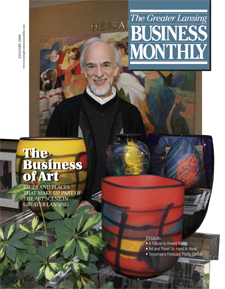
The Greater Lansing Business Monthly
January, 2009
Author: Randy J. Stine
Gallery Exhibits Staying Power
Author: Randy J. Stine
Gallery Exhibits Staying Power
Roy Saper has mixed economics and art to create a very successful business that just celebrated its 30th anniversary.
That may seem like an odd combination, but for Saper it’s a perfect mix. He founded Saper Galleries in his former Bailey Street home in East Lansing in 1978 after completing his graduate studies in economics at Michigan State University.
Saper began his art collection way before that, collecting original works of art as a teenager, and eventually he started selling parts of his collection to friends. After outgrowing his business’ humble beginnings, Saper Galleries moved in 1986 to its current location, which is just a block off the busy Grand River Avenue strip in East Lansing, on Albert Avenue.
Today the award-winning 6,000-square-foot art gallery features elegant skylights and neutral colored walls and carpet that allow colorful oil paintings and marble vases to dazzle with stunning visual splendor. Soft music plays throughout as Alto Relief sculptures from Bill Mack and magnificent floral paintings of Brian Davis and other art notables grace their beige-walled surroundings.
Saper has a love of the visual arts. The former professional photographer and viola player launched his business after friends told him they liked his art collection and wanted to buy pieces from it.
“This has been just a dream come true. I only collect and sell artwork that I appreciate and like. However, my business grew because I responded to what my clients were looking for. Listening to what your customers tell you and being able to satisfy their needs by giving them exactly what they want--we’ve lived by that philosophy for 30 years now,” says Saper.
Saper Galleries, which also provides custom framing, consulting services, appraisal services and free art searches, has received many awards over the years, including being named Décor Magazine’s selection as the number one gallery for 2007. Saper is often tapped to speak at art conferences and symposiums because of his knowledge of the art gallery business.
“We focus on what we know best. We want to be a leader in the industry. That is how you grow your business the right way. I work 16 to 18 hours a day at this. It’s everything I do. You have to do that to survive,” Saper says.
When one strolls through the museum-like gallery, which at any one time could include 1,500 works of art by 150 different artists, the quality of Saper’s collection is clearly evident. All art media are crisply displayed, from paintings, drawings, sculptures, limited edition prints, holographs, hand-blown glass to Raku and bas-reliefs.
“I have always appreciated quality work. The execution and creativity of others impresses me. I look for quality and that which hasn’t been done before. I like things that are a bit different and provide a sense of calm. I look for harmony and colors…all the elements of composition,” Saper says.
The artistic tastes of Saper’s clientele are constantly being broadened due to the increasing variety of art media, Saper adds. New technologies allow for art to be created using different techniques.
“There is more experimentation in art these days. I lean toward contemporary art, so I like much of it. Some I wouldn’t consider buying,” Saper says.
Reading the client testimonials on Saper Galleries’ website, which are totally unsolicited and overwhelmingly flattering, one can clearly understand the devotion Saper has to his customers.
“That is why we are in business. People know what they like, but we guide them through the process and not in an intimidating way. We make the process of selecting art very comfortable,” Saper explains.
Saper, who has routinely traveled to China, Japan, Europe and Australia over the years in his quest for fine art, uses the Internet more and more to find pieces to add to his collection. He doesn’t miss the travel and puts the time he saves to good use by spending more time with his wife and family. In fact, ask him what part of his art collection he is most proud of, and he points to a small display near his desk of paintings and art projects created by his two sons.
“That is what really counts. My boys [ages 17 and 22] gave me those things, and they are priceless,” Saper adds.
Business art is an important part of Saper’s gallery. Corporations, associations, hospitals and professional offices looking for artistic décor often can find that perfect piece to become their atrium’s centerpiece.
“We do a lot of commercial work. It could be paintings, sculpture or three-dimensional works,” Saper says. “We can commission whatever a customer is looking for. Much of what we do is having works of art created explicitly for spaces in homes and offices.”
While the state’s struggling economy has impacted his walk-in gallery’s business, Web retailing has helped ease the impact, and plays a crucial role in Saper’s current business success. Online sales have soared the last five years, sometimes accounting for nearly 60 percent of the gallery’s monthly sales.
“You can only have so much within the walls of the brick-and-mortar building. But online, it is all there for customers all over the world to peruse,” Saper says. “We’ve had months where 50 percent of our business has come from outside the United States thanks to the Internet.”
Meanwhile, look for more exclusive art exhibits coming to Saper Galleries, like the recently completed “The Art of Dr. Seuss” exhibit, which closes in early January. Through the years Saper’s art exhibitions have included showings of work from Michael Callihan, Picasso and Sunol Alvar.
The gallery’s in-house custom framing department continues to be a source of pride for Saper. The gallery specializes in archival framing and provides framing services for artists and collectors around the country.
“Our framing team here is outstanding. They have all been with me for a long time. Plus, they all have degrees in art,” Saper notes.
Expect Saper and his staff of seven full-time employees to continue to live by the same business philosophy that has served the store so well for 30-plus years.
“What distinguishes us from others is that we never say no. If you don’t say no to your clients, they will be your clients for life.
Whether it is the governor of Michigan or an MSU student who wants to buy something for his parents as a gift, respond to their needs and they will be loyal customers. That is not a culture of most businesses I know,” Saper says. “Good customer service is zero cost but offers phenomenal return. We practice that every day.”
The New Citizens Press
Saper
Showcases Some Seuss Surprises
Sunday, December 7, 2008
Sunday, December 7, 2008
Saper Galleries latest exhibit captures the inspiration and imagination of both children and adults alike. For many, Dr. Seuss is a household name. His books hold most children’s eyes wide open with wonder and amazement while being read Oh the Places You’ll Go. This creative and colorful collection of artwork also gives us new insight to who Dr. Seuss really was.
Saper Galleries owner Roy Saper said, “This exhibition of The Art of Dr. Seuss will allow you a better understanding of the artist who forged a new genre of art and the career experiences that contributed to the Dr.Seuss who is so admired by people everywhere.”
During the tour of the exhibit, Roy Saper displays excellent knowledge of each piece of artwork and Dr. Seuss’ life as he explains the background of the pieces.
Dr. Seuss was born Theodor Seuss Geisel was born in Springfield, Massachusetts on March 2, 1904. Ted left Springfield as a teenager to attend Dartmouth College, where he became editor-in-chief of the Jack-O-Lantern, Dartmouth's humor magazine. "Seuss” became his pseudonym while in college after being fired from his editor position for misbehaving on campus. However, he still found a way to write under the name “Seuss”, which is his mother Henrietta’s maiden name and his middle name. The “Dr.” was chosen because his father, Theodor Robert Geisel wanted him to be a “real” doctor.
Prior to creating children's books, Dr. Seuss was a prominent cartoonist and illustrator who worked in adult venues, such as advertising for magazines and political cartoons for newspapers. His early works in the exhibit gives insight to the imagination yet to be unleashed.
To Think That I Saw it on Mulberry Street, was rejected over 25 times before it was published in 1937. It was the beginning of the creation of many books that taught us to be kind to each other and listen to our innerselves and most importantly to learn to read. His books showed a deep understanding of human nature and expressed it to us with interesting and sometimes hairy creatures.
The exhibit shows his illustration art, which most of us are familiar with through viewing each picture on every page that is turned in his children’s books. However, also included are some of his private works, created over a period of 60 years. Some of the highlights of the exhibit include three dimensional fictional animals made out of plaster and some with real horns.
Dr. Seuss promoted literacy and in the process created some enchanting and beloved artwork. The Dr. Seuss exhibit is sure to bring back memories and create new ones.
Expect the unexpected and learn about the other side of Seuss.
The gallery is open to the public and viewing of the exhibit is free. This must see exhibit will continue through, Sunday, January 4, 2009. For more information or price inquiries on the limited edition artwork, call 517-351-0815. Saper Galleries is located at 433 Albert Avenue, East Lansing. The website for more information is www.sapergalleries.com.
Lansing State Journal
November 17, 2008
Saper builds business into an East Lansing mainstay
Kathryn Prater
kprater@lsj.com
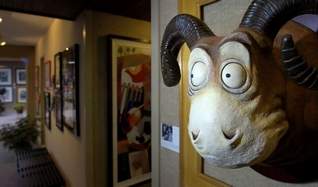
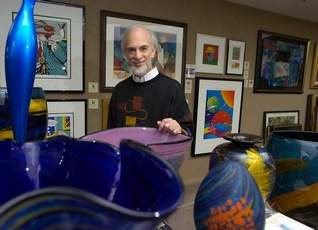
Left: 'Art of Dr. Seuss': The Saper Galleries in East Lansing is currently featuring "The Art of Dr. Seuss!" during the gallery's 30th anniversary year.
Right: Labor of love: Over three decades, Roy Saper has grown Saper Galleries and Custom Framing at 433 Albert Ave. in East Lansing.
EAST LANSING - Roy Saper started his art collection as a teenager, spending most of the money he'd save to buy one painting.
That collection has grown into a business - and a downtown East Lansing mainstay. Over the last three decades, Saper has built up a well-known gallery that boasts 2,000 works of art and reaches art lovers all around the world.
As Saper Galleries enters its 30th year, Roy Saper, 56, still handpicks each artist and piece of art - just like the Victor Vasarely serigraph, or silk screen, he bought for $750 at age 17.
"I bought the artwork because I felt very strongly about it. It's artwork I would hang in my home," he said. "I strive for perfection in all that we do. I always want everything to be the best."
The 6,000-square-foot gallery at 433 Albert Ave. also has a custom framing shop. The gallery's works are originals and limited editions. They include paintings, sculptures, drawings, water colors, mobiles, ceramics and hand-blown glass. Original pieces range in price from $20 to $140,000, Saper said.
"What I like to do is hear what people want and acquire what people want," Saper said. "We bring in the artists that I like and I feel we can have a future relationship with - artists who I believe represent the interests of the people of mid-Michigan. It's the people of mid-Michigan for whom this gallery was created."
Building relationships
About 1,000 artists request Saper Galleries display their work, but Saper said he can accept only three or four new artists a year. If one proves popular, Saper may offer an exhibition.
An exhibition dedicated to the works of Theodor Seuss Geisel - better known as Dr. Seuss - is on display until Jan. 4. Previous exhibitions have included Norman Rockwell and Pablo Picasso.
The gallery has three full-time employees, Saper said.
Saper Galleries' commitment to continuing customer relationships beyond the purchase of artwork is what sets the gallery apart, he said. For example, the gallery may send customers biographical information about their favorite artists or invite them to special receptions if the artists are in town. The gallery also offers free delivery and installation.
"We've built this business with one transaction at a time, but we look at every transaction as the beginning of a relationship, not the end of a relationship," Saper said.
Art collector Kevin Scott, an attorney and law professor at Thomas M. Cooley Law School, moved to Okemos in 1996.
"Roy and his staff were so very welcoming and genuine," said Scott, 53. "I came quickly to understand this was high-quality, high service - an important life endeavor versus someone just making money in the art gallery business."
24-hour online chat
Saper also is the main person to respond to the gallery's 24-hour online chat on its Web site, sapergalleries.com.
It draws inquiries from 22 countries, from those searching for artwork to those needing framing services. Saper's known to answer inquiries as late - or early - as 4 a.m.
More than half of Saper Galleries' business comes from outside the Lansing area. Last month, 60 percent of October sales came from out of state, and the majority of those were outside the country, Saper said.
He declined to give exact figures, but said the gallery is profitable. It has about 7,500 recent clients.
One industry expert said Saper is ahead of the online game.
A recent readership survey found half of 24,000 readers of "Decor" trade magazine have Web sites, managing editor Kristin Stefek Brashares said.
"You would think in this day and age, with the amount of people who are online shopping, there would be more. I would say our industry is kind of slow to get into the Internet," said Stefek Brashares, whose art and framing publication is based in St. Louis, Mo.
The U.S. Census Bureau reported 6,328 retail and wholesale art dealers nationwide in 2002, said Dimitrios Delis, marketing research director of the Jackson-based Photo Marketing Association. They made $4.2 billion in sales.
Michigan was home to 173 art dealers in 2002, making $134.5 million in sales, the Census Bureau said.
In 2007, there were about 6,000 independent framing shops in the United States, a $2.8 billion industry, Delis said. About 800 art galleries offer framing services.
Additional Facts
East Lansing Towne Courier
November 16, 2008
Roy
Saper's 30th year
Admirer of great art, talent
By DAWN PARKER
Staff Writer
Admirer of great art, talent
By DAWN PARKER
Staff Writer
EAST LANSING — From Rembrandt to Picasso, to Norman Rockwell and Peter Max, Saper Galleries has exhibited the works of the masters over the last 30 years.
The gallery is celebrating its 30th year of creating noteworthy and unique art exhibitions that have received international acclaim, all at its downtown East Lansing location.
East Lansing resident and gallery owner Roy Saper started the business in 1978 at his former Bailey Street home, soon after completing his graduate studies in economics at Michigan State University.
He began collecting original works of art as a teen-ager.
"I remember when I was a young teen-ager at home in Flint, taping reproductions of works to my walls in my basement bedroom at home," Saper recalled.
It was the early 1960s, and the Beatles had yet to appear on Ed Sullivan's show. There was the lure of music — a longed-for guitar appeared on his bed one day, thanks to his parents — but the pull of art was much stronger.
"A cousin of mine reminded me about how, when I went through Chicago, I would buy works of art," Saper said.
"I've always had this fascination for the talent and ability of others. Not just in the visual arts, but anyone who has great command of their field, be it speaking, writing, thinking, journalists — people in all fields. You admire great talent and ability."
Despite his youth and relative lack of funds, Saper pursued his passion.
Money invested
"My admiration was so great that I put my money where my mouth (was) and said this was so beautiful, I want to own it," he said.
Saper's development as an artist included spending his 10th grade year at the Interlochen Arts Academy in northern Michigan. He played the violin.
"There were about 200 of us kids from all over the world, and they were (each) the equivalent of the valedictorian or concertmaster from their school," he recalled.
"Everyone was phenomenally smart, phenomenally talented. It was a great school, a great experience."
His collecting got more serious as a Michigan State University student, as Saper began attending auctions around Lansing.
"I remember going to those auctions and buying works of art. I had never heard of the artist, but I loved the works of art," he recalled.
That moment
One memorable evening, the 17-year-old spent the then-staggering sum of $750 for a painting by 20th-century Hungarian-French abstract artist Victor Vasarely.
"I did it because I loved it so much, I wanted to have it," he recalled.
The business formed when friends wanted to buy art from his collection, most of which came from New York and other art centers of the world.
"A friend of mine in New York loved some of the works I had from my descriptions of them," Saper said. "She bought some of those works of art that I had, and I came to the realization that if someone in the mid-Michigan area wanted to acquire an Alexander Calder lithograph or a Victor Vasarely, where would you go to get it? You wouldn't go around here - you couldn't find it."
Saper devoted much of his wages from lawn mowing and baby-sitting to growing his collection, and has rarely looked back over the last 40 years.
"What I've learned - when you see something you want, get it, because tomorrow it will either be ... unavailable or unaffordable," he noted.
Before opening his own place, Saper visited with gallery owners around the country, asking questions about the artists they represented, as well as how to gain a greater appreciation for different styles of art.
The predecessor to Saper Galleries, 20th Century Fine Arts, opened its doors in the summer of 1978.
Gallery takes shape
After operating the business on an appointment basis for seven years, Saper designed and built the current gallery building in downtown East Lansing, opening that location in 1986.
"1985 is when we started building this place," he said. "I realized I needed to take this to the next level."
Saper's wife, Nell, gave birth to their oldest son, Adam, the week before the gallery's debut. Younger son Jay is an East Lansing High School senior.
To build his art inventory, Saper polled public figures and asked who their favorite artists were. He then bought original works of art by those artists and that became the basis for the first artwork displayed at the new Saper Galleries location.
"I asked them, 'If they could have any artist in the world, who would they want to display in their home?' They all responded, and I think most people said (Marc) Chagall," Saper recalled.
"I went out and I bought artwork by all these people, and that became the first exhibition."
Along the way, Saper earned one of the inaugural Crystal Awards in 1988. The Crystal Awards honor businesses, individuals and organizations who have impacted the quality of life in East Lansing.
For its major exhibitions the gallery often brings to East Lansing some of the world's most popular artists, allowing the public (at no charge) to meet and speak with the artists. It's been an important presence in the lives of area residents, even though they may not realize it.
A jewel
East Lansing resident Kevin Epling is a director of the Matt Epling Creative Arts Competition and a member of the East Lansing Arts Commission.
"As an East Lansing resident, what Roy has created with Saper Galleries is a jewel in the crown of East Lansing. It's a wonderful facility for artists and residents alike, and Roy has brought great exhibitions to town, things people might not otherwise have had a chance to see," Epling said.
"On a personal note, he helped out with our art competition in judging, and that's just helping extend the arts to the next generation within East Lansing."
SAPER EXHIBIT SHOWS THE MANY SIDES OF DR SEUSS
Including insecticide
By
LAWRENCE COSENTINO
Lansing CityPulse
At first, it looked as if 30
years of running an art gallery in East Lansing
had finally gotten to Roy Saper. Two weeks ago, I
walked into Saper’s gallery, tiptoed past the
pricey vases and sculptures, and found him lying
on the floor, clutching a bright yellow book for
babies.
“I Can Read With My Eyes
Shut,” he recited, grinning through his graying
beard. Who can blame him? If you’re American and
under 65, you probably started life that way, with
your diapered butt on a carpet, glued to the
adventures of the Cat in the Hat, Yertle the
Turtle or some other Dr. Seuss beastie with a long
neck and girly eyelashes. But Saper wasn’t
reverting to childhood. He was clearing the decks
for a big new show. He looked as excited as
McGrew, the hero of Dr. Seuss’ “If I Ran the Zoo.”
Down went the sober landscapes and portraits in
the main galleries.
For his 30th anniversary
show, Saper wanted big fun. He also wanted to
showcase an artist everybody knows and nobody
knows. The result is “The Art of Dr. Seuss,” a
touring exhibit authorized by the estate of Dr.
Seuss that kicked off Sunday in East Lansing. Of
course, the show salutes Theodore Geisel, AKA Dr.
Seuss, as the subversive fantasist who liberated
children’s books from the conformist blahs of Dick
and Jane. But the exhibit also goes outside the
margins to put Geisel into context as an
advertising man, editorial cartoonist, magazine
artist, wartime propagandist and moonlighting
painter.
“Millions of people grew up
with his books, but Dr. S euss is only beginning
to be recognized as a fine artist, and all but
unknown in the way this show reveals him,” Saper
said. Or, as Seuss put it: “My new zoo , McG rew
Zoo, will make people talk . My new zoo, McGrew
Zoo, will make people gawk.” People began to gawk
and talk as soon as the Saper show went up last
week. At the First Sunday opener, Saper greeted
almost 1,000 people in one afternoon. Visitors
ranged in age from nine weeks to nine decades, and
smiles were much more abundant than they were at
Saper’s 2006 Picasso show.
When it comes to shared
cultural experience, you can’t press a bigger,
brighter multi-generational button in the American
brain than Dr. Seuss. Flanked by friends, Michigan State
University freshman Katie O’Donnell stood under a
wall-mounted animal head with ram’s horns and
giant eyeballs like hard-boiled eggs. A label
under the trophy read “Goo-Goo- Eyed Tasmanian
Wolghast.” O’Donnell whipped out her cell phone
and called her parents, who live in Battle Creek.
“Now you have to come visi t m e, bec ause you hav
e to see this thing,” she told them. The Wolghast
is one of several pieces of “unorthodox taxidermy”
peering from the gallery walls. “Every pompous
corporate boardroom should have one,” Saper said.
Geisel built the fanciful creatures from real
animal parts his dad brought home from the Forest
Park Zoo in Springfield, Mass. Across from the
taxidermy, two college students looked at a
display of advertisements dating from the 1920s to
the 1940s. Several ads trumpeted the virtues of
Flit, an insecticide. One ad shows a Seussian
mosquito committing suicide with it. “Improved
with DDT,” another ad boasted.
“That’s against the law
now,” one of the students said in awe. Geisel’s
slogan, “Quick, Henry, the Flit,” became a
national catchphrase in the 1930s. A 1936 Flit ad
showed a little girl urging her brother, who has
swallowed a bug, to gargle with the stuff. About
40 years later, in 1971, Seuss created “The
Lorax,” a landmark children’s book advocating
environmental stewardship and bemoaning the
“gluppity-glup” and “schloppity-schlopp” poisoning
rivers and forests. That’s the kind of twist that
fascinates Bill Dreyer, curator of “The Art of Dr.
Seuss.” For 10 years, Dreyer has been researching
and writing a book on Seuss’ artistic legacy, to
appear in 2009. “The show is not just about Dr.
Seuss’ work,” he said. “It’s a history of the
changes in our culture.”
Little-known stuff like the
old ads make up the backbone of the show, a
not-for-sale, museum-type array of 32 panels with
200 images that cover Geisel’s magazine covers,
ads, oil paintings, unpublished material and many
other facets of his career, with lots of
explanatory text. It’s an impressively thorough
collection; there’s even a rusty old Flit spray
gun. About 200 more prints feature the familiar
Dr. Seuss characters, in various sizes, with text
cards by Saper and fanciful frames to match the
images. Dreyer said the material for the show
began to come out in 1995, when Seuss’s widow,
Audrey Geisel, authorized a book, “The Secret Art
of Dr. Seuss.” (Theodore Geisel died in 1991.) “In
1997, she gave us permission to recreate some of
these as limited editions,” Dryer said.
Saper and Dreyer admit up
front that all the Dr. Seuss images in the show
are reproductions. (The magazines and other
ephemera are original.) Most of the originals are
in archives at the University of California in
San Diego, or
hanging in Geisel’s home in La Jolla, where Audrey
still lives. The comprehensiveness of the show
makes it easy to trace Dr. Seuss’ distinctive
style (the “golden thread,” Dreyer calls it)
through the phases of his career. A 1933 magazine
cover sports a prototype of Yertle the Turtle. A
1949 Ford ad uses a glove-on-a-stick contraption
Seuss used 20 years later, in “Green Eggs and
Ham.” Even when the material is racy or
politically charged, it’s still obviously Seuss.
An unpublished book, “The Seven Lady Godivas,”
bulges with inflated-looking Seussian nudes.
A caged elephant in a 1944 political cartoon is winningly Horton-esque, even with a Nazi swastika on its backside. One amazing painting, “The Rather Odd Myopic Woman Riding Piggyback on One of Helen’s Many Cats,” features a signature Dr. Seuss cat, strategically positioned in a woman’s crotch. An unpublished 1938 novelette addresses Depression-era unemployment in familiar imagery and verse: “Then back to Nobsks with sighs and sobsks…
There are, in Bobsks, no
jobsks for Obsks.” For those who are used to
seeing Dr. Seuss’ contraptions, creatures and
landscapes in the flat coloring-book format of his
children’s books, another aspect of the Saper show
will come as a shock. Wedged into the crowd at
Sunday’s opening was Dennis Preston, longtime
Lansing caricature specialist and commercial
artist. Despite the crush of bodies, Preston
wasn’t budging from a row of prints reproducing
Geisel’s phantasmagoric oil paintings. Dreyer said
the paintings (cheesily dubbed the “secret art” in
this show) were made at night and never left
Geisel’s house in La Jolla until Audrey Geisel
began to authorize prints in the late 1990s. One
of the paintings, “The Joyous Leaping of Uncanned
Salmon,” looks like paisley rain falling in
reverse from a rainbow-dyed shag rug, in close-up.
“This is psychedelic,”
Preston said. “Get some 3-D glasses and this would
pop off the wall.” Preston, who had his own show
of psychedelic rock posters at the Creole Gallery
a couple of years ago, saw a kindred spirit in Dr.
Seuss. “I used to copy his characters and paint
them onto shirts,” he said. “Of course, I grew up
reading his books. But when you’re a kid you don’t
think about this dimensional stuff.” Another
print, “O solo meow-o,” features a cat poling a
gondola through a wild network of canals and
streets. The colors drench your eyes until they
sink into your face like two shreds of sponge in a
lake.
“He was like a Fauvist from
the earlier part of the last century,” Saper said,
naming the color-mad early-20th-century modernist
movement that produced Matisse’s eye-spanking
“Woman With a Hat” and many other vivid works. In
the oil paintings, Geisel seems to spin the color
wheel with total abandon, but Saper pointed out
that the combinations are carefully planned. “Some
people are born with perfect pitch,” Saper said.
“He was born with perfect
color. He just knows which colors go with others.”
The same goes for the more controlled world of the
Dr. Seuss books. Geisel’s career as the most
beloved and best-selling children’s author began
in 1937, with “To Think That I Saw It On Mulberry
Street,” but was interrupted by wartime propaganda
work with film director Frank Capra and Warner
Brothers animator Chuck Jones. One of the
characters they created was Private Snafu, a
bumbling soldier who demonstrated the wrong way to
do everything. (You can check out some of these
films on YouTube.) Geisel came back after the war
with a string of brilliant books, from
“McElligot’s Pool” in 1947 to his last, “Oh, the
Places You’ll Go,” published in 1990. Some of the
most interesting panels in the show are
reproductions of Geisel’s book pages as they were
delivered to the printer, with “color calls”
written in the margins specifying hue, saturation
and other details.
“He’s not just thinking
regular threeor four-color children’s book,” Saper
said. “’Cat in the Hat’ is a great example. He
uses saturated blues and reds, because he knows
they grab your eye.” When Saper chose Dr. Seuss
for his 30th anniversary, he wasn’t motivated
solely by admiration for Geisel’s technical
prowess. Saper doesn’t conceal his disdain for a
lot of modern art, a view he shares with Geisel.
“He didn’t like the pompous attitude of some
people, particularly museum curators who would
hang works of art where you couldn’t tell whether
it was upside down or right side up,” Saper said.
According to “Dr. Seuss and Mr. Geisel,” a biography by Judith and Neil Morgan, Geisel once played a trick on a friend who lectured him condescendingly on modern art. Geisel rubbed a piece of art paper with charcoal, dabbed it with hunks of bread soaked in vodka and sold it to the man for $500 as an “original Escorabus.” (There is no such artist.) “If I can do this stuff, it couldn’t be that great,” Geisel is said to have cracked. It’s a philosophy after Saper’s own heart. Forget the shock of the new, little Cindy Lou Who — there’ll be no ooze or goo when McGrew runs the zoo.
THE ART OF DR SEUSSThrough Jan. 4, 2009 Saper Galleries, 433 Albert Ave., East Lansing Hours: 10 a.m. – 6 p.m. Monday-Wednesday & Friday-Saturday 10 a.m. – 9 p.m. Thursday 1-4 p.m. First Sunday (517) 351-0815 www.sapergalleries.com
Seuss at Saper
Explore the bright wit, art of the man behind Dr. Seuss' whimsical stories
Lansing State JournalPublished November 1, 2008
|
Mike Hughes
If you drift into Saper Galleries on Sunday, you might wonder just where you are. Is this an art gallery or a playground? Or did you make a wrong turn and step into someone's childhood? That reflects the world of Theodor Seuss Geisel, the late author and artist. "The Art of Dr. Seuss - Graphics and Sculpture" begins a nine-week stay."This is going to be so cool," gallery owner Roy Saper said. Saper is 56, an art lover and mathematician who savors the old masters. (After its Picasso exhibit, Decor magazine named his place the nation's best gallery of 2007.) Still, the subject of Seuss has him talking with childlike awe. "You look at the pictures and you'll feel like you know him," Saper said. Most of the 60 pictures or sculptures are familiar enough. Scattered through the gallery are Sneetches and the Lorax and more. Still, there also are his sculptures and some artwork that Geisel made for himself, not his books. And there are surprises. One view has a straight evolution: Geisel wrote silly stories first, starting with the 1937 "And to Think That I Saw It on Mulberry Street"; he showed his social conscience late, peaking with "The Lorax" in 1971 and "Butter Battle Book" in 1984. Still, Saper's exhibit - with lots of text and history - shows the social side started early. As World War II began, Geisel attacked the notion of segregating black or Jewish soldiers. Emerging artist This wasn't someone who followed the norm, Saper said. "He rejected the notion of properness in everything." A teacher scolded him for his eccentric art style, but Geisel persisted. That was in Springfield, Mass., where his father was the supervisor of the zoo. He brought home horns and antlers that had been shed; young Geisel turned them into make-believe animals. Geisel called this "the Dr. Seuss School of Unorthodox taxidermy." Later, a magazine would call him "the world's most eminent authority on unheard of animals." Those would re-appear later in "If I Ran the Zoo" and "If I Ran the Circus" and more. First, there were other tasks. Geisel graduated from Dartmouth, sold cartoons to magazines and drew ads that brought national attention to an insecticide called Flit. He did his first two books, then joined the Army for World War II. "He worked with (Hollywood's) Frank Capra, producing film," Saper said. "He changed the nature of how the U.S. government communicated." Instead of the stodgy training films, Seuss made an animated one with Chuck Jones, of Bugs Bunny fame. After the war, he did the cartoon "Gerald McBoing-Boing." Bright writing Mostly, though, he returned to books. The surge came in 1954, Saper said, when Time magazine had an essay. "It said, 'Our books are boring. The illustrations are not exciting; the colors are muted. Kids are not excited." Geisel took it to heart, Saper said. He got a list of 400 words that should be in a book, then trimmed it to 223. "He replaced the Dick-and-Jane books with 'The Cat in the Hat,' " Saper said. The words spilled out with mad fun. In the books that followed, the pictures became brighter and more vibrant. The social messages followed. Ted Turner was a grown-up when he read "The Butter Battle Book"; he promptly proclaimed it "the best book ever" and turned it into a cartoon for his cable stations. "Butter Battle" didn't soften its impact with a happy ending. "These were real messages," Saper said. "And at the end of the book, it was not resolved." Geisel's early books offered wide-eyed optimism: A grinch can repent; a skeptic can learn to love green eggs and ham. His later ones ended with dark caution. The Lorax ravaged the environment; the butter battle left worlds at the eve of destruction. Throughout it all, however, there was still the bright wit and bright art of Dr. Seuss. |
|
Morgan and Chase Publishing,
2008
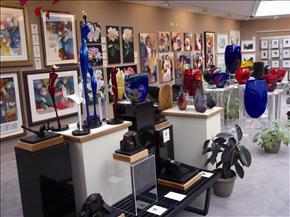
Saper Galleries & Custom Framing
433 Albert Avenue
East Lansing, Michigan 48823
USA
(517) 351-0815 or (877) 537-5251
http://www.sapergalleries.com
Saper
Galleries & Custom Framing
Roy C. Saper is
respected by art collectors throughout the world for
the quality of his gallery collection, his research
and free search services. You can usually find him
at Saper Galleries and Custom Framing, where he has
been introducing East Lansing to quality art since
1978. Saper owns more than 1,500 artworks from the
world’s finest artists and displays paintings,
drawings and sculptures along with glass and
ceramics in sky-lit rooms. The mediums, subject
matter and pricing vary, while the quality is always
top drawer. The Saper reputation earns patron art
collectors many special courtesies. Saper also
manages prestigious estate paintings, such as those
of Dutch born painter Tunis Ponsen. Art classes from
nearby Michigan State University visit Saper
Galleries the way they might visit a museum. You can
shop online, use the website’s chat option or simply
stop by to admire the offerings. Saper installs
sculptures in public places and helps businesses
make acquisition decisions. In 2007, Décor Magazine,
a national trade publication, named Saper as the
country’s top gallery. The award came in light of a
Picasso exhibition Roy created and displayed in
2006. Increase your art IQ with a visit to Saper
Galleries.
Art in a green setting
Michigan
Retailer
July/August,
2008
Saper Galleries, an art gallery with custom framing services in East Lansing, has been conserving natural resources and using green business practices for the past 22 years. The shop minimizes the use of paper by processing all Internet orders electronically, including invoicing and appraisals. Through extensive recycling and donation of scrap material, the store’s weekly trash output is much less than that of an average family residence, says owner Roy Saper.
Throughout its 6,000-square-foot building, Saper Galleries relies mostly on natural daylight through numerous skylights (up to 48-feet long). The lights are rarely turned on, and when lights are used, they are programmed to dim down when the spaces are not occupied.
The UV-filtering, double-layer skylights also filter out heat during the warmer months and provide additional insulation. The ceilings, roof and 14-inch thick walls are highly insulated so that the store’s high-efficiency zoned furnaces rarely cycle on.
Painter Callihan's impressionist work tranquil, inspired by Mich. landscapes
Lowdown/State News
By
Peter
Nichols
November 15th, 2007
A dusty dirt road stretches out for miles, tapering off into the horizon and extending into a canopy of lush, green trees. The dark brown of the road is reflected in the dark browns and reds of the first leaves of autumn that appear in the foreground.
If the image seems familiar, that's because it may very well be - it's a scene taken from northern Michigan and filtered through the imagination and oils of artist Michael Callihan.
"Most of the work is derived from Leelanau Peninsula," Callihan said. "Some of it is my imagination, while some of it is from sketches and photos. I wanted to reflect the beauty of the peninsula and what I find there."
The painting, called "County Line," is one of many in Callihan's show, "Michigan Impressions: Oil Paintings by Michael Callihan," which is running until Dec. 31 at Saper Galleries and Custom Framing, 433 Albert Ave.
Describing the show as Michigan "impressions" was no accident, Callihan said.
"I think I'm inspired by the impressionists but more of the softened, dreamy look," he said. "They're just pleasing and relaxing somehow."
Callihan said he chose Leelanau Peninsula as his subject because of its unique beauty and the sheer variety of landscapes it offers.
"It's just something about the rows of vineyards and orchards and the surprising fields and vistas you see when you're driving through there across the peninsula," he said.
It was the tranquil quality of the images that drew the attention of Roy Saper, curator and owner of the gallery.
And it's that same sense of relaxation that will cause viewers to respond to Callihan's work because it stands in contrast to the current state of the world, Saper said.
"He's painting things for just the love of painting," Saper said. "There's too much harsh activity in the world ... Callihan's work conveys a sense of repose, a sense of calm. It's standing back and saying this world is a lot more than headline news."
Saper, who has been running the East Lansing gallery since 1978, does not throw praise around lightly.
Of the 500 artists who vie for a place in the gallery, less than 1 percent are displayed, Saper said.
"No matter what (the artist) has done before," he said, "the only thing that matters here is if the work is quality and that it fills a void."
While Callihan admits that some might dismiss his type of paintings because of their softness, he said he paints them to stay true to himself and his tastes.
"Some critics might say it's not challenging what I do, but I don't know - it's what I do," he said.
Saper said despite the critics, Callihan's unique style is what sets him apart.
"They're paintings that connect with people," he said. "There is a place for beauty in art. Beauty in art is not trite."
Towne Courier
November 4,
2007
EAST LANSING — At the Saper Galleries exhibition "Michigan Impressions: Oil Paintings by Michael Callihan" opening Sunday, Nov. 4, the artist portrays scenes based on places Callihan remembers from his Michigan experiences.
The public is invited to meet the Rockford, Michigan artist at the opening reception and unveiling of 30 new paintings from 1 to 5 p.m. Nov. 4 at Saper Galleries, 433 Albert Avenue in downtown East Lansing. The exhibition will continue through December.
Callihan paints pastoral settings "because the paintings that I'm doing are in my heart." The work reflects his ideal of "living in harmony, without stress; calm, relaxed, and observing nature."
Born in Hastings, Michigan and raised in a small house in Freeport with a large family, Callihan would wander through the fields or fish along Coldwater Creek, with friends or alone, soaking up the peace and quiet.Callihan studied at the Kendall School of Design in Grand Rapids, graduating with a fine arts degree in 1985. After Kendall, he earned a master of fine arts degree from Parsons School of Design in New York.
Callihan cultivates a lifelong love of nature, tending to vegetables and flowers on an acre overlooking Rockford's Rogue River dam.
Gallery owner, Roy Saper, receives about 500 requests a year from artists who wish to display their art in his downtown East Lansing location.
"Four years ago, I was struck with the sensitivity of imagery and the clear understanding of the medium that came through in each of Mike Callihan's Impressionistic landscapes," Saper noted. "And that is why I knew they would be right for Saper Galleries and for those who enjoy seeing examples of such well-executed art by a superb Michigan artist."
"Michigan Impressions: Oil Paintings by Michael Callihan" is the major Saper Galleries exhibition for 2007 and opens Sunday, Nov. 4 from 1-5 p.m. at Saper Galleries, 433 Albert Ave. in Downtown East Lansing.
Through December, the gallery's display of Callihan landscapes will be open to the public Monday through Saturday 10 a.m. to 6 p.m. and Thursdays, 10 a.m. to 9 p.m. The first four Sundays in December the gallery will open from 1-4 p.m. Images of Callihan's paintings and biographical information on the artist may be viewed on-line at www.sapergalleries.com.
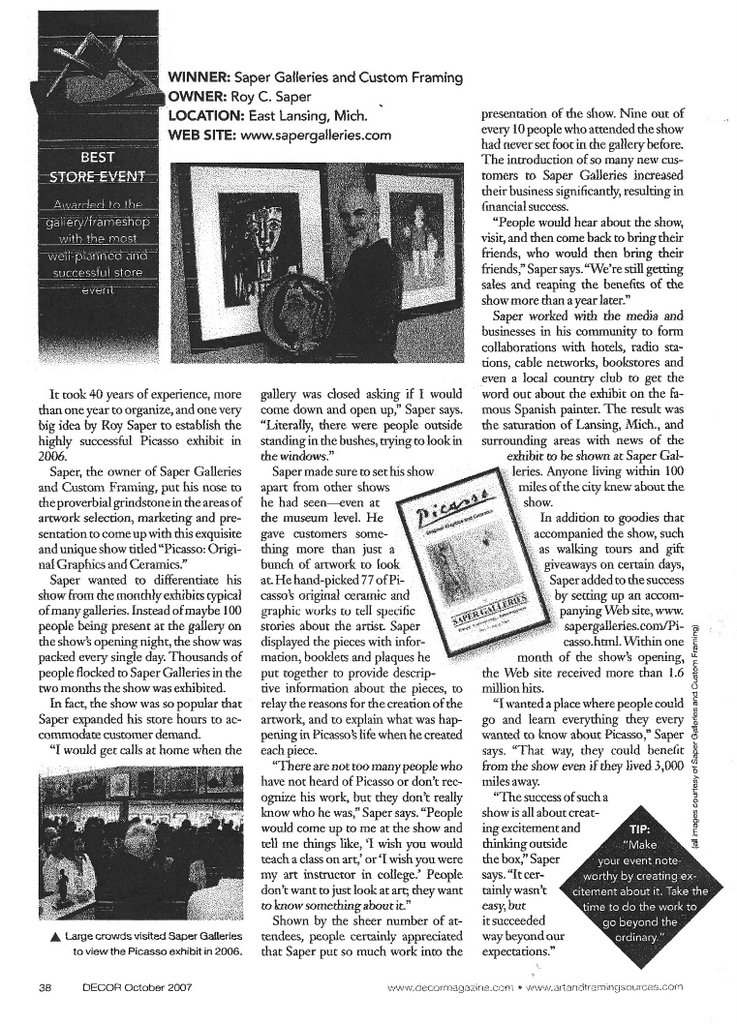
Published July 17, 2006
Take 5 with Roy Saper of Saper Galleries
Five questions. Five
answers.
Roy
Saper took an usual path to becoming an art
dealer
He became an economist.
Saper, who started his Saper Galleries business in his home in 1978, is a former economic forecaster for the state.
These days, however, he's a force in the local economics of art. He travels the globe looking for the right piece for his clients, which range from individuals to businesses to governments.
Saper's been collecting art since he was age 14 or 15. The art he sells ranges from $10 posters to pieces that cost thousands.
"We serve the population that has the following common characteristics: they have walls," Saper said.
Saper moved his art acquisition business in 1986 from his home into a building he designed. It cost three times the price of his home for Saper Galleries' property, but Saper said the risk has been worth it.
"When you want to do something you just have to jump in and do it," he said.
The gallery most recently put on a show featuring works of Pablo Picasso.
Why did you choose East Lansing for your business?My home was on Bailey Street, which is only a couple blocks from where we are now. I don't do things like anybody else. Some businesses would go into the mall or would want to be on Grand River for exposure. None of that is me. I wanted to be close to home.
What keeps you there given East Lansing's history of problems, whether you call them melees or fracases or riots?It's frustrating to go outside with your staff and plant many flats of flowers, come inside to get something and by the time you go out have them already pulled out. But you can't let that slow you down. My belief is what we provide the area far exceeds the occasional inconvenience of having to replace landscaping and replace windows."
You own nearly all the art in your gallery, right?Pretty much everything in the gallery here I purchased with the same checkbook I use to buy things from other merchants in town. I put my money where my mouth is. Just like the Picasso collection: I brought in a large number of works of art. I spent between $100 and $500 per person for everyone who walked through the door to see that exhibition.
How do you identify artworks for a business as opposed to individuals?We visit the firm to learn a little bit more about it - the type of population it serves, a sense of who works there and where they come - and then develop an understanding of what the image is they want to serve. That allows us to narrowly focus the type of imagery that's right. When we provide art to a credit union or bank ... we want high-quality art, but not so high that people think the bank is spending too much on art.
Who's your favorite artist?
My two little boys, Adam and Jay, are my favorite artists. I have their works displayed in my office and my home. Any parent who has a child has an obligation and responsibility to hang your children's works of art up.
ROY SAPER
Owner,
Saper Galleries
•
Where: 433 Albert St., East Lansing
•
Employees: 5
•
Services: Art acquisition, sales, exhibits
and framing
•
Founded: 1978
•
Education: Bachelor's degree in computer
science from Michigan State University;
doctorate work in economics at MSU
•
Family: Wife, Nell Kuhnmuench; sons Adam,
20, and Jay, 15
• On buying art: "A
work of art that's an 11 on a 1-to-10 scale
is a piece of art that you want to acquire.
If it's only a 3 or 4, take some thought,
take some hesi- tation and something else
might be coming down the pike."
Published May 31, 2006
Picasso exhibit impresses
Christian Czerwinski | NOISE
The compliments have been overwhelming.
But what would one expect from a Pablo Picasso exhibit?
Roy Saper, owner of Saper Galleries in East Lansing, started his exhibit dubbed "Picasso: Original Etchings and Ceramics," which includes graphics and ceramics from the artist, in May. Of the 60 featured works, he's sold about 15, but he plans to bring in about 20 more to replenish the exhibit.
So far, he's been impressed with the response. His guest book has been signed by visitors from Greece (yes, the country), Georgia, Pennsylvania, Florida, Illinois and South Dakota and "amazing," "beautiful," "lovely" and "exquisite" are just a few of the adjectives used to describe the collection.
Throughout the exhibit, the gallery showcases biographies of Picasso's life, from his early years to the women he was involved with.
"Picasso just works and what makes it exciting is that this show is just more than artwork. "We've told the story of Picasso and what was going on during his days in Europe and America. As you start in the front and walk around you'll walk away with a phenomenal amount of knowledge. You'll come back with a story and you'll be conversant on Picasso far more than the general population," Saper, 54, said.
"Unlike the Museum of Modern Art, you won't have to pay $20 either."
Arguably the most famous artist of the 20th century, Pablo Picasso created more than 20,000 works of art during his lifetime, ranging from the first cubist paintings to simple line drawings, sculptures and ceramics. He created more than 500 etchings in his final years and made about 2,000 graphic images.
Many of the etchings in Saper's show are from a set of 100 images created between 1933 and 1937. Picasso examines the relationship between artist and model in the works along with his own relationships with women.
Before the exhibition closes on July 2, Saper said the gallery will have shown more than 100 original Picassos ranging in price from $1,200 to $75,000.
"I wanted to keep them all in a relatively narrow price range. One Picasso sold for $104 million two years ago. Earlier, on May 3, one sold for $92 million," he said.
"You can get a Picasso for a few thousand and the reason is that he was so prolific. Although he's the most famous and recognized artist ever, his works are out there."
Lansing State
Journal, May 4, 2006
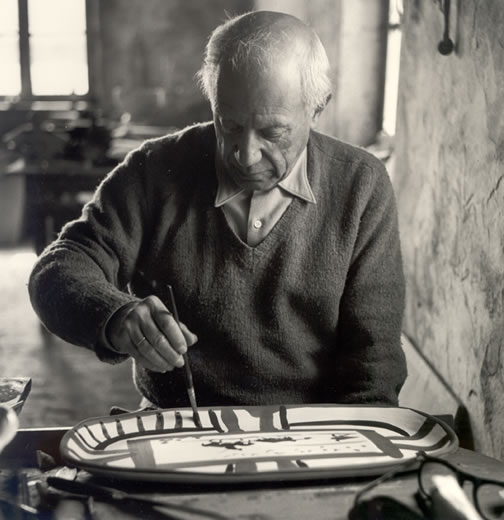
Pablo Picasso is
recognised as one of the most important
artists of the 20th century. For the
next two months, Saper Galleries in
East Lansing will exhibit original
graphics and ceramics by the legendary
artist.
Gallery owner Roy Saper has a
love for art which is evident throughout
his gallery and collections.
“The gallery was created to
make available original works of art to
collectors and interested people who
would otherwise have to travel to locate
them.”
Saper bought his first Picasso
piece as a teenager, and has now
accumulated enough for an exhibition.
“I like shows that are
noteworthy. After having Picassos from
my earliest purchases, I decided that
the time was right to display what I had
due to availability, access and the
breadth of imagery I could find.
The Picassos are more
affordable now than they will be in the
future so the timing seemed right."
There are many highlights to
the show, including a medley of etchings
from the “Suite Vollard,” a series of
100 etchings created between 1933 and
1937 for French art dealer and
publisher, Ambroise Vollard.
These etchings are of the same
caliber as ones that can be enjoyed
today in prestigious museums such as the
Bibliotheque Nationale in Paris, and New
York's Museum of Modern Art.
Surprisingly, the most
rewarding aspect of the art business is
the service of “providing works of art
and framing services that make [peoples]
lives better,” Saper said. “Every thank
you card or letter, and positive
response we receive from our gallery
clients and visitors is the reason I
choose to continue providing the
services of Saper Galleries.”
Saper said he hopes that people
will walk away from the exhibit, with a
conversant understanding of Picasso's
life and artwork.
"When we have an understanding
of what an artist is doing - whether it
be a painter, a poet or a dancer," Saper
said. "Then we can feel better about our
judgment of the work because our
criticism is informed."
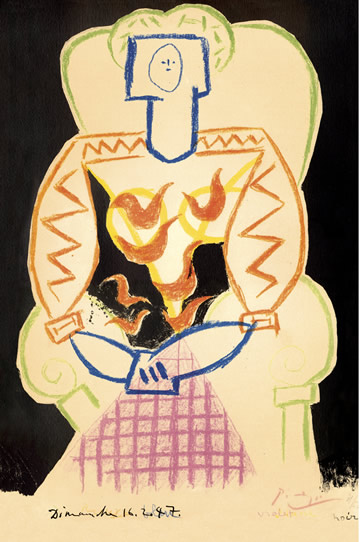
One of the
Picasso pieces at Saper Galleries
Lansing
City Pulse
Tuesday, 02 May 2006
The
Picasso etchings have arrived and
are leaning against the walls of
Saper Galleries. Owner Roy Saper is
giving an exclusive tour, going from
print to print on hands and knees.
His wonder at the beauty, skill and
grace of the works is sincere,
exuberant and infectious. One thing
is for certain: when Saper says,
“Wanna come up and see my etchings?”
it’s not a pickup line, it’s a
privilege.
Saper
Galleries’ “Picasso: Original
Graphics and Ceramics” includes over
60 etchings, lithographs and
ceramics, as well as photographs of
the artist at work and play.
Saper is such a perfectionist that when a Picasso etching arrives at his gallery that’s not matted and framed to his standards, it causes a great ethical battle in his head.
Saper is such a perfectionist that when a Picasso etching arrives at his gallery that’s not matted and framed to his standards, it causes a great ethical battle in his head.
“There are some frames here that I wouldn’t put on my wall, and I have to figure out what to do,” he comments. “But some of these might have been framed 50 years ago by Picasso’s daughter or granddaughter.” What to do, what to do? Should Saper potentially alter the history of a piece and reframe it to his exacting standards, or hang it as is? It’s issues like these that keep him up late at night.
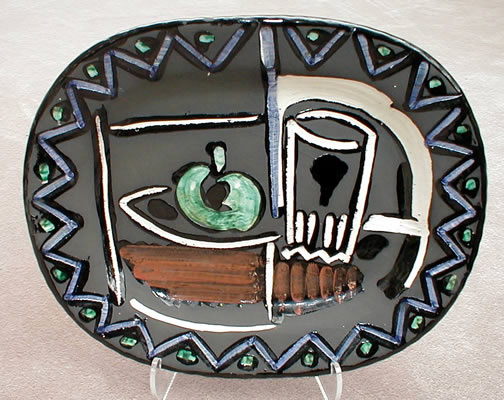
Serving
art:
Pablo Picasso created thousands
of ceramics up to his death in
1973, treating plates, jugs,
vases, and other vessels as a
form of canvas. This plate was
created in 1953 at Madoura
Pottery in Vallauris, a small
town in south France. (Courtesy
Saper Gallery)
Yet even when
sleep-deprived, Saper has the
energy level of someone half his
age. He talks a mile a minute,
sharing every tidbit of history of
each piece in the show, bouncing
around the gallery as if it were a
giant Moonwalk.
The idea to do an exhibit of Picasso etchings had been rolling around Saper’s frenetic brain for years, since he purchased his first Picasso reproductions almost 40 years ago. A recent visit to a Picasso exhibit in London sealed the deal. Finding the exhibit disjointed and disappointing, Saper decided that he could do a better job at presenting Picasso’s works.
The bulk of the works come from a series of 100 etchings Picasso created for French art dealer Ambroise Vollard between 1933 and 1937. At first glance, those who are acquainted with Picasso only through the paintings of his Blue, Rose or Cubist periods may find these etchings quite simplistic. But closer inspection reveals the genius it takes to create these seemingly simple pieces.
Symbols like seemingly innocuous vases of flowers are scattered throughout the series. Picasso connoisseurs are capable of discussing these details for hours. For some, the flowers track the shifting shape of love, changing in intensity and mood as the stem lengths and the amount of droop changes from piece to piece. In one of the later pieces, the flowers are moved from the windowsill to the floor, replaced by a potted plant. The shift could symbolize a more permanent, rooted love, or the flower of youth being replaced by a less showy yet mature rooted plant.
The subtext to these etchings is an affair Picasso had with his model and secret mistress, Marie-Thérèse Walter, whom he met in 1927 when she was 17 years old.
The exhibit will also feature several pieces of ceramics, which strike the viewer as more whimsical than many of Picasso’s other works. One piece in particular, “Hen Subject, 1954”, in Dutch blue and white, looks like something one might find in an antique store in West Michigan. “Still Life, 1953” is an easily recognizable Picasso-style still life rendered on the surface of a serving platter.
To help audiences appreciate and understand Picasso, Saper will add descriptive, informational text to accompany each piece. “It’ll be kind of like Picasso 101,” he says.
Saper has organized large exhibits from well-known artists such as Norman Rockwell, Peter Max and Pissarro. After 28 years in business in East Lansing, Saper could rest on his laurels and still pay the rent. “There’s no reason to do this other than the mountain is there and I’ve got climbing boots,” he says.
Bold art
born of muscles, breath and sand
‘Ioan
Nemtoi: Hand-blown Glass’
Nov. 6-Dec. 31,
2005
Saper Galleries
433 Albert Ave., East Lansing
433 Albert Ave., East Lansing
Mon.-Sat. 10 a.m-6 p.m.; Thurs. until 9
p.m.(517) 351-0815
It seems absurd to
call the blazing globs of glass blown by
Romanian master Ioann Nemtoi “vases” and
“pitchers,” unless you’ve got mutant poppies
from Jupiter or thrice-cursed dragon blood
to put inside them.
With Nemtoi, whose
glass art is now on display at Saper
Galleries in East Lansing, form overwhelms
function on the audacious scale of a Frank
Gehry building or the mouth of Marilyn
Monroe.
Gallery owner Roy
Saper says he saw Nemtoi’s work at a New
York exposition three years ago, where it
stopped him in his tracks. “What
distinguishes Nemtoi from other glass
blowers is his ability to control the medium
in such a large size,” he says.
“Other glass blowers
make things you can put in your pocket, but
this stuff would have to go in the back seat
or the trunk of the car.”
The boldest pieces
catch the eye first: a 2-foot-tall,
electric-indigo vase with an inky black
spiral inscribed in front; glowing yellow
and red bowls with curled sides like giant
cupcakes; a fearsome pitcher with dinosaur
spikes and a curling tendril based on the
fleshy “fishing” appendage of the deep-sea
anglerfish.
Alongside this wild
stuff sit quieter pieces that convey a more
grounded energy. “Forest Green Vase” may be
the masterpiece of the whole lot. It’s a
classic near-sphere, dappled and flecked
with deeply evocative earth tones that seem
to implode at the vase’s tiny lip and
balloon out generously at the equator.
Even the biggest
pieces have an elegance of form and fineness
of finish that give no hint of the effort
required to make them. Some of these pieces
weigh 20 or 30 pounds, and weighed no less
when they were molten blobs to be wrangled
and massaged into shape at the end of a
long, heavy metal rod. Imagine holding a
5-foot pole with a double-size bowling ball
on one end, trying to melt it like a
marshmallow over a fire, and you get some
idea of the physical effort — but not the
subtle art — involved.
“He puts the end of
the rod into a furnace,” Saper says. Inside
is a white hot mass of molten glass. “It’s
in a vitreous state — almost a slurry, like
a pancake mix.”
“He moves the rod
around until he gets the quantity he wants.
Then he turns it, using only gravity, and he
goes on doing a dance with that rod in the
middle of the air. He brings it to his mouth
and gives it a puff of air.”
All the while, Nemtoi
has to keep turning the piece, re-heating
and rotating it selectively so it doesn’t
sag or fall. He adds new colors and textures
by returning the piece to the fire, dipping
it into a different glob of glass, and going
through the process all over again.
Nemtoi’s favorite
colors are Chinese-lantern reds and yellows,
often accented by bold black borders. Gold
leaf feathers the finish on some pieces,
helping the eyeballs gain some extra
purchase on the slippery surface of the
glass. One vase, a tribute to Vincent Van
Gogh, is a tour
de force, squashing all the cornfields and
starry nights of Van Gogh’s fevered vision
into a self-contained universe of
Vincent-ness. “He controls the finishes so
well,” Saper says. Although most of the
pieces are shiny and bead-like, several have
matte finishes that interact with the light
in the room on completely different terms
than the reflective pieces. (Narcissists may
want to skip the matte ones.)
Besides the
beauty of the pieces themselves, Nemtoi
has one other thing to offer in this
exhibit. Every gallery owner on Earth has
heard the same old complaints about modern
art a million times, and Saper is
delighted to host an exhibit with
contemporary flair that, for once, can’t
be brushed off by philistines. “Nobody can
look at this stuff and say, ‘My 6-year-old
kid can do that,’” Saper says with a grin.
Gallery
exhibit showcases a personal connection to
Midwestern impressionist
By Kathleen
Lavey
Lansing State
Journal
Published July 20, 2005
| Tunis Ponsen, who was born in
the Netherlands but lived in Michigan and
Illinois, was inspired by the Midwest
landscapes around him. |
| |
|
View the exhibit
in person or online • More than 100 paintings by Tunis Ponsen are on display at Saper Galleries, 433 Albert Ave. in East Lansing, through July; the show is likely to be extended through Aug. 13 to coincide with the Great Lakes Folk Festival in East Lansing. • Gallery hours are 10 a.m. to 6 p.m. Mondays, Tuesdays, Wednesdays, Fridays and Saturdays and 10 a.m. to 9 p.m. Thursdays. • The exhibition includes a mix of watercolors and oil paintings. • Learn more by checking the gallery's Web site at www.sapergalleries.com or calling 351-0815. Tunis trivia • In 1928, Tunis Ponsen won an $800 award to travel to Europe and paint. A runner-up in the competition: "American Gothic" painter Grant Wood. • Ponsen's paintings have graced the walls of the Michigan governor's residence during both the John Engler and Jennifer Granholm administrations. • Four of his paintings are on loan from Saper Galleries to the Grand Hotel on Mackinac Island. • Fiction writer Stuart Dybek, who grew up in Chicago and teaches creative writing at Western Michigan University, asks his publishers to use Ponsen paintings on the covers of his books. • Ponsen is listed alongside other Michigan notables such as historian Bruce Catton and astronaut James McDivitt in a new social studies text that focuses on Michigan. |
Roy Saper stepped back from the oil painting of a gnarled tree against a mostly gray sky.
The clouds reveal just a hint of blue sky.
"See?" Saper said. "He painted things as he saw them. The sky is gray. But there's a little blue. There's room for hope."
The painting is one of 100 by Dutch-born American impressionist Tunis Ponsen, on display through the end of the month at Saper Galleries in East Lansing. Ponsen, known for portraits and, especially, landscapes, lived in west Michigan and Chicago, where he taught at the Art Institute of Chicago.
Ponsen's portraits are arresting, from that of an elderly Civil War veteran to an elegant woman. His landscapes are evocative, depicting scenes such as Michigan's rolling farmland, the seaside village of Gaspe, Quebec, and Chicago's industrial heart.
But his life story is just as arresting as the paintings he created. Ponsen's legacy of nearly 1,000 paintings was kept in his niece's basement for decades after his death in 1968, emerging through a series of twists and turns before winding up at Saper Galleries.
Painting his future
The story starts in 1891 in the Netherlands, where Ponsen was born. He emigrated to America in 1914.
Like many Dutch settlers, he wound up in Muskegon, where he worked as an interior decorator and house painter. After raising the money to bring his childhood sweetheart to America, he found she had fallen in love with another man during the Atlantic crossing. He never married.
Ponsen, who experimented with art in his teens, studied at the Art Institute of Chicago for six months in 1917, then applied for American citizenship and enlisted in the military to fight during World War I.
After the war, he returned to Muskegon as a professional decorator and an amateur painter. He showed some of his work at a Muskegon gallery to generally good reviews. In 1924, he enrolled in the Art Institute of Chicago full time, completing the three-year program in about 18 months.
Ponsen achieved good reviews and some commercial success, so he stayed in Chicago, teaching at the Art Institute and in his own studio. He visited Michigan often to see his sister, Arnolda Schogt, her husband and their daughter, Angenita, who lived on a fruit farm near Benton Harbor.
The fields and trees on the farm became favorite subjects for Ponsen, who is said to have created as many as a dozen watercolors in a single day.
Bountiful inheritance
After Ponsen's death in 1968, his niece Angenita Morris inherited his estate. When she and her husband went to Chicago to close out his estate, they found a trove of 1,000 works in oil and watercolors.
They hung many on the walls of their home near Benton Harbor and stored the rest on homemade racks in the basement. The paintings stayed there until 1990, when the Morrises called an insurance appraiser to help them put a value on the collection in case of loss.
He did that, but he also encouraged the couple to share the paintings.
Between 1994 and 1996, they allowed 51 of the paintings to be used in an exhibit shown at six museums, including Michigan State University's Kresge Art Gallery. Saper became interested in the paintings and bought a few.
After Morris died in a car accident, her daughter agreed to have Saper dispose of Ponsen's entire estate, including the paintings, scrapbooks, newspaper clippings and tools.
Saper recalls the first time he went to the Morris home to look at the paintings, taking his wife and two young sons along.
"All we did all day long was just look at paintings," he said. "We just went through those racks."
Regional impressions
Judith Hayner, executive director of the Muskegon Museum of Art, described Ponsen's paintings as a good example of American impressionism and called him a significant regional artist.
"Whether or not he has, or will, break through to more of a national or international circle has yet to be determined," she said. But she admitted she has a Ponsen East Coast scene hanging on the wall in her museum office.
"It's quite beautiful," she said. "It's a great painting."
Saper said Ponsen's appeal is in his honesty.
"People feel like they have a connection with the artist," he said, standing in front of one of the Michigan landscapes. "It's not buying a pretty picture, it's not buying something to decorate a wall."
Oil paintings listed on the gallery's Web site are priced at $3,000 to $13,000; watercolors are in a lower range.
The paintings, of course, are the heart of the show. But Saper has gathered letters, photos and objects from Ponsen's life that help visitors make a connection with the artist.
For example, a linoleum-cut print made by Ponsen is accompanied not only by the block he used to print it but by the tools he used to carve the block and the ink he used to make prints. Letters - including a handwritten resume - and photos give glimpses into the artist's life and subject matter.
The artist's palette is on display, with a gray mountain range of dried paint at its edge topped by dabs of unmixed red, yellow, blue and white.
"I wanted to bring together not only his paintings, but the personal elements of his life," Saper said.
Saper has spent so much time with Ponsen's work that he feels a direct connection to the artist. He doesn't say he sold a painting but rather, "I had to let that one go" to a new owner.
"He's kind of like an uncle," said Saper, who has visited Ponsen's former home and studio in Chicago, as well as many of the sites he painted. "I probably know more about Tunis Ponsen than his family members."
A room with a
hundred windows
New
exhibit
brings
unsung 20th century master to life
By
LAWRENCE COSENTINO
Lansing
CityPulse
June
1, 2005
At the wild banquet of
modern art (picture Andy Warhol as host,
Salvador Dali as DJ and Pablo Picasso as
bouncer), the earthy canvases of Tunis
Ponsen stick out like baskets of bread on
a table dusted with cocaine.
Not that the moderns
aren’t fun. There’s nothing like trundling
off to the museum to eye-wrestle with
three-eyed women, electric pink soup cans,
half-acres of stringy viscera or pianos
covered in ants.
But forging an alternate
reality was never the thing for Ponsen, a
Netherlands-born, Chicago-based artist who
lived from 1891 to 1968, and who resided
briefly in Muskegon, Mich. As a result,
this still largely unknown master is just
now getting his due: an unprecedented
100-canvas-plus show, including personal
memorabilia, at East Lansing’s Saper
Galleries.
Roy Saper, who is sitting
on a dense shale of a 1,000 Ponsen works
acquired from the artist’s niece, says
this is the biggest show the artist has
ever had. It not only eclipses the biggest
exhibit Ponsen had during his lifetime, at
Chicago’s Drake Hotel in 1938 (47
paintings); it doubles the amount of works
shown at the "Lost Paintings" tour of the
mid-1990s, which wintered at MSU’s Kresge
Museum in 1996 and made Ponsen hundreds of
local converts.
The exhibit is further broadened and deepened by a large stock of the artist’s personal effects, including Ponsen’s battered paint box and paints, a handful of linoleum-block prints (both prints and blocks), original exhibit catalogs and actual objects that appeared in his paintings (including a book about Ponsen’s idol Vincent Van Gogh, conspicuously left on the floor in a splendid view of the artist’s Chicago digs).
The paintings and the memorabilia reveal Ponsen as a visual poet of sanity, moderation, diligence and self-effacement. "I have no particular theories," he told a reporter in 1932. "I just paint the thing the way I see it."
Yet the paintings also show that Ponsen was no folksy, pandering illustrator, either. During his lifetime, he was even called a "modernist" now and then, owing to his lack of interest in fine detail, bold brushstrokes and compositional restlessness. Ponsen’s innovations, however, were never systematic, but always instead integral to the image at hand. It’s hard to find a canvas of his that doesn’t release an unexpected spore of newness — the blazing red undersides of geranium leaves, odd brackets of bananas in a still life, a strangely blank side of a building. Later in life, Ponsen even dabbled in abstraction (it was the ‘60s, after all), as evidenced by two of the Saper paintings: a giant, textured white blob and a flat array of varied shapes imprisoned by a row of realistically painted white birches.
Still, observation, not experimentation, was Ponsen’s guiding light. At the Saper exhibit, there are interiors and exteriors, nature scenes and industrial wastelands, human subjects of all ages and body types.
Gnarled trees, elegant ladies, skyscrapers, piles of books, demolished buildings, meadows, rocky beaches, sandy beaches, farms, fields, streets, flowers — all of these got Ponsen’s loving and careful attention.
Ponsen’s quiet mastery shows that just looking out the window, if done properly, is enough excitement for a lifetime. In fact, many of his best paintings literally look past the casement of his studio window, over a burning cigarette or a half-finished book, into a street charged with potential color and movement.
Outside, there might be a darting figure in the rain, a tree caught in one of its myriad moods or merely the white surface of the street itself, doing its job merely by reflecting light.
By concentrating so much attention on his subject rather than his own psyche, Ponsen becomes less a creator than a human vantage point, a well-situated and stimulating room — in the case of the Saper exhibit, a room with 100 windows.
Born in the
Netherlands in 1891, Ponsen settled in
Muskegon in 1914, where he began to exhibit
at the Hackley Art Gallery (now the Muskegon
Museum of Art). Many of the canvases at
Saper will be familiar to anyone who has
traveled through West Michigan. There are
unruly old orchards, rolling hills,
farmhouses overgrown with brambles and
lilacs, sand dunes crawling with spidery,
stunted trees.
Within a few years of his emigration to the United States, Ponsen inevitably found his way to Chicago. In 1925, he graduated from the Art Institute of Chicago, precociously finishing a three-year Master of Fine Arts program in 18 months.
With its industrial hellfires, tumbledown neighborhoods and graceful skyscrapers, Chicago vastly broadened Ponsen’s visual world. Furthermore, the city’s semi-insulation from the trendy coasts suited Ponsen’s old-world training and methodical eye. Though his career spanned some turbulent decades in art history, Ponsen never associated himself with a stylistic movement.
The artist’s heyday lasted from the ‘20s through the ‘40s, when his work was exhibited 34 times at various museums, including the Art Institute of Chicago, the Detroit Institute of Arts and the Toledo Art Museum. For most of his life, he supported himself by selling his paintings and teaching.
Ponsen lived alone throughout it all. Just after arriving in Muskegon, he wrote back to the Netherlands, asking his girlfriend to join him, but she succumbed to a shipboard romance on the way across the Atlantic. Ponsen never married. Some have found in his work a melancholy directly traceable to this misfortune; it’s just as logical to suppose that in his many interior paintings, the viewer serves as a ghostly roommate, politely removed in space and time.
While warmly received by many critics during his lifetime, Ponsen was handicapped by his low-key, unsensational approach and Midwestern location. At the time of his death in 1968, few art lovers could name any Chicago painters at all, let alone Ponsen.
In 1968, Ponsen’s niece
Angenita and her husband inherited the
artist’s considerable legacy. Over a
period of several months, they drove more
than 1,000 paintings, carload by carload,
to their home in Benton Harbor, Mich.
There, the loving niece kept the paintings
in climate-controlled conditions. In 1990,
a homeowner’s insurance appraiser saw the
cache and appreciated its significance.
The result was the mid-’90s "Lost
Paintings" tour, which hit seven Michigan
cities and sparked a visit by Roy Saper to
Angenita’s Benton Harbor home.
He is delighted to sit on so rich a mountain, and with good reason. The timing couldn’t be better for a Ponsen revival. Not only is the artist a generation gone (an unfortunate bonus in the arts world), the world seems quite ready to take bold yet figurative art like Ponsen’s to its bosom again. Flashy decadence is out; rock-solid integrity is in.
One painting in the exhibit, a portrait of a confident, seated woman in a red dress, appears in the gallery on "un-loan" from a highly placed party Saper declined to identify, except that she’s "the governor of a certain Midwestern state bounded almost entirely by the Great Lakes."
It’s their favorite painting," Saper said with a grin.The variety of the Saper exhibit goes beyond subject matter. Some paintings appear in multiple versions — loose water colors and taut oils, finished works and preliminary studies.
For example, a view of Lake Michigan, with the skyline of Chicago in the distance, will be seen in two versions — a watercolor done on site and an oil painting made in the studio.Children’s puzzle books are full of such "How are these two pictures different?" games. Here, however, the differences between Ponsen’s water color and oil versions aren’t just diverting; they sound out the hidden hinges that link sight to memory. Glancing from water color to oil painting, the viewer exchanges the sunny moments of discovery Ponsen must have experienced on the lake for darker hours of carefully considered composition in the studio. Rocks on the shore lose their lines and erode. The lake’s color deepens and darkens. The sky grows grayer and more ominous. Which version is more "true"? Under that question lie several more, among them: What can a picture hope to capture? How intensely should anything be looked at and thought about before moving on?
Among the finished oils at the Saper exhibit are a large number of looser, brighter water colors, many of them laced with eye-relaxing white space that invites the viewer to fill in the rest of the picture. In one striking picture, a mighty, ancient tree felled by lightning — a recurring Ponsen subject — continues to reach to the sky in death with a thousand curling branches. It’s hard not to think of the many paintings Ponsen left behind, filling the eye many years after his passing, when viewing this scene.
If there is any common theme running through the profusion of Ponsens on exhibit at Saper, it might be the artist’s uncanny skill at blurring seemingly opposite principles — growth and decay, the natural and the man-made, clutter and emptiness, monotony and variety — into a profoundly integrated yet open-ended reality. Again and again, Ponsen finds roughness in smoothness, greyness in color, and vice versa. For example, a railroad embankment on Chicago’s south side — really a big heap of dirt — delights the eye in Ponsen’s painting, revealing florid swirls of color when viewed up close. Conversely, a giant terraced garden, apparently located near the same embankment, almost bores the viewer with its monotonous spiral of greenery. Ponsen’s portraits, especially his nudes, further show his aversion toward arousing passions that could get in the way of quiet, persistent and rewarding absorption in reality. The most remarkable case in point in the Saper exhibit is a large painting of a reclining, semi-nude man. Eyes closed, hand behind his head, he is seen from a foreshortened, low angle, the position and vantage point recalling many Renaissance paintings depicting Christ on the cross.
But dramatic passion plays are out of place in Ponsen’s world. Here, no particular agony or ecstasy is detectable — only a moment of calm repose in a man’s life. Fully in tune with his surroundings, with just enough self-consciousness to enjoy floating in the world, it’s hard not to think of the nude as a psychic self-portrait. The beatific facial expression and muscular beauty combine to ask the most Ponsen-esque of questions: "Isn’t this enough?"
Gallery resembles mini Louvre
By
MADDIE TRIER
The State News, March 23, 2005
Camouflaged
behind dull sand-colored walls and an
unobtrusive display window lies a treasure trove
of art in Saper Galleries.
This large, three-room gallery, located at 433 Albert Ave., displays paintings, sculptures and pottery from about 150 artists. But because of its location, the shop is often easily missed. But, for people in the know, it's a place to frequently visit.
Todd Rosa, a 36-year-old Detroit resident, who once took classes at MSU, said whenever he comes into the Lansing area he makes a point to stop by Saper Galleries.
"There's not many places like it," he said. "It's a nice, pleasant, modern gallery."
Saper Galleries tries to serve the multitude of art preferences found in the university area, said framing specialist Jennifer Cuthbert, who has been working at the gallery for more than a decade.
Roy Saper, owner of Saper Galleries, said it is difficult to choose which artists to include in the exhibits because he receives about 500 portfolios per year.
"I like that which is truly amazingly great," he said. "It is not just the 'wow' factor that makes the work stand out, it is balance, uniqueness in terms of medium, imagery, control and other factors that are clearly subjective but together stand out way above the "competition."
In order for an artist to have an actual exhibit in the gallery - which consists of multiple works shown apart from the general melee of the rooms - the artwork must rank an 11 on a scale of one to 10, Saper said.
Saper Galleries currently is featuring the work of Bill Mack, who creates relief sculpture. Relief is a 3-D projection, or object, from a flat background. The front room of the gallery displays 12 pieces by Mack in materials varying from mixed metal to bonded sand.
The sculptures are of men and women and focus mostly on the themes of love and lust. The Mack exhibit will continue through April.
"He skillfully creates a sense of depth and dimension, suggesting the full body, when in reality it may only be half there," Saper said. "He is better than good."
In the back rooms, thin glass vases stand on pedestals surrounded by molded wire sculptures of male and female bodies, and paintings follow the stylings of Claude Monet to MC Escher.
The diversity of the art works is one of the reasons the gallery has done so well, Cuthbert said. The gallery also has moved with the times, expanding the building and creating an Internet store that aids income.
Saper Galleries offers a variety of services, such as framing and matting, but art is the primary source of profits, Cuthbert said.
Rosa said he enjoys many of the pieces at Saper Galleries, but since he prefers to buy actual pieces rather than copies, he has yet to purchase a substantial piece from the East Lansing venue.
Although many of the pieces on exhibit are too pricey for students to buy, arrangements can be made, Saper said.
"I know what
it's like to have eyes that are bigger than the
billfold capacity, so we make an extra effort to
allow flexibility," he said.
Bending the World with Magic Realism
Lansing
CityPulse
COVER STORY :: DECEMBER
01, 2004
By LAWRENCE COSENTINO
By LAWRENCE COSENTINO
Imagination
is
a great leveler. Any 7-year-old girl can sink a
tin-can Titanic or crush the moon with her
thumb. It’s the poor, cowering grown-ups —
the ones supposedly running things — who need
basic lessons in mastering reality.
The rediscovery of childhood mind games is the
substance of Saper Galleries’ biggest exhibition
of the year, devoted to the illusionist art or
“magic realism” of Rob Gonsalves.
A former architect who lives and works in Ontario,
Gonsalves has become a specialist in vibrantly
colored visual puns usually based on naïve ideas
like clouds that turn into sailing ships or
sunflowers with faces.
It sounds simplistic, and in some ways it is. But
the theme of empowerment by imagination is the
crimson thread that binds the 67 Gonsalves prints
collected at Saper with their fascinated fans.
It’s a force with wide appeal, and not one to be
dismissed lightly.
In
Gonsalves’ vision, imagination is a constructive
force, not a quaint escape into fields of unicorns
and fairies. In “Table Top Towers,” for example, a
foreground city of toy building blocks blends
seamlessly into a massive full-scale skyline. The
trick is that the toy and real buildings both rise
from a cleverly placed picnic table that lines up
perfectly with the horizon, making it impossible
to distinguish one city from the other. A boy
hangs from a tree overhead, putting the capstone
on both cities. This is no mere visual gag; under
the surface illusion is a mental Mobius strip
showing the organic link between childhood fantasy
and adult civilization.
Gonsalves has been
compared to masters of visual illusion M.C. Escher
and Rene Magritte, two artists he acknowledges had
a big influence on him. Gonsalves’ world, however,
is a lot brighter than Escher’s and less fraught
with provocative, arbitrary symbols than
Magritte’s.
Imagine, if possible, the exacting, math-professor
surrealism of Escher dragged into a
gingham-and-pie world of fluffy clouds and flying
children. It’s an odd mix of honey and codeine — a
broad-daylight, highly saleable dream world that
has made Gonsalves a hot property in the art
market since the early ‘90s.
Already, the Saper show has grabbed a much wider
variety of viewers than most exhibits, with young
children and school kids among the most
enthusiastic. When Saper brought in a group of
elderly residents from the Burcham Hills
Retirement Center, they, too, were fascinated.
Much of the show is an open invitation to conspire
in brazen acts of illusion. “Change of Scenery,”
set on the shore of a remote northern lake,
depicts a young man festooning his hearth-lit log
cabin with curtains. The cloth is cut in such a
way that the negative space around it forms a
completely convincing cityscape, turning a
firmament of northern Canadian stars turn into so
many big-city lights.
Many of the pictures hinge on an artfully
feathered visual fold where one world blends into
another. A cozy wooden library floor, for example,
morphs into the dark forest from which it was
built. Other illusions take a spiral form, drawing
the viewer into the illusion as if into a
whirlpool. A group of children put together a
jigsaw puzzle of a mansion, escaping the puzzle
room to climb the steps of the two-dimensional
house. They diminish in perspective as they go,
finally popping out of the second-floor window
with outsized pieces of jigsaw sky to finish the
job.
Perhaps the most ambitious canvas of the lot is
“On the Upswing,” which does a triple riff on the
dizzying heights of a tree-hung swing. Piles of
leaves become trees, picket fences become
brownstones, and the patch of park below the
swingers telescopes upward to three distinct
levels. (The kids in this picture, like most of
Gonsalves’ figures, are clumsy and foreshortened,
but that only makes it easier for viewers to
project themselves into their world.)
Despite some painfully literal clichés (pine trees
fog into cathedrals; books open into fantasy
worlds), many of Gonsalves’ images show surprising
depth. One striking image, “Here Comes the Flood,”
hints that the power of imagination has a powerful
political vector. A winding European-style street
seems to be inundated with water. Upon closer
inspection, the flood — complete with reflections
of buildings overhead — turns out to be painted on
placards carried by townspeople marching down the
street, which is perfectly dry. The image is too
weird to be good clean fun; it smells more like
postmodern revolution.
Another piece with unexpected depths, “House by
the Railroad” offers Gonsalves’ artistic manifesto
by turning the empowerment equation the other way
round. A young boy plays with a model train in a
gloomy, dark house, unaware that a real
locomotive, riding the same toy track, is bearing
down on him from behind. The inevitability of
manhood — and its sexuality, if you’re inclined to
view trains that way — is a dark and terrible
thing here. (Most kids in Gonsalves’ world swing
and jump and fly like Peter Pan over cozy quilts
that morph into storybook fields.)
“Railroad” is also a tribute to an artist as far
from Gonsalves’ sensibility as could be, stark
American realist Edward Hopper. To cinch the nod
toward bleak reality, Hopper’s own “House by the
Railroad” hangs on the wall behind the boy. It’s
the perfect way for Gonsalves to explain to the
academic art police his decision to follow the
hollow brick road. “I know all about this
sad-lady-in-the-window stuff,” he seems to say
here, “but it’s not my thing. I prefer to go out
and play.”
It’s a commercial exhibit, to be sure, but gallery
owner Roy Saper doesn’t seem to mind pleasing
people. He says he doesn’t even look at the bona
fides of the hundreds of artists who aspire to a
full-scale show in his space. “We don’t care about
their awards, their degrees, where they’ve showed
in the past,” he says. “All we care about is
whether we love it or not.” A lot of people have
been agreeing with Saper on this one.
By
Tim Lane
For the
Lansing State Journal
Published November 11, 2004
Roy Saper believes that a fertile imagination is the key to progressing to new levels.
"Imagination provides inspiration to do things - to run a gallery, to run for office, to teach new courses," he says.
"The Magic Realism of Rob Gonsalves,"
the new exhibit appearing at Saper Galleries in East
Lansing through December, embodies Saper's belief.
Canadian artist Rob Gonsalves' Magic
Realism involves unexpected shifts and
transformations. In "Medieval Moonlight," gray
clouds on the left slowly morph into gray, hooded
monks on the right. In "Written Worlds," shelved
library books become doorways to the real and
imaginary worlds that books depict and create.
"Gonsalves' work is all about opening our eyes to
worlds only the imagination can take us to," says
Saper.
Initially, a sharp eye is needed to appreciate the dimensions of the Gonsalves' show. Slowing down helps.
"If you walk by, you miss it," says Saper, referring to the magical elements of Gonsalves' artistry. "But if you stop, it only takes a few seconds for the piece to open up."
When considering the exhibition, the art movement known as Surrealism - which was founded in 1924 - comes to mind. But as far as labels go, Magic Realism is clearly more appropriate. Gonsalves' realistic and imaginary vision is more about imaginative possibilities than the locked up secrets of the subconscious, or the psychology of dreams.
Gonsalves was born in Toronto in 1959. Some of his major influences include Salvador Dali, Rene Magritte and M.C. Escher.
The show, which will interest
art lovers of all ages, is his first exhibition in
mid-Michigan.
LANSING, Mich.--The Lansing Regional Chamber of Commerce recognized East Lansing businessman Roy C. Saper of Saper Galleries and Custom Framing as its 2003 Outstanding Small Business Person Award recipient in February.
The annual Outstanding Small Business Person Award is presented to the owner of a local small business that meets the criteria of stability, innovation, commitment to community, perseverance and commitment to diversity.
Roy Saper has been in the art and framing business for 25 years after a career as an economist with the state of Michigan. He said he started 20th Century Fine Arts in 1978 to provide high-quality, unique and limited-edition works of art to individual collectors, as well as custom framing. He ran the business out of his home for eight years until there was no longer sufficient space to manage the volume of activity and growing inventory. After purchasing property in East Lansing, Saper planned and designed both the exterior and interior of his gallery, designing a 4,000-square-foot building. In 1986, Saper Galleries opened its doors and has since hosted more than two-dozen major art exhibitions, including Rembrandt, Picasso, Normal Rockwell and Peter Max and has garnered a client base of 7,500.
Saper embraced computers early, and created a program that showed clients the exact cost of every component of their framing order years before it became standard practice. The gallery expanded in 1998, adding more than 2,000 square feet, and Saper continues to make improvements in lighting, display and security.
Since its inception, Saper has been involved in all aspects of the business, from human resources, finances and public relations to record maintenance and client and artist relations. He has overcome hurdles, such as start-up financing, break-ins, destruction and loss of property and increasing demands of his time. He has supported diversity by offering the community works of art from artists from different cultures, mentoring and supporting minority artists and hiring a range of employees, including one who was homeless.
Saper's expertise has been utilized by countless local and national organizations to jury art exhibitions, lecture on art, share industry innovations with others in the field and to serve as an expert for legal cases involving art fraud. Saper has won three DECOR magazine awards for gallery design, creative management and advertising and promotion. He has also received the East Lansing Crystal Award and the Business Arts Award from the Arts Council Center of Greater Lansing.
Among many others, Saper's community service includes being president of the Friends of Kresge Art Museum, Chairman of the Dean's Community Council of the College of Arts and Letters, co-founder of the Greater Lansing Association of Galleries and Museums and chair of the East Lansing Downtown Development Authority. He is a member of the East Lansing Fine Arts Commission, East Lansing Arts Festival Board, Economic Development Corp. and Greater Lansing Food Bank.
For more information, call 877-537-5251 or visit www.sapergalleries.com.
COPYRIGHT 2003
Advanstar Communications, Inc.
COPYRIGHT 2004 Gale Group
Inside
Saper Galleries
PMA Magazine, November, 2003
By Alice Gibson, CPF
Natural
beauty
Taking advantage of what nature provides keeps costs down and the image impressive
Taking advantage of what nature provides keeps costs down and the image impressive
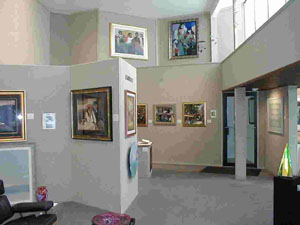 The front entrance to the
east gallery presents a bright vista and
artwork to view in all directions.
The high expanse of windows floods the gallery
with natural light, keeping lighting costs
down. Ultraviolet filters on the glass help
protect the artwork.
The front entrance to the
east gallery presents a bright vista and
artwork to view in all directions.
The high expanse of windows floods the gallery
with natural light, keeping lighting costs
down. Ultraviolet filters on the glass help
protect the artwork. In 1986, Roy Saper built a state-of-the-art gallery in East Lansing, Mich., to house his growing art and framing business, Saper Galleries. The 4,000 square-foot gallery and frame shop was beautiful, highly energy efficient, and designed with many special features to enhance the showing and selling of artwork. And, at a time when only a few galleries saw the benefits of business computers, Saper had one to help him run his operation — a 64K Kaypro II that gave him a myriad of reports about his business, and generated work orders and invoices.
The gallery has served Saper well as a business home. He has been well rewarded by his faith in energy-efficient buildings, and the gallery has become a well-established part of the East Lansing landscape. In the ensuing 17 years, the gallery has been expanded by more than 2,000 square feet, the energy-efficient features have been upgraded, and the computer systems have undergone several revolutions. The gallery now has a worldwide audience, served by a fully operational website at www.sapergalleries.com.
A member of the Professional Picture Framers Association since he added a framing operation to the gallery in the 1980s, the art and framing business has provided Saper with a satisfying career for more than 25 years.
He has won numerous industry and business awards, including several trade magazine awards. Saper also received the 2003 Outstanding Small Business Person award from the Lansing Regional Chamber of Commerce. The Chamber of Commerce award was pleasing, Saper says, because it shows “even little picture framers can earn the respect of their community.”
It is important, Saper says, that picture framers and art dealers not only support their trade, but also be an active part in the community where they live and work. “Success is not always measured by dollars,” he says. “Making a contribution to the community is extremely important.”
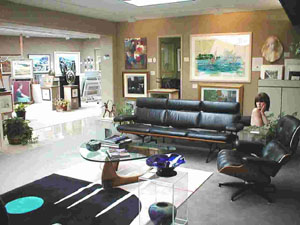 The center gallery ceiling was replaced recently
with a 32-foot skylight. The
The center gallery ceiling was replaced recently
with a 32-foot skylight. The result is a comfortable space that gives visitors the feeling of being outdoors in the California sunshine, even during Michigan’s severe winters.
Planning pays off
The planning that went into the striking building that houses Saper Galleries all those years ago has paid off handsomely, Saper says. In spite of its northern location and the wide expanses of glass, the building’s thick walls and super-heavy layers of insulation mean utility bills are kept to a minimum. While the glass provides little in the way of insulation, the windows do provide a great deal of natural light. The trade off has worked well, he says.
“The energy efficiency of the building has been a phenomenal success. This is important in a winter climate such as ours,” he says.
When it was time to expand, and the new gallery was added, Saper again paid attention to the energy needs. The space includes a 48-foot long center skylight and three dome-shaped skylights. It also has UV-filtering glazing in the skylights, extra-thick insulating walls, hidden air return vents, hidden electrical outlets, grouped light switches, and built-in speakers behind the acoustical wall covering.
Saper says he was surprised to learn to heat and cool the new 2,010 square-foot space would require two furnaces and two air conditioners. The skylights add heat in the summer, he says, but the extra cost is offset by the light the skylights also provide, reducing the need to use the halogen light fixtures during the day.
“The skylights provide all the light needed, so the electric bill is largely for the furnace/air conditioner, and almost nothing for lighting.”
As with the original construction, the savings have been substantial. The electric bills for the first seven months of this year average $140 for the entire gallery, and that includes using three furnaces and air conditioners, he says.
The effect of the striking new skylights was such that Saper was inspired to take out the ceiling of the center gallery and replace it with a 32-foot long, barrel-shaped skylight.
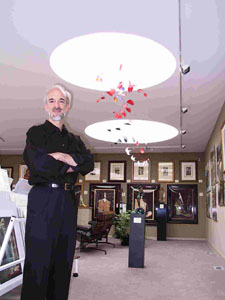 Saper loves the large
skylights in his new west gallery. There is
enough light
Saper loves the large
skylights in his new west gallery. There is
enough light throughout most days that the halogen fixtures he installed are rarely needed.
“The new gallery skylight was so effective, there was an obvious need to naturally illuminate the center gallery,” he says. “Although the skylight cost about what I paid for my first house in 1975 ($32,000), the effect is magical and beautiful. Visitors feel like they are outside when they visit the center gallery — except it is fully climate controlled. The lighting provides a better feel in the gallery and is as uplifting as being in the California sun, no matter what the season.”
Saper has become so convinced about the advantage of skylights, he has added them to both framing rooms, as well as having them in all three gallery spaces.
“They provide great efficiency, and the best possible lighting for the display of art,” he says.
Another feature from the original gallery that was duplicated in the new space is sliding wall panels that add exponentially to the wall space available for hanging artwork. Twenty-four sliding wall panels in the new gallery allow the display of 48 large works in a space only 12 feet wide. Behind the sliding walls is a hidden storage room.
The state-of-the-art gallery also has a soft – but durable – carpet, security sensors, security cameras that include a 24-hour recording of everything in the gallery areas, and infrared and motion detectors for lighting control.
The entire addition was carefully planned, Saper says. “Everything done was intentional, from the precise placement of the long skylight and the three dome-shaped skylights, to the layout and spacing between light switches, and what light tracks or fixtures were put on which circuit to control the lights manually or by sensors.”
New age selling
Saper, who has a degree in computer science, created his own website; and he pays less than $100 a year in off-site hosting fees. In return, it generates about four dozen e-mail messages daily. “Every month, we have about twice the amount of website activity as we did the same month in the prior year,” he says.
Saper says there is no doubt galleries lose sales to the Internet, where everything from reproductions to original artwork is available. “On the other hand, just as the Internet may take away business from some galleries, it also brings in a lot of business to galleries such as ours, which never say ‘no’ to a prospective client. We go the extra mile to find what the client is seeking.
“The website is effectively a whole new business,” he says. “The only downside to this new wave of art merchandising is it does add more tasks to one’s day.”
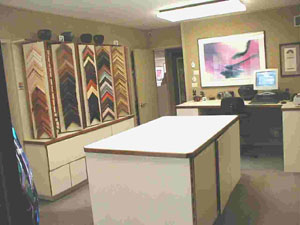 In
a room set aside for frame design and selection
is another Saper innovation. Corner samples are
arranged on a row of rotating columns atop a
storage cabinet. The arrangement keeps the
samples accessible and visible, yet uses minimum
space.
In
a room set aside for frame design and selection
is another Saper innovation. Corner samples are
arranged on a row of rotating columns atop a
storage cabinet. The arrangement keeps the
samples accessible and visible, yet uses minimum
space. Saper says he does most of the website business, including answering inquiries and e-mails, from his home computer in the mornings or at night. “I prefer, at the gallery, to focus on local clients and walk-in visitors, as well as team issues and management concerns,” he says.
He gets help in the website chores from his son, Jay, age 12, who has been helping update the pages for three years. “He has uploaded many of the photos, set up many of the pages, and uploaded changes and updates to the site,” Saper says. “He is great!”
Both the website and the gallery’s current business computer system represent a large leap from the Kaypro II he started with, says Saper. “Then, computers were not able to send faxes, show pictures live in real time, or send digital images,” he says. “We use the computer to the fullest capability of what it can offer in the area of art commerce. And it clearly pays off. Much of our most expensive gallery sales transactions come from the Web. That is, the average selling price of website purchases is greater than the average walk-in gallery purchase.”
Showing off
Saper Galleries has been spotlighting the work of major artists from around the world for 25 years now, including French artist Michel Delacroix, K. B. Hwang of Korea, Spain’s Sunol Alvar, and China’s Jiang. American artists also are well represented, from the nostalgic Americana of Norman Rockwell and the beautiful “Birds of America” of John James Audubon, to the pop abstract works of New Yorker Peter Max.
Saper owns the art inventory he shows. It includes more than 1,500 works in all media and at a wide price range. The inventory includes paintings, drawings, limited edition prints, sculptures, hand-blown glass, raku, bas-reliefs, Polages, kinetic light sculptures, mobiles, marble vases, and holographs.
“The one criterion that must apply to any work we show is quality,” he says. “We have a broad view of art. Art reflects the tastes of individuals. We respect the interests of all kinds of collectors, and we show a range of imagery from traditional and impressionist styles to contemporary and nonrepresentational imagery.”
The gallery mounts regular exhibitions for these and other artists. In June, the gallery hosted the work of Laurent Schkolnyk, a master engraver from France. In November, the gallery will open a new Alvar exhibit.
In addition to mailing four-color invitations to clients for the exhibitions, Saper also utilizes outdoor advertising — 48-by-14-foot billboards.
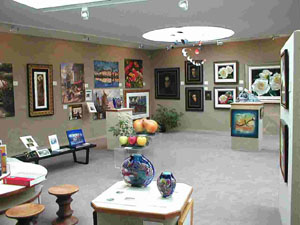
The
inventory
at Saper Galleries includes a wide variety of
artwork, from
original works on paper and canvas, to high-end glass and other fine art crafts.
original works on paper and canvas, to high-end glass and other fine art crafts.
“I spend a lot of time looking for and planning to acquire the best billboard locations for my needs. I put a ‘hold’ on the spaces months in advance. The billboards are phenomenally more advantageous than most print advertising,” he says. Most stay up a month at a time, although they could stay longer in some cases.
“The billboard presents a strong visual image — what better for an art gallery? And there is daily repetition for commuters. The billboards produce all month long in living color, and they are seen by 60,000 people a day, every day they are up.”
The billboards work, he says, and like the spectacular and efficient building and the website, add to the total success of Saper Galleries.
Saper
Galleries Celebrates First 25 Years
With Special Exhibition And Reception
June, 2002
Saper Galleries and Custom Framing Turns 25
With Special Exhibition And Reception
June, 2002
There
are only five living artists in the
world who are known for their excellence
in creating mezzotint engravings. French
artist Laurent Schkolnyk, the master of
the mezzotint, will demonstrate the
arduous technique at a reception and
exhibition celebrating the first 25
years of Saper Galleries in East
Lansing.
The public is invited to help celebrate the silver anniversary of the internationally renowned gallery Sunday, June 1 from 1:00 p.m. to 5:00 p.m., 433 Albert Avenue in downtown East Lansing. Artist Schkolnyk will demonstrate the mezzotint process of printmaking at 3:00 p.m. On display will be 50 of Schkolnyk’s masterful, imaginative still life images, very small works of art on paper in glowing colors against rich dark-toned backgrounds.
The Saper Galleries framing team has framed the mezzotint engravings in exquisite hand-carved and gold-leafed museum frames, designed and crafted to the exact size, style, and proportions that best complement each work of art.
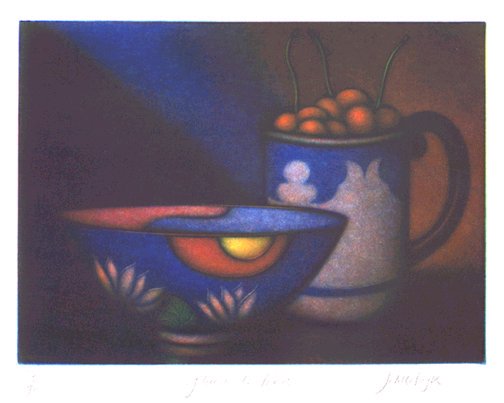 Gallery
owner, Roy C. Saper, bought his first
Schkolnyk mezzotints soon after he
created the gallery in 1978. “When one
sees how difficult a process it is to
create such beauty in the mezzotint
medium, one is awestruck at their
magnificence,” Saper commented on the
Schkolnyk engravings. “His imagery
conveys intense emotion and the beauty
of his mezzotints is everlasting. I love
them – and knew long ago that I wanted
to show the Schkolnyk mezzotints for our
25th anniversary exhibition!” Saper
continued.
Gallery
owner, Roy C. Saper, bought his first
Schkolnyk mezzotints soon after he
created the gallery in 1978. “When one
sees how difficult a process it is to
create such beauty in the mezzotint
medium, one is awestruck at their
magnificence,” Saper commented on the
Schkolnyk engravings. “His imagery
conveys intense emotion and the beauty
of his mezzotints is everlasting. I love
them – and knew long ago that I wanted
to show the Schkolnyk mezzotints for our
25th anniversary exhibition!” Saper
continued.
THE ARTIST
Schkolnyk studied drawing and etching at the Beaux Arts School in Nantes, France from 1971-1978. Since the 1980s he has exhibited throughout Asia and in France. Several exhibitions in major U.S. cities have been followed with Schkolnyk mezzotints being added to collections of the Cleveland Museum, Minneapolis Institute of Arts, Portland Art Museum, Los Angeles County Museum of Art, and the Bilbiotheque Nationale in Paris.
WHAT IS A MEZZOTINT?
A mezzotint is an original print using a technique from the 17th century in Holland. It requires that the artist prepare a flat metal plate by incising it with a small hand-held tool called a “rocker”. The rocker tool has a small curved blade with fine ridges on the bottom edge. The wooden handled tool is firmly rocked onto the metal plate creating a systematic arrangement of impressed lines that intersect and cross in every direction. Artists may spend weeks preparing their metal plate to be roughened uniformly.
If the metal plate were inked at this point, the paper printed from the inked plate would display a velvet-like impression due to the roughened texture of the plate.
The actual image is made by Schkolnyk using a burnisher to press down and flatten selected areas of the pitted plate. Those areas flattened by the burnisher will not hold the ink when transferring the image to the paper. It is this burnishing that allows the still-life image to come to life out from the black background.
Laurent Schkolnyk creates his rich colors by producing three completely different plates each using one primary color: blue, magenta and yellow. The plates are printed individually; each inked by hand, one color after the other. By layering the colors, Schkolnyk is able to create as much as seven or eight different tints and hues.
The light is brought out of darkness in these exquisite designs created by Laurent Schkolnyk. The works have a sensual quality and display a unity between realistic themes and fantastic compositions that resides in an intimate atmosphere that discloses the extreme attention and the loving respect of the artist for the birth of the precious image on the plate.
THE 25TH YEAR ALREADY?!
In 1978 Roy Saper opened his fine art gallery, then called 20th Century Fine Arts, in his Bailey Street home near downtown East Lansing. On an appointment basis he provided art to collectors who sought quality works of art without having to travel to the major art centers of the world. The 20-something MSU computer science graduate had recently completed his graduate coursework in economics and did tax-related consulting for the State of Michigan.
Saper’s circle-the-globe trips brought sought-after works of art by Chagall, Picasso, Dali as well as lesser-known artists to East Lansing where eager collectors bought them all.
In 1985 Saper renamed the business and built the present Saper Galleries building in downtown East Lansing, opening during art festival weekend, exactly 17 years ago. In 1998 Saper doubled the gallery exhibition space by adding on to the gallery building.
In recent years the gallery has expanded worldwide with a strong Internet presence, responding to inquiries from about 30 counties a month. Every week Saper Galleries delivers art to purchasers in and outside of Michigan who rely on the gallery’s commitment to quality and service, knowledge of art, and free art search services.
Saper has been called on to serve as a legal expert witness in art-related fraud cases, identifying forgeries and fakes in museum and private collections. He lectures widely on all aspects of the art world, and is frequently heard on talk shows offering guidance to collectors and evaluations of what they own.
The gallery has won numerous international awards in its 25 years and is often featured in Art World News, Art Business News, Picture Framing Magazine, and Décor magazine. Locally, Saper won the East Lansing Crystal Award the first year it was awarded (1988) and this year won the Outstanding Small Business Person of the Year Award from the Lansing Regional Chamber of Commerce.
Saper Galleries has acquired millions of dollars worth of original works of art to display in the East Lansing gallery, and created more than 30 unique exhibitions, always free to the public. In 1996 the gallery acquired the 1,000 “Lost Paintings of Tunis Ponsen”, the Dutch-born artist whose art has been widely sought by collectors since the paintings were rediscovered after the artist’s death in 1968.
“The public has been very supportive of Saper Galleries in our first 25 years. Our current plan is to continue providing art and excellence that visitors to the gallery may enjoy for at least another 25,” Saper stated.
The public is invited to help celebrate the silver anniversary of the internationally renowned gallery Sunday, June 1 from 1:00 p.m. to 5:00 p.m., 433 Albert Avenue in downtown East Lansing. Artist Schkolnyk will demonstrate the mezzotint process of printmaking at 3:00 p.m. On display will be 50 of Schkolnyk’s masterful, imaginative still life images, very small works of art on paper in glowing colors against rich dark-toned backgrounds.
The Saper Galleries framing team has framed the mezzotint engravings in exquisite hand-carved and gold-leafed museum frames, designed and crafted to the exact size, style, and proportions that best complement each work of art.
Gallery
owner, Roy C. Saper, bought his first
Schkolnyk mezzotints soon after he
created the gallery in 1978. “When one
sees how difficult a process it is to
create such beauty in the mezzotint
medium, one is awestruck at their
magnificence,” Saper commented on the
Schkolnyk engravings. “His imagery
conveys intense emotion and the beauty
of his mezzotints is everlasting. I love
them – and knew long ago that I wanted
to show the Schkolnyk mezzotints for our
25th anniversary exhibition!” Saper
continued.THE ARTIST
Schkolnyk studied drawing and etching at the Beaux Arts School in Nantes, France from 1971-1978. Since the 1980s he has exhibited throughout Asia and in France. Several exhibitions in major U.S. cities have been followed with Schkolnyk mezzotints being added to collections of the Cleveland Museum, Minneapolis Institute of Arts, Portland Art Museum, Los Angeles County Museum of Art, and the Bilbiotheque Nationale in Paris.
WHAT IS A MEZZOTINT?
A mezzotint is an original print using a technique from the 17th century in Holland. It requires that the artist prepare a flat metal plate by incising it with a small hand-held tool called a “rocker”. The rocker tool has a small curved blade with fine ridges on the bottom edge. The wooden handled tool is firmly rocked onto the metal plate creating a systematic arrangement of impressed lines that intersect and cross in every direction. Artists may spend weeks preparing their metal plate to be roughened uniformly.
If the metal plate were inked at this point, the paper printed from the inked plate would display a velvet-like impression due to the roughened texture of the plate.
The actual image is made by Schkolnyk using a burnisher to press down and flatten selected areas of the pitted plate. Those areas flattened by the burnisher will not hold the ink when transferring the image to the paper. It is this burnishing that allows the still-life image to come to life out from the black background.
Laurent Schkolnyk creates his rich colors by producing three completely different plates each using one primary color: blue, magenta and yellow. The plates are printed individually; each inked by hand, one color after the other. By layering the colors, Schkolnyk is able to create as much as seven or eight different tints and hues.
The light is brought out of darkness in these exquisite designs created by Laurent Schkolnyk. The works have a sensual quality and display a unity between realistic themes and fantastic compositions that resides in an intimate atmosphere that discloses the extreme attention and the loving respect of the artist for the birth of the precious image on the plate.
THE 25TH YEAR ALREADY?!
In 1978 Roy Saper opened his fine art gallery, then called 20th Century Fine Arts, in his Bailey Street home near downtown East Lansing. On an appointment basis he provided art to collectors who sought quality works of art without having to travel to the major art centers of the world. The 20-something MSU computer science graduate had recently completed his graduate coursework in economics and did tax-related consulting for the State of Michigan.
Saper’s circle-the-globe trips brought sought-after works of art by Chagall, Picasso, Dali as well as lesser-known artists to East Lansing where eager collectors bought them all.
In 1985 Saper renamed the business and built the present Saper Galleries building in downtown East Lansing, opening during art festival weekend, exactly 17 years ago. In 1998 Saper doubled the gallery exhibition space by adding on to the gallery building.
In recent years the gallery has expanded worldwide with a strong Internet presence, responding to inquiries from about 30 counties a month. Every week Saper Galleries delivers art to purchasers in and outside of Michigan who rely on the gallery’s commitment to quality and service, knowledge of art, and free art search services.
Saper has been called on to serve as a legal expert witness in art-related fraud cases, identifying forgeries and fakes in museum and private collections. He lectures widely on all aspects of the art world, and is frequently heard on talk shows offering guidance to collectors and evaluations of what they own.
The gallery has won numerous international awards in its 25 years and is often featured in Art World News, Art Business News, Picture Framing Magazine, and Décor magazine. Locally, Saper won the East Lansing Crystal Award the first year it was awarded (1988) and this year won the Outstanding Small Business Person of the Year Award from the Lansing Regional Chamber of Commerce.
Saper Galleries has acquired millions of dollars worth of original works of art to display in the East Lansing gallery, and created more than 30 unique exhibitions, always free to the public. In 1996 the gallery acquired the 1,000 “Lost Paintings of Tunis Ponsen”, the Dutch-born artist whose art has been widely sought by collectors since the paintings were rediscovered after the artist’s death in 1968.
“The public has been very supportive of Saper Galleries in our first 25 years. Our current plan is to continue providing art and excellence that visitors to the gallery may enjoy for at least another 25,” Saper stated.
Saper Galleries and Custom Framing Turns 25
By ALYSSA BROWN
Lansing City Pulse,
May 28, 2003
At the age of 20, Roy Saper, the owner of
East Lansing’s Saper Galleries and Custom Framing,
made his first trip to Europe. In Paris, he
purchased a Renault from a local factory. He spent
the next three months logging 8,015 miles and
several art purchases in 14 countries. He resold the
car to the factory and returned to America with the
beginnings of a lifelong passion for art.
In 1969, Saper entered Michigan State University as a music therapy major but soon transferred to the computer science department. His decision to change his major came in part by chance. Due to a clerical workers’ strike that year, students enrolled in their classes without much guidance from the university. Bewildered as to what courses he needed for a music therapy major, the computer science course descriptions intrigued him. At the time, MSU owned only a few computers.
In 1969, Saper entered Michigan State University as a music therapy major but soon transferred to the computer science department. His decision to change his major came in part by chance. Due to a clerical workers’ strike that year, students enrolled in their classes without much guidance from the university. Bewildered as to what courses he needed for a music therapy major, the computer science course descriptions intrigued him. At the time, MSU owned only a few computers.
|
Saper Galleries,
433 Albert Ave., East Lansing. Will celebrate
its 25th anniversary 1 p.m. to 5 p.m. Sunday,
June 1, with a reception and the opening of an
exhibit, “Laurent Schkolnyk: Still Lifes by the
Master of Mezzotint.” The artist will
demonstrate the mezzotint process at 3 p.m.
Hours: 10 a.m. to 6 p.m. Monday through Saturday, Thursdays until 9 p.m., and First Sundays 1 p.m. to 4 p.m. For more information, call (877)537-5251 or (517)351-0815, or visit www.sapergalleries.com . |
After completing his graduate studies in
economics at MSU several years later, Saper found
a job as a tax consultant for the State of
Michigan. As a side venture, he opened his
gallery, then known as the 20th Century Fine Arts
Gallery, in his East Lansing home on Bailey
Street. At first, the business was open only by
appointment. Although he claims not to remember,
Saper’s friends recall having to thread their way
through the stacks of artwork lined up against the
walls to cross his living room.
Over time, the business grew and eventually
required Saper’s undivided attention as he
realized his dream of providing East Lansing and
mid-Michigan residents with art they normally
would need to travel outside the region and often
across the ocean to find. To stock his gallery, he
traveled around the globe each spring. His
journeys brought him everywhere from Hawaii, Japan
and India to France and Australia. Over the years,
he acquired work from a number of renowned
artists, including Picasso, Dali and Chagall.
Other artists he purchased work from had never
been shown in the United States before. “My pride
was in selecting works I loved and re-enforced by
others wanting the same,” he said.
Saper has been so successful in achieving this
goal that in 1985, he moved his business, which
eventually became known as Saper Galleries, to its
present-day location on the corner of Albert and
Division streets in East Lansing. The gallery is
housed in a custom-designed building featuring
large spacious rooms lit entirely by natural light
that filters into the space from several
skylights, each more than 30 feet long.
On June 1 from 1 p.m. to 5 p.m., Saper Galleries
will host a reception to celebrate its 25th
anniversary and the opening of their newest
exhibit, “Laurent Schkolnyk: Still Lifes by the
Master of Mezzotint.” Saper says that he has known
for years that he wanted to show the Parisian
artist’s work to celebrate the gallery’s silver
anniversary. He purchased his Schkolnyks in the
early 1980s. Fifty of Schkolynk’s captivating
still lifes will be on display during the exhibit.
Schkolnyk creates his imaginative images using the
mezzotint process, a method of printing developed
in Holland during the 17th century. Schkolnyk is
one of only five artists in the world known for
their mastery of the technique. The process
requires the artist to create different metal
plates for each of the primary colors through a
time-consuming method.
Schkolnyk layers the colors to create small prints
of jewel-toned fruits, violins and other objects
that practically glow from within. The artist will
briefly demonstrate aspects of the mezzotint
process at 3 p.m. on the day of the reception. As
with all the work in his gallery, Saper stresses
the excellence demonstrated in Schkolnyk’s prints.
Drawing inspiration from the sheer labor involved
in producing a mezzotint print, Saper believes,
“This [exhibit] should give one the impetus to go
out and do things very well.”
Saper, of course, has done very well with his
gallery. After 25 years, the business boasts a
client base over 7,000 people strong, and some 500
artists contact him annually hoping to attain a
coveted spot in the gallery. As Saper Galleries
has expanded, it has gained international acclaim
in publications,such as Art World News, Art
Business News, Picture Framing Magazine, and D’cor
Magazine. The business’s Web site has “opened
Saper Galleries from being a local gallery to a
borderless one,” Saper said. Buyers from around
the world now purchase artwork from the site. Yet
Saper remains attached to the area. “We’ve been
honored to be part of the community and downtown,”
he said.
Return to top of
page
The offer read: “Mailing Tubes, free to a nonprofit agency. Saper Gallery, East Lansing.”
What the offer did not state was that there were over 600 mailing tubes of various sizes available to the nonprofit organization that claimed them. Realizing that the tubes would suit a variety of purposes, Kevin Green, Assistant to the Superintendent for School and Community Relations, solicited possible usage ideas from teachers throughout the district. Based upon the sheer volume of immediate responses, a date was set to collect the tubes.
On Tuesday evening, January 30, 15 ELHS National Honor Society students formed a “bucket brigade” to remove the mailing tubes from the Saper Gallery’s basement storage area. The process was reversed at the district’s Service Center, where the students sorted the tubes by size, wrapped the tubes into assorted bundles for ease of handling, and stacked them for further processing. Within a few weeks, the students in Norm Scott’s Whitehills Elementary classroom separated the mailing tubes by size, re-bundled them according to teacher requests, added labels and organized the tubes for distribution to classrooms throughout the district. With an estimated value exceeding $4,000, uses for the mailing tubes cross all buildings, grade levels, and curriculum areas. Specific uses include sound resonance tubes for high school physics classes, and, cut horizontally, convex/concave tools for physics class projects at the middle school; cut into varying heights, tubes with different diameters will provide volume and surface area tools for math classes at several grade levels; cylindrical forms for high school pottery and sculpture classes; tree trunks for the elementarylevel social studies curriculum on rain forests; and construction of a log cabin for the fourth-grade component on Michigan history.
Roy Saper, owner of the Saper Gallery, has been a partner in education with the East Lansing Public Schools for years. Hosting classes of students for forums, gallery exhibitions, hands-on-projects, or visiting individual buildings to discuss artists and art work, Roy Saper has enriched the educational experience of thousands of students. Little did he know that what appeared to be a simple offer to donate mailing tubes would positively impact the entire district. Thanks, Roy!
Return
to
top
of page
Spotlight
E A S T L A N S I N G P U B L I C S C H O O L S . J U N E 2 0 0 1
MAILING TUBE GIFT FINDS MANY USES
E A S T L A N S I N G P U B L I C S C H O O L S . J U N E 2 0 0 1
MAILING TUBE GIFT FINDS MANY USES
The offer read: “Mailing Tubes, free to a nonprofit agency. Saper Gallery, East Lansing.”
What the offer did not state was that there were over 600 mailing tubes of various sizes available to the nonprofit organization that claimed them. Realizing that the tubes would suit a variety of purposes, Kevin Green, Assistant to the Superintendent for School and Community Relations, solicited possible usage ideas from teachers throughout the district. Based upon the sheer volume of immediate responses, a date was set to collect the tubes.
On Tuesday evening, January 30, 15 ELHS National Honor Society students formed a “bucket brigade” to remove the mailing tubes from the Saper Gallery’s basement storage area. The process was reversed at the district’s Service Center, where the students sorted the tubes by size, wrapped the tubes into assorted bundles for ease of handling, and stacked them for further processing. Within a few weeks, the students in Norm Scott’s Whitehills Elementary classroom separated the mailing tubes by size, re-bundled them according to teacher requests, added labels and organized the tubes for distribution to classrooms throughout the district. With an estimated value exceeding $4,000, uses for the mailing tubes cross all buildings, grade levels, and curriculum areas. Specific uses include sound resonance tubes for high school physics classes, and, cut horizontally, convex/concave tools for physics class projects at the middle school; cut into varying heights, tubes with different diameters will provide volume and surface area tools for math classes at several grade levels; cylindrical forms for high school pottery and sculpture classes; tree trunks for the elementarylevel social studies curriculum on rain forests; and construction of a log cabin for the fourth-grade component on Michigan history.
Roy Saper, owner of the Saper Gallery, has been a partner in education with the East Lansing Public Schools for years. Hosting classes of students for forums, gallery exhibitions, hands-on-projects, or visiting individual buildings to discuss artists and art work, Roy Saper has enriched the educational experience of thousands of students. Little did he know that what appeared to be a simple offer to donate mailing tubes would positively impact the entire district. Thanks, Roy!
Saper Galleries, East Lansing,
MI
Art World News -- June,
2000
Roy Saper began selling art from his house in East Lansing, MI, in 1978. By 1986, the business had spread to the degree that living space had been consumed by artwork, and there wasn't even space to add much-needed staff.
He was forced to make a change and the location he found on which to construct his new gallery was just a few blocks away from his original home-based business. Here he built a spacious 3,753-square-foot gallery. The original name, Twentieth Century Fine Art, was changed to Saper Galleries and Framing.
By 1998, Mr. Saper acknowledged that the word "spacious" no longer applied to the gallery. More room was required and this time 2,000 square feet of space were added to the existing structure. It was completed in May 1999.
One of the highlights of the new addition, which looks more like a museum than a gallery, is the ceiling. Just as art museums treasure natural light in order to gain full appreciation of the art displayed, so does Mr. Saper. Above an extensive space devoted to display, there is a 48-foot-long by four-foot-wide skylight and three round skylights which let in the daylight, but screen out UV rays which are harmful to the art. At night, the lighting gets as close to day as technology permits. Passive infrared sensors automatically program white halogen lights to the appropriate level of illumination.
The gallery space is made flexible with portable wall partitions on casters and wall units on tracks to change the configuration of the room. He has space now which made possible the expansion of his video library, art publications, and book collections. The new addition is furnished with comfortable sofas and chairs for those who wish to browse or search for information about artists and their work.
His "End of the Century" show celebrated a mix of Picasso, Max, Rembrandt, and Rockwell, and 20 other artists whose work he has exhibited over the years. He also looks kindly on artists who walk into the gallery to show him their work. He is always interested in discovering new artists and he estimates he reviews 500 portfolios a year brought or sent to him. About 1% are accepted.
All bases in the gallery are covered by Roy Saper. When it comes to his business, his degree in computer science is put to good use, especially in tracking gallery sales, framing costs and profits, overhead, advertising and promotions, labor outlay, profit margins, and comparative figures from month to month and year to year. This information provides him statistics which direct him to cut costs in one area or to increase spending in another.
His gallery personnel are schooled to treat people visiting the gallery in a gracious fashion so that they feel special. Within 60 seconds after they walk through the door, an art consultant must greet them with a smile and again with a smile and goodbye when they leave, whether or not a purchase has been made.
His consultants also
are expected to keep in touch with buyers and
would-be buyers, dropping them notes or calling to
update them about artists who interest them.
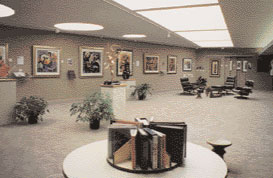
The
interior of Saper Galleries, East Lansing, MI.
One of his full time employees has been with the gallery for eight or nine years and two others for five and six. "Key members are here for the long term and are almost like family to me. Every year they do better than the prior year."
To sum up his business philosophy, Mr. Saper says, "Never say no to a client, always deliver more than he or she would reasonably expect, treat people with the courtesy, kindness, and respect that everyone deserves, and as long as one monitors financials, success can only prevail."
However, challenges and changes are always on the horizon, and ironically, with the sizable addition so recently completed, Mr. Saper now has to decide about yet another change. The block his gallery is on is in the process of redevelopment and all the buildings but his are coming down. He was offered the option of selling his gallery with its brand new addition to the developers and having it demolished. They in turn promise him ground-floor space in the new building or he can stay where he is in the only small structure remaining. It's a hard decision to make and at last contact, he had not made it.
Arlene Shattil is a Contributing Writer for Art World News, based in Chicago.
Return to
top of page
Greater
Lansing Business Monthly, Dec 01, 1998
When
people purchase art for their home or business, they
naturally want to like the piece, and they also want to
get a good value. Roy Saper of Saper Galleries in
East Lansing hopes his customers feel they get both.
Saper Galleries: Providing valuable works of art
Greater
Lansing Business Monthly, Dec 01, 1998
When
people purchase art for their home or business, they
naturally want to like the piece, and they also want to
get a good value. Roy Saper of Saper Galleries in
East Lansing hopes his customers feel they get both.
Saper is a Flint native who came to East Lansing in 1969 as a music therapy major at Michigan State University. The viola was his passion at the time; he played with the MSU Symphony Orchestra and the MSU Chamber Orchestra, along with the Flint Symphony and the Saginaw Symphony. However, at the same time, he was attracted to classes in computer science. He wound up earning a B.S. degree in computer science and pursued doctoral course work in economics.
In 1978, Saper opened his business from his Bailey Street home in East Lansing, just a few blocks from the current location at the comer of Division and Albert streets. The spot was vacant at the time; he bought it in 1985 and built the existing gallery, opening the weekend of the East Lansing Art Festival in the spring of 1986.
Now, Saper is nearing the completion of an expansion project. Space limitations had led to displaying some artworks on the floor, even double stacked on the walls. He described the look as being comparable to an attic. "For me," Saper explained, "this business is as much me as the art. I like to sell and make available to people works that I really enjoy. My belief is that by expanding into a second or third location, as had been the intent initially, the gallery wouldn't be Saper Galleries. It would be an art gallery that carries artwork.
"So," Saper continued, "I decided that I wouldn't do justice to the art, the artists, or our clients by staffing buildings with people who could talk about the art, because I want to be a part of it. I want to share my perspective and add my eye to what is purchased and who gets what. I rejected the notion of a second location, but in the past several years we've grown to such an extent that our existing space is not at all adequate."
The expansion is going into a small courtyard that had been alongside the building a space where Saper had put outdoor furniture and sculptures from time to time. Unfortunately. items would sometimes turn up missing from the courtyard.
Along with the extra space, Saper is especially pleased with the natural lighting that the addition will enjoy. He boasts that "we'll never have to have lights on unless it's late at night and the moon's not shining. One skylight is 48 feet long; there are four other skylights--slots of beautiful, natural light, the best light to display art in. It's going to be open, contemporary, and beautiful. We're really excited about it. We expect to be in by December and then we'll be fine-tuning ... getting the furniture made and having wall displays assembled."
Those wall displays will include some portable wall partitions on casters, and wall units on tracks, similar to those now in the gallery's hallway. Saper will be able to move pieces around at will, even moving the walls themselves.
In the back of Saper's mind is a third phase, behind the existing gallery; he's thinking about the ways he might be able to use today's advancing technology to better display art there.
Roy Saper has very high standards for his staff. He describes his employees this way: "Everyone here is a permanent, full-time professional with a strong commitment to quality and a dedication to excellence and service. We have such a superb staff here, I would never want to bring somebody in who's just out there looking for a job. We have a lot of people who come in looking for a job, but 99 percent of them don't have a chance. You have to be great to work here."
Saper credits the continuity and consistency of his staff for bringing in repeat business. Many are artists themselves.
Getting a job at Saper Galleries is as tough as getting one's art shown there. Saper stated that, "You don't show your work here just by wanting to show it: you've got to be great! You've got to be better than anybody else. I don't want mediocrity in anything we do. Of 500 artists who might ask us in a year to display their work we might take three or four or five. We're tough! But then again, that's what our clients and visitors want. That doesn't mean it has to cost more; it's just that we do a discerning eye evaluation for the people."
Saper points out that, while be makes all the final decisions, he does seek input from others at the gallery. Still, if he sees an artwork that he wants in the gallery, he buys it without hesitation.
Framing and matting is a specialty at Saper Galleries. It all started shortly after Saper started his business out of his home; he found local framers unsatisfactory. "I took my artwork to every framer in town," he explained. "I brought the artwork pieces back to the gallery, took them apart, evaluated them, and saw what the framers had done. No one passed; 100 percent failure! They used materials different than was specified; they used highly acidic materials such as corrugated cardboard, masking tape, cellophane tape, duct tape; some of them trimmed my artwork, to get it to fit the frame! There were nails sticking through the front or the back or the side of the frame. Total failure. I said, I can't have that.'"
Saper tells his framing team that he wants the corners of the mats to be perfect, and he wants no shaggy corners or shabby edges from using an old blade. He refers to his framers as "true artists. They have a great design sense. They know art not only from the aesthetic point of view, but also from the scientific point of view in terms of what color is a complement to another, which ones go side by side and which ones don't. They understand balance and harmony. They also have a tremendous understanding of what quality is and what quality isn't."
Quality materials are a must, according to Saper, who says, "I buy frames without regard to cost because it's the best burl available in America; or it's the highest quality lacquer, without little dust flecks or spots in it; or it's the best finish gold you can get. However, our framing will cost equal or less than most of the exact same apples-to-apples comparison. We have many prices that haven't changed since we opened."
Saper enjoys introducing artists to the community, and he has a special place in his heart for shows he has assembled featuring the works of Peter Max and Norman Rockwell. Two shows have featured works by Rembrandt; the first included over 40 Rembrandt etchings (he created around 350), while the second placed Rembrandt etchings side by side with works by Picasso that they inspired.
To Roy Saper, his gallery is his home away from home. He's now spent over 20 years providing works of art that his customers are proud to display in their homes.
Copyright Greater Lansing Business Monthly Dec 01, 1998Local gallery blends works of Picasso, Rembrandt
By LINN HAUGESTAD EDVARDSEN
State News MS&U Writer, East Lansing, Michigan Thursday, April 17, 1997
Saper Galleries, 433 Albert Ave., has combined the works of Pablo Picasso and Rembrandt Harmenz van Rijn in a unique exhibition displaying original etchings, linographs and linocuts. There are more than three dozen pieces from both artists on the walls of the gallery.
"Meeting of the Masters" is a once-in-a-lifetime opportunity to see these works displayed together before they go into private collections, said Saper Galleries owner Roy Saper.
Saper said this could easily have been two separate exhibits. Combining the two created an interesting effect. Not only does this exhibition provide an opportunity to view Picasso and Rembrandt's artistic relationship but it also emphasizes their individuality.
"We like to create exhibits with a story," Saper said.
Patricia Deventer, assistant to the director at Saper, believes the exhibition highlights the artists' ability to produce the "essence" of a subject. Although the two were very different and lived hundreds of years apart, they both managed to produce the soul of the particular image they were working on, Deventer said.
"What separates good art from great art is going a step beyond simply making a representation of something," Deventer said. "No two viewers will see the same thing."
Art History Professor and Director of Kresge Art Museum Susan Bandes considers the exhibition a great opportunity for the community to learn about fine art.
"It is a chance to discover and rediscover," Bandes said.
Bandes, who has seen the exhibition, said it is accessible to everyone.
"There is a certain intimacy when you look at a print and you certainly have that in Saper Galleries," Bandes said.
The gallery offers explanatory tags on each piece, texts and other information on the artists. The size of the gallery and the way the art is presented allows the viewer to really get a feel for the artists, Saper said.
The idea developed in an exhibit in Amsterdam, The Netherlands, which also connected the two artists. This was the starting point, Saper said. He recognized the distinction and rarity of such a match and used that as the basis for his exhibition.
"We wanted to pave a path that hadn't been done before," Saper said. "The goal was to present the artists in a different light."
Saper, who bought his first Rembrandt and Picasso artwork in the 1970s, considers the show a challenge to put together but a great success.
"People are coming from all across the United States," Saper said.
Saper Galleries, which is celebrating its 11th year in East Lansing, puts on about two major exhibitions a year.
"Nothing like this comes together quickly," Saper said. "It's a major research project."
All of the art is for sale and the showing is open to the public. Admission is free and the atmosphere is "laid back," Saper said.
"Meeting of the Masters" will be on display through July 7. Saper Galleries is open throughout the week from 10 a.m. to 6 p.m. with the exception of Thursday and Sunday. On Thursdays, the gallery is open from 10 a.m. to 9 p.m. and on the first Sunday of every month from 1 p.m. to 4 p.m.
E.L. gets to the art of the matter
Saper
galleries to expand — again
Thursday, June 4, 1998
The State News • MIEKE ZUIDERWEG
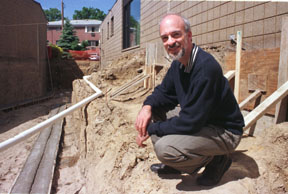 Roy Saper, owner
of Saper Gallery, 433 Albert Ave., sits
Wednesday near the gallery, where a renovation
is underway. The gallery will have gain an
additional 2,000 square feet in the next four
months.
Roy Saper, owner
of Saper Gallery, 433 Albert Ave., sits
Wednesday near the gallery, where a renovation
is underway. The gallery will have gain an
additional 2,000 square feet in the next four
months.
By NICOLE M. KAMMER
State News Staff
Writer
There is a million dollars’ worth of art on a corner in East Lansing, and Roy Saper is surprised more residents don’t know about it.
“We get a lot of visitors from out of the area,” said Saper, owner of Saper Galleries, 433 Albert Ave. “It is unfortunate that area residents haven’t been here. Everybody knows about other art galleries in the Lansing area, but not this one.”
With out-of-town business booming, Saper said the gallery has outgrown its location for the second time in 20 years and is under renovation.
The gallery will undergo renovation for the next four months, adding an additional 2,000 square feet.
The $500,000 project, headed by Milestone Construction Company, will add reading areas and a “living room” atmosphere to the gallery. Saper said the renovated space will be lit by a 48-foot-long skylight and is not purely for commercial purposes.
“You don’t have to come in with the intent to buy something. You can just sit and read or look around,” he said. “It’s going to feel more like a living room than an exhibit room.”
Before the gallery opened in May 1986, Saper showed art from his Bailey Street home on an appointment basis.
“Just as the business outgrew my home 12 years ago, it’s outgrown itself here, too,” said Saper, an East Lansing resident since the late 1960s. “From day one, we’ve needed more space. We’re busting at the seams. We own more than 1,000 works of art.”
While Saper Galleries may still be a little-known place in East Lansing, Saper and others in the local art community have noticed that East Lansing’s interest in art is growing.
Susan Bandes, director of the Kresge Art Museum, said that after the East Lansing Art Festival, the museum experienced a jump in attendance.
Bandes also said the museum had a great turnout in the recent “Be a Tourist in Your Own Town” event and has had a lot of new visitors.
The museum has close to 6,000 objects from many different cultures and centuries.
“Our mission is to collect, interpret, care for and exhibit the works,” Bandes said. “We do a lot of education. We hope to make people comfortable with art and visiting museums and galleries.”
Saper, the original chairperson of East Lansing’s Downtown Development Authority, said he has turned down several offers to relocate his gallery to locations everywhere from Paris to Ann Arbor.
“We’ve generated millions of dollars of revenue from this community and we’d like to keep it here,” he said. “When you build relationships with the people that come to this gallery, you can’t pick up your bags and move away.”
Saper said art is important to any community, and he hopes other art galleries come to the city.
The East Lansing City Council may grant his wish.
The council is discussing adding art-related projects to the community center that will be developed at Hannah Middle School, 819 Abbott Road.
“We’re not sure of whether it’s going to be a private business gallery or whether it’s going to be a room where the city will display art that’s been purchased from the art festival,” Councilmember Beth Schwarze said.
Tunis Ponsen (1891-1968), Estate Paintings
November
14, 1999 - January 9, 2000
Krasl Art Center
St. Joseph, Michigan
 The
Krasl Art Center will present an exhibition of
paintings, watercolors, and prints from the estate of
the late artist, Tunis Ponsen. On view will be over 40
landscapes portraits and still-lifes that have never
before been seen in public. This unique exhibition was
co-curated with the assistance of Mr. Roy Saper from
the Saper Galleries in East Lansing, MI. (left:
Weeping Willow by Barn with Open Door, oil on canvas,
From the Tunis Ponsen Estate, Saper Galleries)
The
Krasl Art Center will present an exhibition of
paintings, watercolors, and prints from the estate of
the late artist, Tunis Ponsen. On view will be over 40
landscapes portraits and still-lifes that have never
before been seen in public. This unique exhibition was
co-curated with the assistance of Mr. Roy Saper from
the Saper Galleries in East Lansing, MI. (left:
Weeping Willow by Barn with Open Door, oil on canvas,
From the Tunis Ponsen Estate, Saper Galleries)
Though
Ponsen was native born to the Netherlands in 1891,
he journeyed as a small boy to southwest Michigan
and by 1910 was working as a house painter and
decorator in Muskegon. This job allowed him to save
enough money to send for Cato Van Boekering, his
hometown love, who was still living in the
Netherlands. Upon her arrival in New York Tunis
discovered Cato had fallen in love with another man
on the trip over. Ponsen was devastated by this and
never married. In 1917, he began studying at the
School of The Art Institute of  Chicago.
In 1929 one of his paintings was chosen by popular
vote to become the first oil painting acquired for
the collection of the Flint Institute of Arts.
His early paintings have been said to resemble the
Impressionistic style, however his later works
possess an honest, realistic,
regional style. Many of the works in this exhibition
reflect his time spent in southwestern Michigan.
Seascapes, barns, orchards, and open fields were
common subjects for Ponsen. He painted what was
familiar to him. (right: Fishing Nets
Hanging Out to Dry, oil on canvas, From the Tunis
Ponsen Estate, Saper Galleries)
Chicago.
In 1929 one of his paintings was chosen by popular
vote to become the first oil painting acquired for
the collection of the Flint Institute of Arts.
His early paintings have been said to resemble the
Impressionistic style, however his later works
possess an honest, realistic,
regional style. Many of the works in this exhibition
reflect his time spent in southwestern Michigan.
Seascapes, barns, orchards, and open fields were
common subjects for Ponsen. He painted what was
familiar to him. (right: Fishing Nets
Hanging Out to Dry, oil on canvas, From the Tunis
Ponsen Estate, Saper Galleries)
Since Ponsen
clearly loved and enjoyed his work, he was
very reluctant to part with many of his
paintings. In time he amassed over 1,000
completed works. In 1952, Ponsen moved to
Hyde Park outside Chicago where he painted
and taught until his death in 1968. His work
was exhibited during the 1960's at the St.
Joseph Art Association building in St.
Joseph. In 1967 he asked his niece, Angenita
Morris, to keep his work in the possession
of the family. These works were moved to her
home in Benton Harbor were they remained
away from the public eye for 25 years. In
1990 an insurance representative (Citizens
Insurance Company) was asked to appraise
Ponsen's paintings. He was astounded by the
vast collection of Ponsen's work. His
knowledge of art led to articles about these
newly discovered works. The Lost Painting of
Tunis Ponsen were written about in Art News
magazine and the Detroit Free Press magazine
in 1994. Today Ponsen's work can be found in
collections of the City of Chicago, the
Flint Institute of Arts, Northwestern
University and the Muskegon Museum of Art.
Home About Artists Contact Testimonials
Return to the top of this page
Saper
Galleries....where
excellence is the standard!





433 Albert Avenue East Lansing, Michigan 48823 USA (517)351-0815