
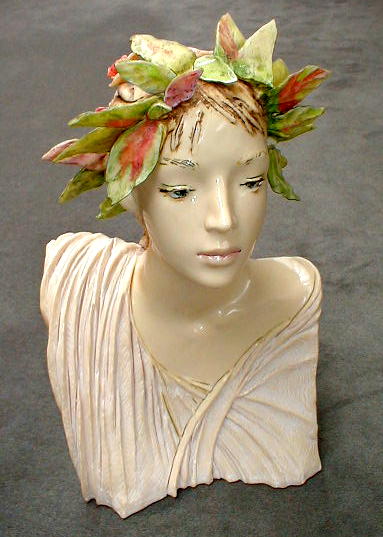
Primavera Cast epoxy resin sculpture Numbered 42/300 21.5" tall $4,200 ($7,500 full market value) 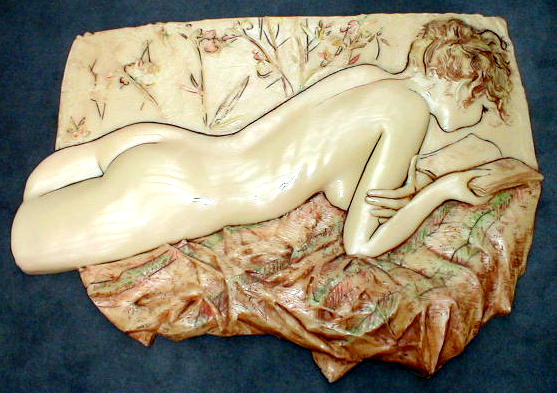
Romantic Novel
($8,500
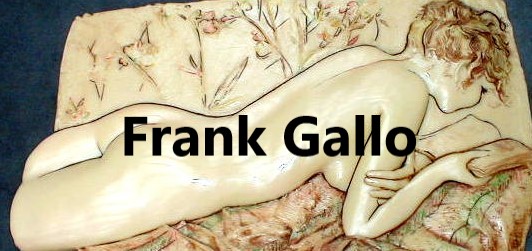
full market value)Cast epoxy resin bas-relief Numbered 61/300 31" tall, 42" wide, 4" deep $6,500 |
Frank Gallo
was born in Toledo, Ohio, in 1933.
He was the youngest of four children born to
a Sicilian shoe repairman and inventor.
Gallo attended the
University of Toledo. In
1956, he received a bachelor's of fine art degree in
education, a degree reflecting both his desire to
become an artist and his family's hopes that he
acquire a trade. He
began graduate work at the Cranbrook Academy of Art
in the summer of 1956 but gave it up for a year to
teach art to students at the elementary and
secondary school level.
He
started graduate work again in 1958 at the
University of Iowa, with an emphasis on both
sculpture and printmaking. Gallo returned to teaching
in 1967 at the University of Iowa and resigned a
year later to become head of the sculpture
department at the University of Illinois, where he
was asked to develop a new graduate program in
sculpture. In 1970, he
also operated a serigraphy studio in the Center for
Advanced Studies at Illinois.
Throughout his years as an
instructor, Gallo has continued to create his own
sculptures, employing several materials and using a
consistent style and subject matter.
For a number of years, he exhibited large
epoxy figures before going to France in 1972 to
study glass at Daum Crystallerier.
Since 1977, Gallo
has been working primarily in cast paper, a
technique he how teaches in the handmade paper and
paper casting program he helped initiate at
Illinois.
Gallo's work has been exhibited in more then 50 galleries and museums worldwide, including The Art Institute of Chicago; the Whitney Museum of American Art in New York; the Smithsonian Institute in Washington, D.C.; the Museum of Fine Art in Montreal, Canada; the Galleria d'Arte Moderna in Milan, Italy; and the Helsinki Museum in Finland. Because Gallo has always believed that the ordinary has in it a magic we don't usually see, he attempts in his work to bring out some of this magic, the "magnificence" of the ordinary.Sadly, Frank Gallo died March 22, 2019 at age 86. |
Saper
Galleries....where excellence is the standard!




433 Albert Avenue East Lansing, Michigan 48823 USA (517)351-0815